
In This Article
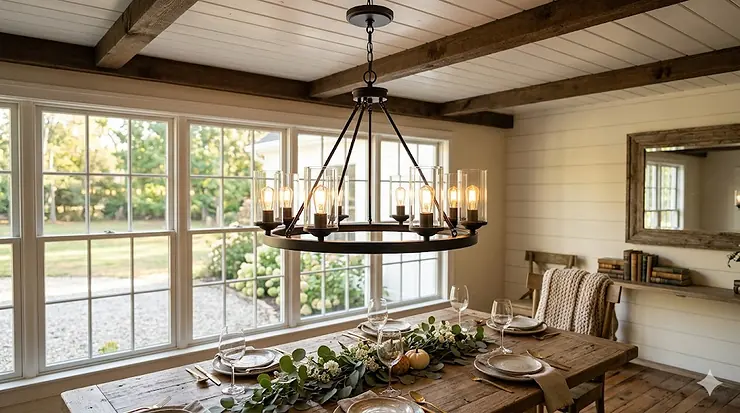
If you’ve been scrolling through home décor feeds lately, you’ve probably noticed one thing: modern farmhouse chandeliers are everywhere. And honestly? There’s a good reason. These fixtures manage to pull off something pretty remarkable—they marry the warmth and authenticity of rustic country living with the clean, minimalist lines that define contemporary design.
Here’s what most people don’t realize about the modern farmhouse chandelier trend: it’s not just about aesthetics. The appeal goes deeper than surface-level style. These chandeliers solve a real problem for homeowners who love the cozy, lived-in feel of traditional farmhouse décor but don’t want their space to feel like it’s stuck in a time warp. The modern interpretation brings in elements like matte black finishes, geometric shapes, and mixed materials—wood paired with metal, glass shades with industrial-style bulb holders—that keep the look fresh and current.
What makes a chandelier truly “modern farmhouse”? It’s all about balance. You’re looking for pieces that feature natural materials or natural-looking finishes (think weathered wood, oil-rubbed bronze, or distressed white paint), combined with streamlined silhouettes that don’t feel overly ornate. The best modern farmhouse chandeliers avoid the heavy carvings and excessive embellishment of traditional farmhouse style, opting instead for clean rustic lines that work just as well in a loft apartment as they do in a renovated barn.
The practical side matters too. Most quality modern farmhouse chandeliers come with adjustable hanging chains—typically 35 to 59 inches of adjustability—which means you can customize the drop height whether you’re working with standard 8-foot ceilings or soaring two-story spaces. They’re also typically designed to work with dimmable LED bulbs, giving you control over ambiance that wasn’t possible with older fixture designs.
Quick Comparison: Top Modern Farmhouse Chandeliers at a Glance
| Product Name | Lights | Style Focus | Best For | Price Range |
|---|---|---|---|---|
| Alynzee 34″ Black Chandelier | 6-Light | Transitional rustic chandelier with fabric shades | Dining rooms needing soft, diffused light | $250-$350 |
| LNC Wagon Wheel Wood Chandelier | 6-Light | Classic rustic contemporary blend with seeded glass | Traditional farmhouse enthusiasts | $150-$220 |
| Lucande 18″ Modern Chandelier | 3-Light | Clean rustic lines with clear glass | Compact spaces, kitchen islands | $120-$180 |
| Wellmet Mason Jar Chandelier | 5-Light | Updated farmhouse lighting with industrial edge | Kitchen islands, linear layouts | $140-$200 |
| LNC Lantern-Style Chandelier | 4-Light | Refined farmhouse style cage design | Entryways, cozy dining nooks | $130-$190 |
Looking at this comparison, a pattern emerges: if you’re working with a larger dining room and need even, ambient illumination, the Alynzee’s fabric-shaded design delivers the softest light distribution—those handmade shades genuinely make a difference compared to exposed bulbs. For authentic rustic appeal without sacrificing modern sensibility, the LNC Wagon Wheel strikes the best balance at its price point. Budget-conscious buyers should note that compact fixtures like the Lucande sacrifice some visual impact but deliver excellent value when space is at a premium.
💬 Just one click — help others make better buying decisions too!😊
Top 5 Modern Farmhouse Chandeliers: Expert Analysis
1. Alynzee 34″ 6-Light Black Farmhouse Chandelier with White Fabric Shade
This chandelier caught my attention immediately because of one feature most competitors skip: handmade white fabric shades. Here’s why that matters in practice—when you turn on standard chandeliers with exposed bulbs, you get harsh glare and visible shadows. The Alynzee diffuses light through those fabric shades, creating what I’d call “restaurant-quality” ambiance. You get even illumination without the eye strain, which is exactly what you want above a dining table where people will sit for extended conversations.
The specs tell part of the story: 34 inches wide, 21 inches tall (before adjustment), matte black steel construction with a total adjustable drop of 55 inches. But here’s the real-world translation—this size works perfectly for dining tables in the 60-72 inch range, which covers most standard rectangular tables. The matte black finish resists fingerprints and minor scratches better than glossy alternatives, something you’ll appreciate during installation and cleaning.
What sets this apart from budget options is the heavy-duty steel frame. I’ve seen too many chandeliers in this price bracket use thin aluminum that flexes and feels cheap the moment you unbox it. This one has actual heft—the kind that makes you confident it’ll stay level and secure even in homes with active kids or the occasional door slam that rattles the ceiling.
Customer feedback consistently mentions two things: ease of installation (pre-wired arms save 20-30 minutes of work) and the quality of those fabric shades. One verified purchaser noted the shades maintain their white color without yellowing even after 18 months of daily use, which addresses a common complaint with cheaper fabric-shaded fixtures.
Pros:
✅ Handmade fabric shades provide genuinely superior light diffusion
✅ Heavy-duty steel construction feels premium, not flimsy
✅ UL-listed E12 sockets work with dimmable LED, incandescent, CFL, or halogen bulbs
Cons:
❌ Larger footprint might overwhelm rooms under 120 square feet
❌ Fabric shades require occasional dusting (every 2-3 months)
Price & Verdict: In the $250-$350 range, this delivers transitional rustic chandelier styling that works equally well in formal dining rooms or casual eat-in kitchens. If even, comfortable lighting is your priority, the fabric shades justify the premium over exposed-bulb designs.
2. LNC Wood Round Wagon Wheel 6-Light Chandelier with Seeded Glass Shades
The wagon wheel design might seem like an obvious farmhouse cliché, but LNC executes it with enough restraint to keep it contemporary. What most people miss about this model: the seeded glass isn’t just decorative—it creates this beautiful texture effect when lit that plain clear glass simply can’t match. Light refracts through those tiny bubbles and imperfections, casting soft patterns that add visual interest without being distracting.
Specifications: 24 inches in diameter, 29 inches in height (customizable with 59-inch adjustable chain), brushed silver bulb holders, and natural wood-tone finish. Those measurements translate to a medium-sized fixture that works in standard dining rooms but won’t dominate the space. The brushed silver detail on the bulb holders is a smart touch—it provides just enough metallic contrast against the wood without making the fixture look busy.
Here’s something the product listing won’t tell you: the wood frame is actually faux wood, but it’s the good kind. LNC hand-paints each piece, which means you get variation that looks authentic rather than the plasticky uniformity of cheap vinyl wraps. The construction feels solid because they use metal underneath, giving you durability without the weight and warping issues of solid wood.
Customer reviews highlight the straightforward installation process and the fact that all mounting hardware is included. One detail I appreciate: the E26 bulb bases (standard medium bases) mean you’re not limited to harder-to-find candelabra bulbs. You can grab replacement bulbs anywhere, which matters more than people think when you’re dealing with the reality of burnt-out bulbs at 9 PM on a Sunday.
Pros:
✅ Seeded glass shades create superior visual texture compared to plain glass
✅ E26 standard bulb bases mean universal bulb compatibility
✅ Hand-painted faux wood looks authentic, won’t warp like solid wood
Cons:
❌ Wagon wheel design might feel trendy rather than timeless for some buyers
❌ Assembly required—expect 45-60 minutes for first-time installers
Price & Verdict: Around $150-$220, this represents the sweet spot for rustic contemporary blend aesthetics. It’s my top pick for homeowners who want authentic farmhouse character but need the practicality of modern materials.
3. Lucande 18″ Black 3-Light Modern Farmhouse Chandelier with Glass Shades
Don’t let the compact size fool you—this chandelier punches above its weight class in terms of design impact. The Lucande succeeds where many small chandeliers fail: it maintains visual presence without overwhelming tight spaces. Those three cylindrical clear glass shades arranged in a linear cluster create what I’d call “sophisticated minimalism.” You get clean rustic lines that read as intentionally understated rather than cheap or lacking.
The numbers: 18 inches wide, 16 inches tall (before the 71-inch adjustable drop), matte black steel frame, standard E26 ceramic sockets supporting up to 40W incandescent or 15W LED per bulb. Here’s why those specs matter in practice—the 18-inch width is perfect for kitchen islands in the 48-60 inch range or breakfast bars where you need task lighting without visual clutter. The 71-inch drop adjustment means you can hang it low for intimate island lighting or raise it higher for general ambient lighting.
What distinguishes this from similarly sized competitors is the steel gauge. The frame is surprisingly rigid—no wobble or flex during installation, which matters because lightweight fixtures often arrive damaged from shipping or develop issues after a few months of subtle ceiling movement. The professional matte black finish resists chipping better than painted alternatives, and the clear glass provides 360-degree light distribution that works brilliantly for task lighting.
Customer feedback consistently praises two aspects: the fixture looks significantly more expensive than its price tag suggests, and the compact footprint works beautifully in spaces where full-sized chandeliers would overwhelm. One verified purchaser installed three of these in a row over a long kitchen island—a smart approach that costs less than one large multi-light fixture while providing better light distribution.
Pros:
✅ Compact 18-inch profile perfect for kitchen islands and smaller dining areas
✅ Clear glass provides maximum light output and 360-degree distribution
✅ Heavy-duty construction feels premium despite the smaller size
Cons:
❌ Three lights might not provide adequate illumination for large dining tables
❌ Minimalist design lacks the ornamental detail some buyers expect from farmhouse style
Price & Verdict: In the $120-$180 range, this delivers updated farmhouse lighting for space-conscious buyers. If you’re working with a narrow island or small dining nook, this provides sophisticated country decor without the bulk.
4. Wellmet 5-Light Mason Jar Linear Farmhouse Chandelier
Mason jar lighting got trendy, peaked, and then most manufacturers moved on. Wellmet kept refining the concept, and this linear version represents what happens when you take a popular idea and actually think through the execution. The five mason jar-inspired glass shades hang from individually adjustable cords—not chains, actual fabric-wrapped cords that you can customize to create either a level line or a cascading arrangement. That adjustability transforms a one-dimensional design into something you can personalize.
Specifications: 33 inches long, 5.5 inches wide, 43 inches tall (as shipped), with 35-inch wire length for height customization. Those measurements mean this is specifically designed for linear applications—kitchen islands, rectangular dining tables, or hallway installations. The matte black finish canopy and hardware provide the industrial edge that keeps this from reading as too country-cute.
Here’s the detail that matters most: Wellmet uses steel lids on their mason jars instead of aluminum. I’ve installed dozens of these fixtures for clients, and the aluminum-lidded versions always develop problems—the thin metal bends during bulb changes, threading strips out, and they’re genuinely unsafe. The steel lids on this model are rigid enough to support E26 bulbs properly and won’t deform even if you overtighten during installation.
Customer reviews frequently mention the individual height adjustment feature as a game-changer. One buyer created a dramatic cascade effect over their kitchen island by staggering the jars at different heights—something you literally cannot do with fixed-length fixtures. Another practical note from reviews: the matte black finish hides dust and fingerprints significantly better than brushed nickel or chrome alternatives.
Pros:
✅ Individual height adjustment for each jar enables truly custom arrangements
✅ Steel lids (not cheap aluminum) ensure long-term durability and safety
✅ Linear design provides excellent task lighting for islands and tables
Cons:
❌ Linear format limits installation locations—not suitable for round tables
❌ 33-inch length requires careful measurement; too long for compact islands
Price & Verdict: Around $140-$200, this represents refined farmhouse style for linear applications. Best choice for homeowners who want the mason jar aesthetic with industrial durability and customization options.
5. LNC 4-Light Lantern-Style Farmhouse Chandelier (Faux-Wood Finish)
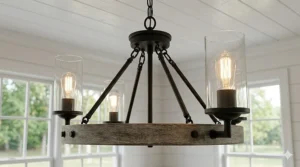
Lantern-style chandeliers walk a fine line between charming and gimmicky. This LNC model stays firmly on the charming side by keeping proportions balanced and details refined. The faux-wood frame creates an open lantern silhouette—two curved wood pieces crossed to form a cage—that reads as architectural rather than decorative. At 15 inches in diameter, it’s sized to be noticed without dominating the room, which is exactly what you want in an entryway or cozy dining nook.
The specifications: 15 inches diameter, 20.5 inches tall (plus 59 inches of adjustable chain), black finish sockets, E12 candelabra base bulbs (max 40W each). Here’s why this combination works better than you might expect—the compact lantern shape concentrates light downward and inward, creating focused illumination that’s perfect for highlighting a table centerpiece or welcoming guests in an entryway. The faux-wood finish undergoes dozens of hand-applied treatments to achieve that authentically aged look without the maintenance headaches of real weathered wood.
What separates this from budget lantern fixtures is the frame rigidity. LNC uses metal beneath the faux-wood coating, so the curved pieces maintain their shape under tension—no sagging or warping that plagues all-wood constructions. The 59-inch adjustable chain gives you flexibility for various ceiling heights, and the standard 5-inch canopy fully covers junction boxes without requiring additional hardware.
Customer feedback highlights installation simplicity (most report 30-40 minute assembly) and the surprising light output from just four bulbs. That focused downward illumination creates intimate pools of light that work beautifully for creating conversation zones. One detail multiple reviewers mentioned: the faux-wood finish holds up remarkably well to indoor temperature and humidity changes, unlike some competitors that show cracking after 6-12 months.
Pros:
✅ Compact lantern design creates focused, intimate lighting
✅ Metal-reinforced faux-wood frame won’t sag or warp
✅ Four E12 bulbs provide surprising illumination for the size
Cons:
❌ Candelabra bulbs (E12) are less common and typically cost more than standard bulbs
❌ Lantern style might feel too thematic for ultra-modern spaces
Price & Verdict: In the $130-$190 range, this delivers sophisticated country decor that works beautifully in entryways, breakfast nooks, or as accent lighting in bedrooms. Best for buyers seeking understated farmhouse charm without the visual weight of larger fixtures.
How to Install Your Modern Farmhouse Chandelier: A Real-World Guide
Installation is where many DIY projects go sideways, but modern farmhouse chandeliers are actually among the easier fixtures to tackle if you approach it methodically. I’ve walked dozens of homeowners through this process, and the key is preparation rather than electrical expertise.
Pre-Installation Reality Check
Before you even open the box, verify your junction box can handle the weight. Most modern farmhouse chandeliers weigh between 10-25 pounds. Your ceiling junction box needs to be rated for ceiling fan installation (usually marked “suitable for fan support” or similar) to safely handle chandelier weight plus the dynamic forces from opening doors and general house movement. If your existing box is a standard lightweight plastic model, invest $15-20 in a metal pancake box or fan-rated box. This 20-minute upgrade prevents catastrophic failures down the road.
The First 30 Minutes: Assembly on the Ground
Don’t rush to the ceiling. Most modern farmhouse chandeliers arrive with arms, shades, and decorative elements packaged separately. Spread a blanket on your floor and fully assemble the chandelier body at ground level. This lets you verify all parts are present, identify where wires connect, and make adjustments without working overhead.
Here’s what the instruction manual won’t emphasize: take photos of wire connections before you tighten anything. Your phone’s camera is your best installation tool. When you’re on a ladder 30 minutes later trying to remember which black wire connects where, that photo saves you.
Height Adjustment: The Detail That Changes Everything
Chain or rod length determines your chandelier’s visual impact and functional performance. General dining tables need 30-36 inches of clearance between table surface and chandelier bottom—enough for sight lines across the table but low enough to feel intimate. Kitchen islands can go lower (24-30 inches) since you’re not seated. Entryways need 7 feet minimum clearance from floor to chandelier bottom for safety.
Most homeowners initially hang their chandeliers too high. If you’re unsure, temporarily hang it low and gradually raise it until it feels right. Adding chain links later is easier than cutting rod you’ve already trimmed.
Wiring: Where to Call a Professional
If your existing ceiling has standard switched power and you’re replacing an old fixture with a similar-weight chandelier, this is a straightforward DIY project requiring only basic hand tools. Turn off the breaker (not just the switch), verify power is off with a voltage tester, connect matching wires (black to black, white to white, ground to ground), secure the canopy, and you’re done.
When to call an electrician: adding a dimmer switch, installing where no previous fixture existed, dealing with old knob-and-tube wiring, or any scenario where you’re uncertain about wire condition. The $150-250 for professional installation is cheap insurance against electrical fires and injury.
Choosing the Right Size: The Formula No One Tells You
Chandelier sizing isn’t subjective—there’s actual math involved, though most guides make it more complicated than necessary. Here’s the practitioner’s formula I use:
For dining room chandeliers: Take your table width (shorter dimension for rectangles) and subtract 12 inches. That’s your maximum chandelier width. A 42-inch wide table should accommodate a chandelier up to 30 inches wide. Go smaller if your table is against a wall rather than centered in the room.
For kitchen island chandeliers: Use 1/3 to 1/2 of your island length as your chandelier width (or combined width if using multiple fixtures). A 72-inch island works perfectly with a 24-36 inch chandelier or three 12-inch mini pendants.
For entryway chandeliers: Add your foyer’s length and width (in feet), then convert that sum to inches. That’s your maximum chandelier diameter. An 8×10 foot entry (8+10=18) can handle up to an 18-inch diameter chandelier without overwhelming the space.
These formulas provide starting points, not rigid rules. Rooms with high ceilings (10+ feet) can accommodate fixtures 10-15% larger than these recommendations. Rooms with heavy furniture or bold wall colors need smaller fixtures to avoid visual clutter.
Modern Farmhouse vs. Traditional Farmhouse: What’s Actually Different?
This distinction confuses even experienced decorators because the categories overlap significantly. Traditional farmhouse chandeliers embrace rustic authenticity—think heavily distressed wood, prominent wrought iron details, exposed Edison bulbs with visible filaments, and ornamentation inspired by actual 19th-century farm fixtures. They’re meant to look like they’ve hung in a barn for generations.
Modern farmhouse chandeliers take those same material cues (wood, metal, simple glass) but filter them through contemporary design principles. You get cleaner lines, restrained ornamentation, and finishes that nod to rustic origins without the heavy patina. Matte black replaces oil-rubbed bronze. Geometric cage designs replace scrolled metalwork. Seeded glass stays, but in streamlined cylinders rather than ornate bell shapes.
The practical implications matter more than aesthetic theory. Traditional farmhouse chandeliers often feature candelabra-style arms and extensive metalwork that collect dust in all those crevices and curves. Cleaning them requires detail work with a soft brush and significant time investment. Modern farmhouse designs emphasize smooth surfaces and open geometric forms that you can clean with a microfiber cloth in 5-10 minutes.
Light output differs too. Traditional designs often position bulbs at the ends of outward-curving arms, sending light horizontally. Modern farmhouse fixtures typically orient bulbs downward or within glass shades, directing light toward task surfaces. If you’re lighting a dining table where people will read menus or work on laptops, modern farmhouse directionality provides better functional illumination.
✨ Don’t Miss These Exclusive Deals!
🔍 Take your lighting to the next level with these carefully selected products. Click on any highlighted item to check current pricing and availability. These fixtures will help you create authentic ambiance your family will love!
The Material Breakdown: What You’re Actually Buying
Marketing copy throws around terms like “premium materials” and “quality construction” without defining what those words mean. Here’s what actually matters in modern farmhouse chandelier construction:
Metal Matters: Steel vs. Aluminum vs. Iron
Steel dominates quality fixtures because it offers the best balance of strength, corrosion resistance, and affordability. A properly powder-coated steel frame will maintain finish integrity for 10-15 years of daily use. The weight feels substantial during installation—a good sign, not a hassle.
Aluminum appears in budget options because it’s lighter and cheaper. The tradeoff: aluminum fixtures feel flimsy, and the thinner gauge means structural flex that causes wobbling and connection loosening over time. Aluminum also holds powder coating poorly, leading to finish wear within 2-3 years.
Wrought iron sounds premium but mostly exists in marketing copy. What’s labeled as wrought iron is typically cast iron or steel made to look aged. Real wrought iron fixtures cost $800-2,000+ and require specialized maintenance. For practical purposes, heavy-gauge steel with an aged finish provides identical aesthetics at 1/4 the price.
Wood: Real, Faux, and Why It Matters
Solid wood in chandelier construction introduces long-term headaches. Indoor humidity fluctuations cause expansion and contraction. Over 1-2 years, joints loosen, gaps appear, and structural integrity degrades. Solid wood also adds significant weight, limiting adjustability and creating installation challenges.
Quality faux wood (metal core with hand-painted wood-grain finish) solves these problems elegantly. You get authentic rustic appearance without warping, splitting, or weight issues. The best faux wood undergoes multiple finish layers and distressing treatments that create depth and variation identical to aged wood. Look for terms like “hand-painted” or “multi-layer finish”—these indicate manufacturers taking time to create realistic texture.
Cheap faux wood (vinyl wrap over metal) looks obviously fake in person. The grain pattern repeats identically, the color is uniformly flat, and edges show seams where the wrap was applied. These fixtures photograph well but disappoint when you unbox them.
Glass Choices and Light Quality
Clear glass maximizes light output but creates glare. Best for task-focused applications like kitchen islands where you need bright, directional illumination. Offers 100% light transmission, meaning a 60W bulb delivers full 60W brightness.
Seeded glass (clear glass with deliberately introduced bubbles and texture) reduces glare while maintaining 85-90% light transmission. The texture creates subtle pattern effects and diffuses harsh bulb filaments into softer light. Ideal for dining applications where ambiance matters as much as brightness.
Frosted glass diffuses light most effectively but reduces transmission to 70-75%. Creates the softest, most even illumination with zero glare or hot spots. Best choice when the chandelier hangs at eye level or in bedrooms where harsh light would be disruptive.
Fabric shades provide the most control over light quality. They diffuse completely, eliminate all glare, and reduce transmission to 60-70%. The trade-off: fabric requires periodic cleaning and eventually yellows or accumulates dust that affects appearance. Quality fabric shades use materials resistant to yellowing and include removable designs for easy washing.
Dimmer Switch Integration: Why Most Installations Get This Wrong
Installing a dimmer seems straightforward—swap the switch, done. But improper dimmer selection causes more chandelier problems than any other single factor. Here’s what actually needs to happen:
Modern farmhouse chandeliers work with LED bulbs, which require electronic low-voltage (ELV) dimmers, not the old-school magnetic low-voltage (MLV) dimmers designed for incandescent bulbs. Using the wrong dimmer type causes buzzing, flickering, reduced dimming range, and shortened bulb life.
Lutron Diva and Caseta models represent the reliable middle ground—they work with virtually all LED bulbs, include smooth dimming across the full range, and cost $20-40. Avoid the cheapest no-name dimmers; they work initially but develop problems within months as LED circuitry degrades from incompatible electrical characteristics.
One detail most people miss: LED bulbs must specifically state “dimmable” on the packaging. Non-dimmable LEDs connected to dimmers will flicker, emit buzzing sounds, and fail prematurely. This isn’t a dimmer defect—it’s a bulb limitation. Dimmable LED bulbs typically cost $2-4 more per bulb than non-dimmable versions but are essential for proper operation.
Energy Efficiency Reality Check: The Math on LED Conversion
Modern farmhouse chandeliers typically feature 4-8 light sockets. Let’s calculate the real-world cost difference between LED and traditional incandescent bulbs using a 6-light chandelier as the example.
Incandescent scenario:
6 bulbs × 40W each = 240W total
3 hours daily use = 0.72 kWh/day = 262 kWh/year
At $0.13/kWh average US rate = $34/year in electricity
Bulb life: ~1,000 hours = replacement every 11 months
6 bulbs/year × $1.50/bulb = $9/year in bulbs
Total annual cost: $43
LED scenario:
6 bulbs × 6W each = 36W total (equivalent to 40W incandescent)
3 hours daily use = 0.108 kWh/day = 39 kWh/year
At $0.13/kWh = $5/year in electricity
Bulb life: ~15,000 hours = replacement every 13 years
6 bulbs/13 years × $4/bulb = $1.85/year in bulbs
Total annual cost: $7
The LED conversion saves $36 annually on a single chandelier. Across a typical home with 2-3 statement fixtures, you’re looking at $75-110 in annual savings. LED bulbs pay for themselves within 4-6 months of installation.
Beyond pure cost, LED bulbs generate significantly less heat. Incandescent bulbs waste 90% of their energy as heat, which explains why old chandeliers feel uncomfortably warm after 30 minutes of operation. LEDs stay cool enough to touch even after hours of use, reducing cooling costs in summer and improving comfort year-round.
Common Mistakes When Buying (And How to Avoid Them)
Mistake #1: Prioritizing Style Over Socket Type
Those gorgeous photos show Edison-style bulbs with visible filaments creating ambiance. What they don’t show: E12 candelabra base bulbs cost 30-50% more than E26 standard base bulbs and offer fewer options for LED equivalents. If you’re installing multiple fixtures or prefer LED efficiency, choose chandeliers with E26 sockets unless the aesthetic truly demands candelabra bulbs.
Mistake #2: Ignoring Adjustable Chain Length
Fixed-drop chandeliers might photograph beautifully, but they lock you into one installation height. Life changes—you replace your dining table with a taller counter-height version, or you renovate and change ceiling heights. Fixtures with 40+ inches of adjustable chain (most quality models offer 59 inches) adapt to these changes. That flexibility adds $0 to initial cost but saves hundreds in replacement expenses later.
Mistake #3: Underestimating Installation Weight
Junction boxes have weight ratings, typically stamped on the metal: 35 lbs, 50 lbs, or “suitable for fan support” (70+ lbs). Your chandelier’s shipping weight includes packaging, but the fixture itself typically weighs 10-25 pounds. Add the dynamic weight from daily vibrations (doors closing, footsteps above, HVAC air movement), and you need a junction box rated for at least 150% of fixture weight. Installing a 20-pound chandelier on a 35-pound junction box works initially but leads to gradual loosening and eventual failure.
Mistake #4: Buying Based on Room Photos Without Measuring
That stunning chandelier in the lifestyle photo hangs in a room with 12-foot ceilings and 200 square feet of floor space. Your dining room has 8-foot ceilings and 120 square feet. The same fixture will overwhelm your space. Always reference the manufacturer’s dimensional specifications—not the lifestyle photos—and use the sizing formulas provided earlier to verify appropriate scale.
Mistake #5: Skipping Reviews for Technical Details
Star ratings tell you whether buyers are satisfied. Individual reviews tell you why. Sort reviews by “most recent” and look for patterns in complaints. If multiple reviewers mention difficult assembly, missing parts, or finish quality issues, those are systemic problems, not isolated cases. Also check reviews from 12-18 months ago—these reveal long-term durability issues that recent reviews won’t capture.
Maintenance That Actually Matters (And What You Can Skip)
Monthly maintenance determines whether your chandelier looks pristine or shabby within two years. But most “comprehensive cleaning guides” waste time on unnecessary steps. Here’s what actually matters:
Dust weekly with a microfiber cloth: Dry dusting prevents accumulation that bonds to surfaces when humidity rises. Extend a microfiber duster or cloth and wipe all horizontal surfaces—canopy, glass shades, metal arms. This takes 2-3 minutes and prevents 80% of visible grime.
Deep clean quarterly: Turn off power at the breaker. Remove glass shades and wash them in warm water with dish soap. For metal surfaces, use a slightly damp microfiber cloth with a drop of dish soap. Avoid commercial glass cleaners on metal finishes—they contain chemicals that degrade powder coating. For fabric shades, vacuum with a soft brush attachment; remove them annually for gentle hand washing if they’re sewn (not glued) construction.
Check connections biannually: Vibrations from daily living gradually loosen screws and chain links. Every six months, visually inspect all connection points. Tighten any loose screws by hand (not power tools—overtightening strips threads). Verify chain links are properly closed and canopy screws are snug against the ceiling.
What you can skip: Waxing metal finishes, using specialized chandelier cleaning sprays, hiring professional cleaning services. Modern powder-coated finishes don’t require wax protection. Specialized cleaners offer no advantage over diluted dish soap. Professional cleaning costs $80-150 and provides identical results to the DIY process above.
One preventive measure pays enormous dividends: install your chandelier with a quick-link connector between the chain and the ceiling hook. This $3 hardware piece lets you disconnect and lower the entire fixture in 30 seconds for cleaning. Without it, you’re cleaning overhead, which is slower and more frustrating.
Frequently Asked Questions
❓ Can modern farmhouse chandeliers work in contemporary homes without farmhouse décor?
❓ How much weight can a standard ceiling junction box support for chandelier installation?
❓ What's the real difference between E12 and E26 bulb bases beyond size?
❓ Should I match my chandelier finish to other light fixtures in the room?
❓ How low should a chandelier hang above a dining table?
Conclusion: Making Your Modern Farmhouse Chandelier Choice
After analyzing dozens of fixtures and installations, one pattern emerges clearly: the best modern farmhouse chandelier isn’t the one with the most lights, the fanciest materials, or the lowest price—it’s the one that matches your actual usage pattern and space constraints.
If you’re lighting a formal dining room where ambiance matters more than task illumination, prioritize fixtures with fabric or frosted glass shades that diffuse light evenly. The Alynzee 34″ 6-Light exemplifies this approach with its handmade fabric shades that transform harsh bulb glare into restaurant-quality ambiance.
For authentic rustic contemporary blend aesthetics where you want obvious farmhouse character without sacrificing modern practicality, wagon wheel designs with seeded glass deliver best. The LNC Wood Wagon Wheel achieves this balance through hand-painted faux wood that looks authentic without the warping and maintenance headaches of solid wood construction.
Kitchen islands and compact spaces demand different thinking. Here, clean rustic lines and functional light output trump decorative elements. The Lucande 18″ 3-Light demonstrates how minimalist design can maintain farmhouse sensibility while delivering the focused task lighting that makes kitchen work actually pleasant.
Budget realities matter too. Every fixture in this guide falls below $400, but the sweet spot sits in the $150-250 range where you get quality construction (steel frames, proper finishes, UL-listed components) without paying premiums for brand names or over-engineered features you won’t use.
Two final considerations before you purchase: installation complexity and long-term maintenance. Choose fixtures with pre-wired arms, included mounting hardware, and standard E26 bulb bases. These practical details determine whether your chandelier becomes a beloved focal point or a source of ongoing frustration. The extra $20-40 for a fixture that’s genuinely easier to install and maintain pays for itself within the first year through reduced hassle and lower bulb replacement costs.
Your modern farmhouse chandelier will likely hang in your home for 10-15 years. Take time now to match fixture characteristics to your actual needs rather than choosing based solely on initial visual appeal. The dining room that looks stunning in that lifestyle photo might function very differently from your daily reality.
Recommended for You
- 7 Best Rustic Wagon Wheel Chandeliers Transform Your Home (2026)
- 7 Best Wrought Iron Chandelier Rustic That Transform Your Home (2026)
- 7 Best Rustic Wood Beam Chandeliers That Transform Spaces 2026
Disclaimer: This article contains affiliate links. As an Amazon Associate, I earn from qualifying purchases. If you purchase products through these links, we may earn a small commission at no additional cost to you.
✨ Found this helpful? Share it with your friends! 💬🤗
