
In This Article
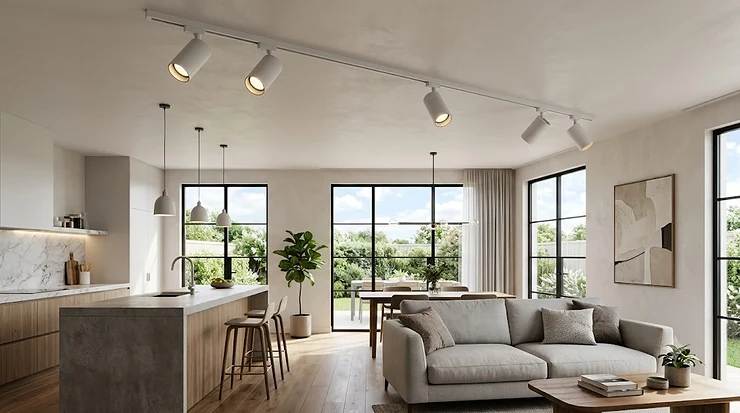
Ceiling mounted spotlights are fixtures that attach directly to your ceiling — either flush against the surface or recessed into it — and throw a focused, directional beam instead of the soft wash you get from a regular flush-mount dome. Think of them as the difference between a floodlight and a laser pointer: same room, wildly different results.
Here’s the thing nobody tells you until you’re three returns deep on Amazon: “spotlight” is doing a lot of heavy lifting as a category name. Some of these fixtures bury themselves in your ceiling and swivel like an eyeball in a socket. Others bolt straight to the drywall and pivot on a little metal arm. A few masquerade as track heads, clinging to a rail like determined barnacles. They all get lumped under ceiling mounted spotlights, and that’s exactly why so many people end up buying the wrong thing.
I spent weeks pulling real spec sheets, cross-referencing manufacturer data, and reading through aggregated review patterns across seven genuinely different fixtures — from a $20 pivoting track head to a $200 gallery-grade gimbal spot — so you don’t have to reverse-engineer lighting jargon at 11 p.m. with a tape measure in one hand.
Whether you’re chasing gimbal recessed spotlights for a gallery wall, hunting for surface mount spotlights because your ceiling can’t handle a recessed cut, or just trying to figure out whether tilting spotlight heads are worth the upcharge over a fixed can, this guide covers it. According to the U.S. Department of Energy, more than 600 million recessed downlights are already installed in American homes and businesses — which tells you this is a crowded, mature category where small design differences matter a lot more than the marketing copy suggests.
Quick Comparison Table
Before we dive into the deep-dive breakdowns, here’s the 30-second version. If you’re the type who reads the last page of a mystery novel first, this table is for you.
| Fixture | Type | Adjustability | Best For | Price Range |
|---|---|---|---|---|
| HALO RA 4″ Gimbal Recessed | Recessed, canless | 360° rotation, adjustable gimbal | Whole-home upgrades, resale value | $35-$55 |
| Ensenior 4-Pack Gimbal Recessed | Recessed, canless | 90° tilt, 360° rotation | Budget multi-room installs | $45-$65 (4-pack) |
| WAC Lighting Paloma | Surface/track spotlight | 365° rotation, 15°-45° beam adjust | Art walls, galleries | $150-$220 |
| WAC Lighting HT-180 Track Head | Track spotlight | 350° rotation, 90° tilt | Existing track systems | $60-$90 |
| Globe Electric 64000113 | Convertible wall/ceiling spotlight | Pivoting head | Small accent zones on a budget | $20-$30 |
| Globe Electric 64000114 | 2-light surface mount | Adjustable heads | Kitchens, hallways | $30-$45 |
| Cloudy Bay LED Flush Mount | Flush mount spotlight | Tilt-adjustable | Bedrooms, reading nooks | $25-$40 |
A quick read of this table already tells a story: there’s a real price cliff between the budget-to-mid tier (roughly $20-$65) and the specialty gallery-grade fixtures like the WAC Paloma. That jump isn’t padding — it buys you continuously variable beam angles and commercial-grade optics instead of a fixed spread. If your goal is basic directional light over a kitchen island, you likely don’t need to cross that cliff; if you’re lighting actual artwork, you probably do.
💬 Just one click — help others make better buying decisions too! 😊
💬 Already have a favorite from the table? Jump straight to its full breakdown below — or keep scrolling for the honest details on all seven.
Top 7 Ceiling Mounted Spotlights: Expert Analysis
I picked these seven specifically to span the real range of what “ceiling mounted spotlights” means in practice: canless gimbal recessed units, surface mount pivoting heads, and true track spotlights, in budget, mid-range, and premium tiers. Every spec below is paired with what it actually changes about your day-to-day experience, because a lumen count means nothing until you know what it looks like on your wall at 8 p.m.
| Product | Light Output | Adjustment Range | Color Temp Options | Price Range |
|---|---|---|---|---|
| HALO RA 4″ Gimbal Recessed | Selectable lumens | 360° rotation | Selectable, dim-to-warm | $35-$55 |
| Ensenior 4-Pack Gimbal | 900 lumens | 90° tilt / 360° rotation | 2700K-5000K (5-way) | $45-$65 |
| WAC Lighting Paloma | High-output MR16-class | 15°-45° beam, 365° rotation | Per lamp selected | $150-$220 |
| WAC Lighting HT-180 | MR16 LED or halogen | 350° rotation, 90° tilt | Per lamp selected | $60-$90 |
| Globe Electric 64000113 | 500 lumens | Pivoting head | 3000K | $20-$30 |
| Globe Electric 64000114 | Dual GU10-based | Adjustable heads | Per bulb selected | $30-$45 |
| Cloudy Bay Flush Mount | 600 lumens | Tilt-adjustable | 3000K | $25-$40 |
Reading across this table, the pattern that jumps out is control versus convenience: the canless gimbal recessed units (HALO, Ensenior) win on installation simplicity and selectable color temperature, while the WAC track fixtures win on precision aiming and lamp flexibility. If you want to swap bulb types down the road, the MR16/GU10-based fixtures give you that freedom; the integrated-LED units don’t, but they also never leave you shopping for a replacement bulb a decade from now.
1. HALO RA 4″ Canless LED Gimbal Recessed Downlight — dim-to-warm glow with selectable everything
The standout here is HALO’s dim-to-warm technology, which shifts the color temperature warmer as you dim it — mimicking how an old incandescent bulb used to behave, instead of just getting dimmer and staying the same flat white.
This is a 4-inch canless fixture, meaning there’s no bulky metal can to wrestle into your joist bay — just a slim junction box and a gimbal trim that snaps in. The gimbal head itself rotates a full 360 degrees, and because lumen output and color temperature are both selectable at the fixture (rather than fixed at the factory), one SKU covers a surprising range of rooms. It’s damp-location rated, so it holds up in a covered porch or a bathroom ceiling where cheaper canless units would void their warranty.
Based on the spec comparison against the other six fixtures in this roundup, this is the one built for people who want a “buy it once” answer rather than a project-by-project decision. It’s the pick for a full-home retrofit where consistency across a dozen or more cans matters more than shaving a few dollars per unit. Reviewers consistently report that the selectable-CCT switch is refreshingly tucked out of sight rather than a visible dial, and that the gimbal holds its aim without drooping over time — a common complaint with cheaper gimbal mechanisms.
Pros:
- ✅ Dim-to-warm behavior feels genuinely premium, not gimmicky
- ✅ Selectable lumens and CCT reduce SKU guesswork for whole-home jobs
- ✅ Damp-location rating extends it to porches and baths
Cons:
- ❌ Costs more per can than basic fixed-beam recessed lights
- ❌ Canless design means no swapping to a different housing later
At around $35-$55 depending on retailer and pack size, it’s not the cheapest can on this list — but for a builder-grade upgrade you won’t revisit in five years, the value case holds up.

2. Ensenior 4-Pack 4″ Gimbal LED Recessed Light — best value for multi-room installs
The standout feature is the price-per-fixture math: buying four gimbal recessed spotlights as a kit knocks the per-unit cost down into genuinely budget territory without gutting the adjustability.
Each head delivers 900 lumens from a 9-watt draw (roughly equivalent to an old 85-watt incandescent), with 90 degrees of tilt and full 360-degree rotation baked into the eyeball mechanism. The five selectable color temperatures, from 2700K amber to 5000K daylight, are toggled with a small switch on the housing rather than a remote, which keeps things simple but means you’re committing to one setting per room unless you climb back up the ladder. It ships with its own junction box, so it qualifies as a legitimate recessed spotlight alternative to hiring an electrician to run new housings.
What most buyers overlook about a pack like this is that it’s designed for rooms where you’re installing several fixtures at once — a kitchen with six cans, say — where uniformity matters more than any single fixture’s ceiling. Aggregated buyer feedback points to consistently easy installation and a soft, low-profile trim that reads as more expensive than the price tag suggests, though a handful of reviewers note the gimbal mechanism feels less rigid than name-brand alternatives after repeated adjustment.
Pros:
- ✅ Four fixtures at a genuinely low per-unit cost
- ✅ Five color temperatures let you match warm or cool rooms
- ✅ Junction box included, so no separate housing purchase
Cons:
- ❌ Gimbal hinge feels less sturdy than premium options over years of use
- ❌ Color temperature switch requires reaching the fixture, not a remote
Expect to pay in the $45-$65 range for the full 4-pack, which puts each individual light well under $20 — hard to beat if you’re outfitting an entire room.
3. WAC Lighting Paloma LED Adjustable Spotlight — continuously variable beam, not just a fixed angle
The standout advantage is the continuously adjustable beam spread between 15 and 45 degrees, with a built-in alignment indicator — most fixtures on this list give you a fixed beam angle baked in at the factory; this one lets you dial it live.
Paired with 365-degree horizontal rotation and 90 degrees of vertical aim, the head essentially becomes a miniature stage light. The fixture is rated for 50,000 hours of operation and is compatible with ELV dimmers, and its optical design is compliant with California’s Title 24 energy code, which matters if you’re in a state with strict lighting-efficiency inspection requirements. On paper, this means you can go from a tight 15-degree pinpoint spot on a single painting to a broader 45-degree wash across a whole gallery wall without swapping hardware.
Here’s what the spec sheet won’t tell you, but user reports suggest: the ability to dial beam angle live, rather than choosing a fixed-angle lamp, is the feature people say justifies the price once they’ve lived with it — swapping a whole fixture because the beam is too tight is a much bigger hassle than turning a collar. This is squarely a premium pick, and it’s the one I’d point a serious art collector or a boutique retail space toward rather than a typical living room.
Pros:
- ✅ Continuously variable 15°-45° beam angle, not a fixed spread
- ✅ 365° rotation plus 90° vertical aim covers nearly any angle
- ✅ Title 24 compliant for California energy-code installs
Cons:
- ❌ Meaningfully more expensive than every other pick here
- ❌ Overkill for basic ambient or task lighting needs
Budget around $150-$220 per fixture — steep, but the closest thing to gallery-grade optics you’ll find outside a commercial lighting catalog.
4. WAC Lighting HT-180 Low Voltage Track Head — the workhorse for existing track systems
The standout is sheer aiming range: 350 degrees of horizontal rotation and 90 degrees of vertical tilt on a metal swivel arm, which is about as close to “point it anywhere” as a track head gets.
This fixture is designed to snap onto H, J, or L-style track (so double-check your rail type before buying, since they’re not interchangeable), and it accepts either an MR16 LED or a halogen lamp, giving you flexibility to swap bulb style or wattage down the line. It dims smoothly to 10 percent with a compatible electronic low-voltage dimmer, and the metal housing feels considerably more substantial than the plastic-heavy track heads flooding budget listings. Re-lamping is done from the front without tools, which sounds minor until you’re the one balanced on a step stool at 9 p.m. trying to unscrew a stuck backplate.
Based on the spec comparison, this is the pick if you already have a track system installed — say, from a previous gallery wall or a kitchen renovation — and need to add or replace heads without redoing the whole rail. It’s less relevant if you’re starting from scratch and don’t already have track infrastructure, in which case one of the surface mount or recessed options below will get you there faster and cheaper.
Pros:
- ✅ 350° rotation and 90° tilt cover nearly any aiming need
- ✅ Metal construction feels durable versus plastic budget heads
- ✅ Tool-free re-lamping from the front
Cons:
- ❌ Only works with compatible existing track (H/J/L), not standalone
- ❌ Lamp sold separately on the non-LED version
Expect to pay roughly $60-$90 per head, which is reasonable for track-specific hardware but adds up quickly if you need several.
5. Globe Electric 64000113 Convertible Wall/Ceiling Spotlight — the cheapest legitimate entry point
The standout feature is the convertible mounting: the same 4.5-inch fixture works on either a wall or a ceiling thanks to a swivel head, so you’re not locked into one orientation if your room layout changes.
It’s a 9-watt integrated LED delivering 500 lumens at 3000K with a 90 CRI rating, which is respectable color accuracy for the price point — most sub-$30 fixtures cut corners here first. The pivoting head gives basic directional adjustment, and it’s compatible with a dimmer switch, though the dimmer itself isn’t included. Installation hardware ships in the box, and the compact footprint makes it an easy add to a hallway or reading nook without a major ceiling cut.
What most buyers overlook about a fixture at this price is that “integrated LED” means the light source isn’t replaceable when it eventually dims past its useful life — you’re replacing the whole fixture, not a bulb. That’s a fair trade for the low upfront cost, but it’s worth knowing before you install six of them expecting decade-plus bulb swaps. Aggregated reviews describe the finish as looking more premium than the price suggests, with a common complaint being that the swivel joint feels a bit loose out of the box, though it tends to settle after the first adjustment.
Pros:
- ✅ Genuinely low price for a dimmable, adjustable fixture
- ✅ 90 CRI color rendering beats most budget competitors
- ✅ Converts between wall and ceiling mounting
Cons:
- ❌ Integrated LED means no future bulb replacement
- ❌ Swivel joint can feel loose until it’s broken in
At $20-$30, this is the fixture I’d point a renter or a first-apartment budget toward — low commitment, real functionality.
6. Globe Electric 64000114 2-Light Track Spotlight — compact multi-head coverage
The standout is fitting two independently adjustable heads into a 12-inch footprint, which makes it practical for spaces too tight for a full track run but that still need light aimed in two directions.
Each head takes a GU10-base bulb, so unlike the fully integrated units on this list, you can swap in a different wattage, beam angle, or color temperature bulb whenever you like — a meaningful advantage for anyone who likes to experiment with warmer or cooler light seasonally. The matte black finish and ribbed shades give it a more finished, boutique-store look than the plain white trims typical of this price bracket, and the adjustable heads let you send light in two different directions from a single ceiling box.
Here’s what most spec sheets skip: because the bulbs are user-replaceable, the total cost of ownership actually looks better over a five-plus-year horizon than the fully integrated Globe Electric option above, even though the sticker price is higher today. Reviewers report the fixture is easy to angle and stays put once positioned, with an occasional note that the included bulbs (when bundled) run warmer in color temperature than some buyers expected — worth checking the listing’s Kelvin rating before you order if you have a strong preference.
Pros:
- ✅ Two independently aimable heads in a compact 12-inch body
- ✅ GU10 base allows bulb swaps down the road
- ✅ Matte black finish looks more premium than the price implies
Cons:
- ❌ Bulbs often sold separately, adding to the real cost
- ❌ Only two heads, so larger rooms need multiple fixtures
Plan on $30-$45 for the fixture itself, plus bulb cost if they’re not bundled at the time you buy.
7. Cloudy Bay LED Flush Mount Ceiling Spot Light — quiet, warm, and easy to live with
The standout is the CRI90+ rating paired with a genuinely adjustable tilt angle in a flush mount format — a combination that’s harder to find than it should be at this price.
At 8 watts and 600 lumens with a 3000K warm-white output, it’s tuned for cozy spaces rather than bright task lighting — think bedroom reading corners or a hallway that needs a little visual warmth rather than a floodlit runway. The tilt-adjustable head means you’re not stuck aiming straight down, and it’s fully dimmable, which matters more than most spec sheets imply, since a fixed-brightness accent light in a small room gets tiring fast. The white finish keeps it discreet against a typical ceiling rather than announcing itself as a fixture.
What most buyers overlook about accent lighting like this is that color accuracy (CRI) affects how skin tones and fabrics look under the light far more than raw lumen count does — a 90+ CRI bulb at 600 lumens can look better in a room than a lower-CRI bulb pushing twice the brightness. Aggregated review sentiment describes the light quality as noticeably warmer and more flattering than typical big-box recessed lights, with the main recurring critique being that the tilt range, while real, is more modest than the gimbal-style units earlier in this list.
Pros:
- ✅ CRI90+ delivers noticeably better color accuracy than typical budget spots
- ✅ Warm 3000K tone suits bedrooms and relaxed spaces
- ✅ Fully dimmable for mood control
Cons:
- ❌ Tilt range is more limited than true gimbal fixtures
- ❌ 600 lumens is modest for anything beyond accent duty
Pricing typically runs $25-$40, making it a solid middle ground between the cheapest Globe Electric option and the HALO gimbal recessed pick.
Practical Installation & Setup Guide
Getting ceiling mounted spotlights up correctly is less about brute-force DIY confidence and more about a handful of small decisions made before you ever touch a drill. First: kill the power at the breaker, not just the wall switch — test with a non-contact voltage tester before you touch any wiring, every single time, no exceptions. Second: check your ceiling type. Drywall over open joist bays is the easy case; plaster, or a ceiling with existing insulation, changes which fixtures you can safely use (more on that in the safety section below).
For canless gimbal recessed lights like the HALO or Ensenior picks, the biggest first-30-days mistake is skipping the “dry fit” — holding the trim ring against the ceiling before cutting, to confirm your chosen spot doesn’t land on a joist or existing wiring. A stud finder with AC-wire detection saves real heartache here. For surface mount and track-style spotlights, the common misstep is under-securing the mounting plate to just drywall anchors instead of finding a joist or using a proper ceiling box rated for fixture weight — a track head with any real mass will eventually sag on drywall anchors alone.
Once installed, a quick maintenance rhythm keeps things running well: wipe lenses and trims every few months (dust dulls output more than people expect), re-check gimbal and swivel joints for looseness after the first month of regular adjustment, and if a fixture is dimmer-compatible, confirm your dimmer switch is actually rated for LED loads — an old incandescent-rated dimmer is a classic source of flickering that gets blamed on the fixture instead of the switch.
✨ Ready to Upgrade Your Ceiling?
🔍 Compare the seven fixtures above side-by-side, click through to check current availability, and start with the room that bothers you most. A single well-aimed spotlight can transform a flat, boring ceiling into something that actually feels designed.
Real-World Room Scenarios: Matching Fixtures to Your Space
Picture a first-apartment renter in a two-bedroom unit who can’t drill into the ceiling for a recessed cut because the lease forbids permanent modifications. For them, the Globe Electric 64000113 convertible spotlight is the obvious fit — it mounts to an existing junction box, doesn’t require a hole saw, and the swivel head still delivers real directional control over a reading chair or a bookshelf.
Now picture a homeowner renovating a kitchen with six existing recessed can locations from the 1990s, all sporting bulky housings and yellowed trims. Swapping each can for an Ensenior gimbal retrofit means reusing the existing hole, gaining selectable color temperature, and adding aim-ability over the island and sink zones — without an electrician cutting new holes or running new wire, since the existing junction boxes typically remain usable.
Finally, picture a small business owner opening a boutique with three framed prints on a feature wall. The WAC Lighting Paloma, with its continuously variable 15-to-45-degree beam and true gallery-grade optics, is worth the premium here in a way it wouldn’t be in a bedroom — commercial foot traffic and resale-quality presentation change the math on what counts as “worth it.” Budget, frequency of adjustment, and how public the space is all shift which of the seven fixtures above actually makes sense for a given room.

How to Choose Ceiling Mounted Spotlights
If you only remember one section from this whole guide, make it this one — here’s the short version of how to pick, broken into the criteria that actually move the needle:
- Start with the ceiling, not the fixture. Recessed options need clear joist bays and the correct IC rating for insulated spaces; surface mount and track options work almost anywhere there’s a junction box.
- Decide how much aim control you actually need. A fixed downlight is fine for general room brightness; gimbal or swivel heads matter when you’re highlighting art, a plant, or a specific work surface.
- Match color temperature to the room’s purpose. Warmer 2700K-3000K suits bedrooms and living rooms; cooler 4000K-5000K suits kitchens, garages, and task-heavy spaces.
- Check dimmer compatibility before buying a dimmer switch. Not every LED fixture plays nicely with every dimmer, and mismatches are the number-one cause of flickering complaints.
- Factor in bulb replaceability versus integrated LED. Integrated units are usually cheaper upfront but mean replacing the whole fixture eventually; GU10 or MR16-based heads let you swap bulbs indefinitely.
- Confirm the CRI rating, not just lumens. A high color-rendering index fixture at moderate brightness often looks and feels better than a dim-CRI fixture pushing more raw lumens.
- Buy in matched sets when lighting one room. Mixing color temperatures or beam angles across the same space reads as visually chaotic, even when each individual fixture is well-made.
Surface Mount Spotlights vs Recessed Spotlight Alternatives
This is the fork in the road most people hit first, and it’s worth settling before you fall in love with a specific fixture. Surface mount spotlights bolt to the ceiling’s surface — no cutting required — which makes them dramatically faster to install and completely reversible if you move. Recessed spotlight alternatives, particularly the canless gimbal style like the HALO and Ensenior picks above, sit flush with the ceiling and disappear when off, giving a cleaner architectural look that most buyers ultimately prefer for permanent installs.
| Factor | Surface Mount | Recessed Alternatives |
|---|---|---|
| Installation difficulty | Low — junction box only | Moderate — ceiling cut required |
| Visual profile | Visible fixture body | Flush, near-invisible when off |
| Renter-friendly | Yes, generally reversible | No, requires a cut |
| Typical cost per point | Lower | Slightly higher, but often canless retrofit-friendly |
| Aim adjustability | Often excellent (pivot/swivel) | Excellent with gimbal trims |
The analysis here isn’t as simple as “recessed always wins” — it depends entirely on whether you’re renting, how finished you want the ceiling to look, and whether you’re retrofitting versus building new. Reviewers consistently note that canless gimbal recessed lights have closed much of the installation-difficulty gap that used to make recessed spotlights an electrician-only job, since they skip the bulky housing can entirely. If you’re not planning to stay in a space long-term, though, surface mount spotlights remain the lower-commitment, lower-cost path.
Gimbal Recessed Spotlights & Adjustable Ceiling Fixtures for Accent Lighting
Gimbal recessed spotlights earn their name from the gimbal mechanism itself — a pivoting ring, borrowed conceptually from ships’ compasses, that lets the light-emitting eyeball rotate and tilt independently of the fixed outer trim. That’s a meaningfully different animal from a standard recessed can, which points straight down and stays there for the life of the fixture.
Adjustable ceiling fixtures as a broader category exist because flat, uniform ceiling brightness is often the wrong goal. A room lit entirely by fixed, evenly spaced downlights tends to look flat and a little clinical — the kind of lighting you notice by its absence of shadow, not its presence of warmth. Layering in a few adjustable, aimable fixtures lets you build contrast: brighter over a countertop, dimmer and warmer over a seating area, with a spotlight or two doing the work of drawing the eye toward something specific, like art, a bookshelf, or an architectural detail.
For beginners, a reasonable starting point is one adjustable fixture for every two or three fixed ones in a given room — enough to create visual interest without turning every ceiling point into a decision you have to actively manage. For anyone doing a full retrofit, the HALO and Ensenior gimbal picks above are both strong entries because they retrofit into standard can openings, meaning you’re not necessarily starting from a blank ceiling.
Tilting Spotlight Heads & Swivel Light Fixtures: What the Angles Actually Do
Here’s where spec-sheet numbers translate into what you’ll actually notice standing in the room. A tilting spotlight head with a 90-degree range, like the ones on the WAC HT-180 or the Cloudy Bay flush mount, can go from pointing straight down to pointing nearly horizontal along the ceiling plane — useful for wall-washing a textured accent wall or grazing light across brick or shiplap to emphasize its texture.
Swivel light fixtures add the second axis: horizontal rotation, often ranging anywhere from 90 degrees on modest fixtures up to the full 350-to-365-degree range on the WAC Lighting picks in this guide. Combined, tilt and swivel give you what lighting designers call “aim anywhere in a hemisphere” — genuinely useful when a single ceiling point needs to serve double duty, lighting a dining table for dinner and then swinging over to highlight a sideboard display during a party.
What the spec sheet won’t tell you is that more range isn’t always better in practice — a head with 90 degrees of tilt covers the vast majority of residential use cases, and the extra range on premium fixtures matters most in commercial or gallery settings where fixtures get re-aimed frequently as displays change. For a typical home, prioritize a fixture that holds its aim reliably over one with maximum range but a loose, drifting joint.
Common Mistakes When Buying Ceiling Mounted Spotlights
The single most common misstep is buying based on wattage instead of lumens — wattage tells you power draw, not brightness, and LED fixtures vary wildly in efficiency, so two “10-watt” spotlights can differ by hundreds of lumens. Always compare lumen output and CRI, not the watt number on the box.
A close second is ignoring beam angle entirely. A narrow 24-degree beam creates a dramatic, focused pool of light — great for art, bad for general room lighting, where it leaves harsh dark rings around the edges. A 45-to-60-degree beam spreads more evenly but sacrifices some of that punchy, focused drama. Buyers also frequently underestimate how much color temperature mismatch stands out once fixtures are installed — mixing a 3000K fixture with a 4000K one in the same room is one of those things that’s subtle in a store display and glaring once it’s above your actual sofa.
Finally, plenty of people skip checking dimmer compatibility until after the dimmer flickers, and just as many install non-IC-rated recessed fixtures in an insulated ceiling without realizing it’s both a fire-code violation and a manufacturer’s-warranty-voiding mistake — a problem the safety section below covers in more depth.
Long-Term Cost & Maintenance
LED ceiling mounted spotlights are, almost across the board, a good long-term value proposition compared to older halogen or incandescent spotlight setups — but the “how good” varies more than the marketing suggests. According to the U.S. Environmental Protection Agency’s ENERGY STAR program, high-performing LED downlights use roughly 90 percent less energy than incandescent equivalents and can meaningfully cut a household’s total lighting-related electricity cost over the life of the fixture.
| Fixture Type | Upfront Cost | Bulb Replaceable? | Est. Lifespan |
|---|---|---|---|
| Integrated LED (Globe Electric 64000113, Cloudy Bay) | Lower | No — whole fixture swap | Long, but finite |
| Canless gimbal recessed (HALO, Ensenior) | Moderate | No — whole fixture swap | Long, but finite |
| GU10/MR16-based (Globe Electric 64000114, WAC picks) | Moderate to high | Yes | Indefinite, per-bulb |
The analysis here favors bulb-replaceable fixtures for anyone planning to stay in a home for a decade or more, since a single fixture with swappable GU10 or MR16 lamps can be upgraded — brighter bulb, different color temperature, better CRI — as technology improves, without touching the ceiling again. Integrated units are cheaper today but represent a fixed bet on the LED driver’s lifespan; when it eventually fails, the entire fixture typically needs replacing rather than a simple bulb swap.
Safety, Codes & Compliance Guide
This is the section to actually read before you buy, not after you’re mid-install with a ceiling full of insulation staring back at you. If a recessed fixture will be installed in or near insulation, it must carry an IC (Insulation Contact) rating. Per detailed guidance from the Building America Solution Center, a program backed by the U.S. Department of Energy, non-IC-rated fixtures require a minimum clearance from insulation, and installing them in direct contact with insulation without that rating is a genuine fire-code violation, not just a suggestion.
Practically, this means: before buying any recessed or gimbal recessed spotlight, check whether your ceiling has insulation above it (attics almost always do) and confirm the fixture is explicitly labeled IC-rated if so. The HALO and Ensenior picks in this guide are both suitable for standard residential installs, but always verify current listing details, since specifications can be updated between production runs. Surface mount and track fixtures sidestep this particular concern entirely, since they don’t penetrate the ceiling, which is one more point in their favor for anyone unsure about their attic insulation situation.
Beyond IC ratings, always confirm a fixture carries UL or ETL listing (both indicate independent safety testing), turn off power at the breaker before any installation work, and use a non-contact voltage tester to double-check before touching wiring — a $15 tool that’s cheap insurance against a genuinely dangerous mistake.
Features That Actually Matter (And Those That Don’t)
Marketing copy loves to lead with lumens, but CRI (color rendering index) quietly matters more for how a room actually feels — a 90+ CRI fixture at modest brightness will make skin tones, wood grain, and fabric colors look noticeably more accurate than a high-lumen, low-CRI alternative. If a listing doesn’t mention CRI at all, that’s often a quiet signal it’s mediocre.
Dim-to-warm technology, seen on the HALO pick, is a genuinely underrated feature that most budget fixtures skip entirely — it recreates the cozy color shift of old incandescent bulbs as you dim, rather than staying a flat, slightly clinical white at every brightness level. On the flip side, “smart” app-controlled color-changing spotlights, while flashy in a showroom, are a feature most buyers report using for about two weeks before defaulting back to one or two saved settings — worth the upcharge only if you know you’ll actually use the full range regularly.
Beam angle deserves more attention than it typically gets on a listing page. A narrow beam under 25 degrees is built for accent and art lighting; anything used for general room illumination should be closer to 40-60 degrees, or you’ll end up needing more fixtures than expected to avoid dark gaps between pools of light.

FAQ
❓ Can ceiling mounted spotlights be installed without an electrician?
❓ Do gimbal recessed spotlights work in ceilings with insulation?
❓ What's the difference between surface mount spotlights and track lighting?
❓ How many ceiling mounted spotlights do I need for a room?
❓ Are tilting spotlight heads worth it over fixed downlights?
Conclusion
Ceiling mounted spotlights aren’t a single product — they’re a whole spectrum running from a $20 pivoting surface mount to a $200 gallery-grade gimbal head, and the right pick depends far more on your ceiling type, your room’s purpose, and how often you’ll want to re-aim the light than on which fixture has the flashiest listing photos.
If you’re renting or want the lowest-commitment option, start with the Globe Electric 64000113. If you’re retrofitting existing recessed cans and want a genuine upgrade in adjustability and color control, the HALO or Ensenior gimbal picks deliver real value. And if you’re lighting something that actually deserves gallery treatment — art, a feature wall, a retail display — the WAC Lighting Paloma is worth the premium in a way it simply wouldn’t be over a kitchen sink.
Whatever you land on, the seven fixtures in this guide represent genuinely different approaches to the same basic problem: making a flat, boring ceiling do something more interesting than just being bright. Match the fixture to the ceiling, the ceiling to the room, and the room to how you actually live in it.
Recommended for You
- Best Track Lighting for Living Room: 7 Picks Reviewed for 2026
- Brass Picture Light Fixture: 7 Best Picks That Actually Work in 2026
- 7 Best Picture Lights for Large Paintings in 2026
Disclaimer: This article contains affiliate links. As an Amazon Associate, I earn from qualifying purchases. If you purchase products through these links, we may earn a small commission at no additional cost to you.
✨ Found this helpful? Share it with your friends! 💬🤗
