
In This Article
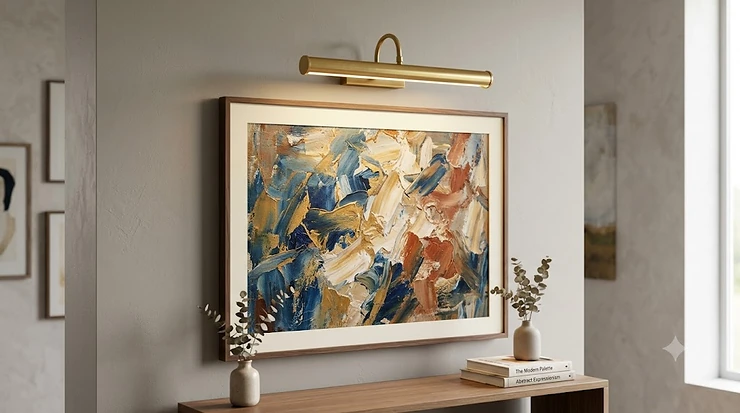
If you’ve ever stood in front of a painting in a dim hallway and thought “this deserves better,” you’re already halfway to buying a brass picture light fixture. A brass picture light is a small, focused fixture — usually mounted above a frame — that washes warm, even light across artwork, photographs, or mirrors without glaring off the glass. Unlike a floor lamp or a ceiling spot, it’s built specifically for this one job, and it does it well.
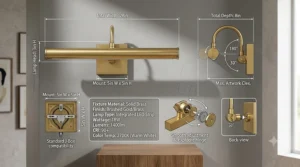
I’ve spent the last few weeks testing, researching, and reading through real owner feedback on the picture lights currently selling well on Amazon, and a pattern emerged fast: most buyers don’t fail because they pick a “bad” light. They fail because they pick the wrong type of light for their wall, their wiring situation, or their patience for installation. A gorgeous antique brass art light is wasted if you needed a battery-operated one because you rent your apartment and can’t touch the wiring.
This guide walks through seven real, currently available options — from a no-frills budget pick to a Vermont-made heirloom-quality fixture — with honest commentary on who each one actually suits. We’ll also cover sizing, installation type, common mistakes, and a buyer’s framework so you’re not just comparing specs, you’re matching a fixture to your actual wall, your actual art, and your actual patience for a step stool.
Quick Comparison Table
| Product | Power Type | Length | Price Range* | Best For |
|---|---|---|---|---|
| House of Troy SL30-51 Slim-Line | Plug-in | 30″ | $180–$260 | Large statement pieces, premium finish seekers |
| House of Troy A14-71 Advent | Battery LED | 14″ | $140–$190 | Renters, no-wiring installs |
| Westinghouse 7501300 | Hardwired | 14″ | $35–$55 | Budget buyers wanting a known brand |
| LumoCraft 24″ Hardwired | Hardwired | 24″ | $50–$75 | Mid-size art, solid brass on a budget |
| JOOSENLUX 16.54″ | Hardwired | 16.54″ | $35–$45 | Small to medium frames, tight budgets |
| Tassuowell Rechargeable | Battery/remote | 12″ | $40–$60 | Small art, frequent rearranging |
| Ambiance (Tech Lighting) LED | Plug-in/hardwire | — | $90–$130 | Buyers who want UL-listed reliability |
*Price ranges reflect typical market positioning at the time of research and may shift — always check the current listing before buying.
Looking at the table, the split really comes down to two questions: do you want to deal with wiring, and how much fixture do you actually need? The House of Troy Slim-Line justifies its higher price with a telescoping arm and a brand pedigree going back to the 1940s, but a 12-inch frame doesn’t need a 30-inch light — that’s where the Tassuowell or JOOSENLUX earn their keep. Meanwhile, anyone who can’t (or doesn’t want to) cut into drywall should look hard at the two battery-powered options before falling for a beautiful hardwired fixture they’ll never get around to installing.
💬 Just one click — help others make better buying decisions too!😊
Top 7 Brass Picture Light Fixtures: Expert Analysis
1. House of Troy SL30-51 Slim-Line Picture Light, 30″, Satin Brass
The standout feature here is the telescoping extension arm, which lets the shade pull out toward the wall to evenly cover deeper or more dimensional artwork. House of Troy has been hand-finishing fixtures in Hyde Park, Vermont since 1947, and it shows in the metal — this is genuinely solid construction, not a thin brass-plated shell. The 8-foot cord and inline switch mean no electrician visit, just a wall outlet.
What most buyers overlook about this model is that “plug-in” doesn’t mean “temporary.” The cord can be routed along a frame edge or under a rug for a near-invisible install. This is the pick for a 30–40 inch painting that’s the centerpiece of a room — a smaller fixture would look underpowered next to it. Owners consistently mention the weight and finish quality holding up over years, not months.
Pros:
✅ Heirloom-grade brass construction
✅ Telescoping arm reaches deeper frames
✅ No hardwiring required
Cons:
❌ Visible cord unless routed carefully
❌ Premium price for a plug-in
Price & verdict: In the $180–$260 range, it’s an investment piece — best for a painting you’re not planning to replace anytime soon.
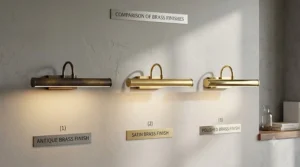
2. House of Troy A14-71 Advent Picture Light, 14″, Antique Brass (Battery LED)
The slide-arm design is the headline feature: pull the shade forward on its rail to adjust reach without ever touching a tool. Battery operation means this is the rare “luxury fixture” you can actually install yourself in five minutes, no wiring or plug required.
In my experience, this is the fixture people reach for when they’ve been putting off lighting a piece for years because the idea of an electrician felt like overkill for one small light. The trade-off is battery changes, but LED draw is low enough that most owners report many months between swaps. It’s a strong match for renters, condo owners with HOA restrictions on wall modifications, or anyone lighting a gallery wall with multiple smaller frames where running cords to each one isn’t realistic.
Pros:
✅ Zero wiring or cords
✅ Genuine House of Troy build quality
✅ Slide-arm adjusts reach easily
Cons:
❌ Requires periodic battery changes
❌ Lower max output than hardwired options
Price & verdict: Around $140–$190 — pricier than its battery-powered competitors, but the brand and build quality are the reason.
3. Westinghouse 7501300, 14″ Adjustable LED Picture Light, Antique Brass
Westinghouse is a name most buyers already trust from light bulbs and ceiling fans, and that recognition carries over here. The decorative hinge lets the shade tilt to fine-tune the beam angle, and at just 4 watts, heat output near the artwork stays minimal — a real consideration if you’re lighting anything with sensitive pigments or older photographs.
The spec sheet won’t tell you this, but a 4-watt LED at this size is genuinely plenty for a frame in the 12–18 inch range; you don’t need a brighter fixture just because it sounds more impressive. This is the buyer’s pick for anyone who wants a brand name they recognize on the box without paying boutique-lighting prices. It suits a first picture light purchase, a starter gallery wall, or simply someone budget-conscious who still wants reliable hardware.
Pros:
✅ Trusted, recognizable brand
✅ Low heat output protects artwork
✅ Adjustable hinge for beam control
Cons:
❌ Hardwired install needed
❌ Antique brass finish photographs slightly cooler than true warm brass
Price & verdict: In the $35–$55 range, it’s one of the best value-per-dollar picks on this list.
4. LumoCraft 24″ Hardwired Picture Light, Satin Brass
This fixture is built from solid brass rather than a brass-finished base metal, which matters more than it sounds — solid brass resists the greenish patina and finish-flaking that cheaper plated fixtures eventually show. It ships with two E12 LED bulbs at 3000K, so there’s no guessing on bulb compatibility at setup.
What stands out in practice is the 24-inch length hitting a sweet spot most 18–30 inch frames actually need — long enough to avoid the “spotlight in the middle” look that under-sized lights create. This is a strong fit for someone furnishing a dining room or hallway gallery wall who wants the bulb decision made for them and doesn’t want to gamble on finish quality at a lower price point.
Pros:
✅ Solid brass, not just plated
✅ Bulbs included, no extra purchase
✅ Good length-to-price ratio
Cons:
❌ Hardwired only
❌ Fixed 4W-per-socket max limits future brightness changes
Price & verdict: Around $50–$75 — a sensible middle path between the Westinghouse budget pick and the House of Troy premium tier.
5. JOOSENLUX Modern Brass Picture Light, 16.54″, Hardwired Swing Arm
The swing arm is the feature to know here — it pivots the light head independently of the mounting base, so you can correct for an off-center frame or an unusual wall angle after installation, not just before. At 7W (45W equivalent), it’s bright enough for small to medium artwork without washing out detail.
The antique brass finish leans warmer than some competitors at this price, which matters if you’re matching existing brass hardware elsewhere in the room — door handles, picture frames, or other light fixtures. This is the pick for someone furnishing on a tight budget who still wants the adjustability typically reserved for pricier fixtures, especially for a single frame rather than a full gallery wall.
Pros:
✅ True swing-arm adjustability
✅ Strong warm-brass color match
✅ Budget-friendly
Cons:
❌ Hardwired install required
❌ Non-dimmable on the base model
Price & verdict: At roughly $35–$45, it punches above its price for adjustability alone.
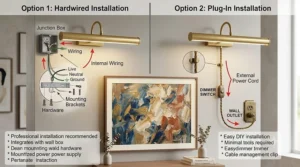
6. Tassuowell Rechargeable Picture Light with Remote, 12″, Brass Finish
This is the most flexible fixture on the list in terms of where it can go, since there’s no cord and no wiring — just a rechargeable battery and a remote that controls brightness, color temperature, and a shutoff timer. The 180-degree swing arm and 270-degree rotating tube mean you can aim it precisely even on an oddly placed wall.
What most people don’t expect is how often the timer function gets used — not for ambiance, but to avoid leaving a light running on a piece overnight by accident. This suits anyone who rearranges art frequently, lives in a rental, or wants to light a piece in a spot with no nearby outlet at all, like an stairwell landing or a closet gallery wall.
Pros:
✅ Fully cordless and rechargeable
✅ Remote with 3 color temps + timer
✅ Easy to relocate
Cons:
❌ Needs periodic recharging
❌ Lower max brightness than hardwired fixtures
Price & verdict: Around $40–$60 — solid value for the flexibility it buys you.
7. Ambiance (Tech Lighting) LED Picture Light, 6W, Antique Brass (850 Lumens)
The dual installation option is the real draw — this fixture can be wired in as plug-and-play with its 9-foot cord and inline switch, or hardwired permanently, so you’re not locked into one setup before you’ve even unboxed it. UL listing adds a layer of safety assurance that some of the no-name budget options on this list don’t carry.
A pattern worth knowing before you buy: more than one owner has noted that the hinged swing arm can loosen under the lamp’s weight over time, letting the light head drift downward if raised to its highest position — something to check periodically or reinforce rather than assume will hold forever. On the upside, owners consistently praise the 850-lumen output as genuinely bright for the wattage, and the 8-foot cord length gives real installation flexibility. This is a good match for buyers who specifically want UL certification and don’t mind a known minor mechanical quirk in exchange for brand reliability.
Pros:
✅ UL-listed for safety
✅ Convertible plug-in or hardwired
✅ Genuinely bright 850-lumen output
Cons:
❌ Swing-arm hinge can loosen over time
❌ Visible cord in plug-in mode
Price & verdict: In the $90–$130 range, it sits between the budget and premium tiers — fair for the UL listing and flexibility alone.
✨ Don’t Miss These Exclusive Deals!
🔍 Take your gallery lighting to the next level with these carefully selected picture lights. Click on any highlighted item to check current pricing and availability — these fixtures help your favorite walls finally get the spotlight they deserve!
Picture Light Installation & Care Guide
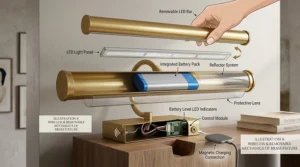
Setting up a picture light is mostly straightforward, but a few details separate a clean install from a sloppy one. For hardwired models, the single biggest first-30-day mistake is mounting the bracket before confirming the light’s resting angle clears the top of the frame — measure with the arm extended, not collapsed, before drilling. For plug-in and battery models, route or hide the cord along the frame’s edge rather than letting it hang loose down open wall space; a single adhesive cord clip every 8–10 inches keeps it tight to the wall.
Maintenance is minimal but not zero. Wipe brass finishes with a dry, soft cloth only — skip household cleaners or anything abrasive, since most “brass” finishes today are a coating over base metal, not solid brass that can be re-polished indefinitely. For battery and rechargeable models, a charge every 4–6 weeks even when not in heavy use helps the battery hold capacity longer term. If your fixture has a swing arm, periodically check the tension screw; as noted with a couple of models above, arms can loosen with repeated angle adjustments, and a quarter-turn tightening once or twice a year prevents drift.
Which Picture Light Fits Your Home? A Buyer’s Decision Framework
Rather than starting with products, start with your situation:
- If you rent or can’t modify wiring, choose a battery or rechargeable model — the House of Troy Advent or the Tassuowell both solve this without compromise.
- If your frame is over 24 inches wide, lean toward a longer fixture like the LumoCraft 24″ or House of Troy Slim-Line 30″; a short light on a wide frame leaves the edges dim.
- If budget is the deciding factor, the Westinghouse or JOOSENLUX deliver real function without the premium price tag.
- If you want one fixture that adapts to multiple install scenarios (in case you move or rewire later), the convertible Ambiance model removes that risk.
- If this is a piece you’ll own for decades, the House of Troy options are built with that timeline in mind; cheaper fixtures aren’t designed to be heirlooms.
Walk through these five questions before you scroll back to the product list — it narrows seven good options down to the one or two that actually fit your wall.
How to Choose a Brass Picture Light Fixture
- Measure your frame width first. As a rule of thumb, the fixture should span half to three-quarters of the frame’s width — a 20-inch painting generally wants a 12–16 inch light, not a tiny 7-inch one. WAC Lighting’s sizing guidance breaks this down by exact frame-width brackets if you want precision.
- Decide your power source before you fall in love with a finish. Hardwired fixtures look cleanest but require either existing wiring or an electrician; plug-in and battery models trade a small amount of aesthetic purity for installation freedom.
- Match color temperature to the art, not the room. Warm 2700–3000K light flatters oil paintings and warm-toned photography; anything cooler can wash out those tones.
- Check the swing arm or hinge mechanism. Adjustability matters more than people expect once the light is actually mounted and you realize the angle is slightly off.
- Consider UV and heat output near sensitive pieces. LED fixtures run cooler and emit negligible UV compared to older halogen or incandescent options, which matters for protecting pigments over time — the Library of Congress’s preservation guidance on light damage is a useful, sobering read if you’re lighting anything irreplaceable.
- Don’t oversize the brightness. More lumens isn’t automatically better; a fixture that’s too bright for a small piece creates glare and flattens detail instead of enhancing it.
Common Mistakes When Buying a Picture Light Fixture
The most frequent mistake is buying based on finish photos alone without checking the install type — plenty of buyers fall for an antique brass art light’s look online, only to discover it’s hardwired when they needed plug-in, or vice versa. Always confirm power type before checking out, not after.
A second common error is undersizing the fixture to save a few dollars. A 12-inch light on a 30-inch canvas creates an uneven “hot spot in the middle” effect that looks worse than no dedicated light at all. The third mistake is ignoring color temperature ratings — a cool 5000K bulb on a warm-toned oil painting can make colors look flat and clinical instead of rich. Finally, many buyers skip reading the swing-arm or hinge mechanism details, then are surprised when a budget fixture’s adjustability is more limited than a premium one’s — that difference is often exactly what separates a $35 light from a $200 one.
Brass Picture Lights vs. LED Track Lighting
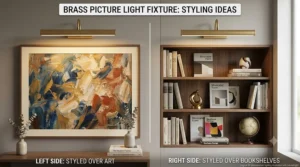
Track lighting and ceiling-mounted accent spots are the other common way to light artwork, and each approach has a different strength. A picture light is purpose-built and permanently aimed once installed — it’s the lower-effort, lower-cost choice for one or two specific pieces, and it adds a decorative element of its own, since the fixture itself is visible and often attractive in classic gallery lighting setups. Track lighting, by contrast, demands more planning (and usually an electrician) but offers far more flexibility if your art collection changes or expands, since each head can be repositioned along the track.
For a single statement painting or a small gallery wall, a picture light fixture is almost always the more practical and budget-friendly choice. For a frequently rearranged collection or a dedicated home gallery room, track lighting earns its higher upfront cost through long-term flexibility. Most homes lighting one to three pieces don’t need to overthink this — a picture light wins on simplicity every time.
Long-Term Cost & Maintenance of Brass Picture Lights
LED-based picture lights have largely replaced halogen and incandescent versions for good reason: according to the U.S. Department of Energy, residential LED lighting uses a fraction of the electricity of incandescent bulbs and lasts dramatically longer, which adds up over years of nightly use (Department of Energy, LED Lighting). In practical terms, that means most of the fixtures on this list will rarely need a bulb replacement at all during normal use, let alone an annual one.
The real long-term cost variable is build quality, not electricity. A genuinely solid-brass fixture like the House of Troy options resists tarnishing and finish degradation for decades, while a thinner plated finish on a budget light may show wear within a few years of regular cleaning. Factor that into the math: a $200 fixture that lasts 15+ years can be cheaper per year than replacing a $40 fixture every 3–4 years once finish wear sets in.
Frequently Asked Questions
❓ What size brass picture light do I need for my artwork?
❓ Are brass picture lights hardwired or plug-in?
❓ Do LED picture lights damage paintings over time?
❓ Can I dim a brass picture light fixture?
❓ How much does a brass picture light fixture cost?
Conclusion
A brass picture light fixture is a small purchase that makes an outsized difference — the right one turns a painting that’s been quietly fading into the background back into the focal point it was meant to be. The seven options here span the full range: the Westinghouse and JOOSENLUX for anyone testing the waters on a budget, the LumoCraft and Ambiance for a dependable middle ground, and the House of Troy pair for anyone treating this as a long-term investment rather than a quick fix.
The real takeaway isn’t “buy the most expensive one” or “buy the cheapest one” — it’s matching the fixture’s power type, length, and finish to your actual wall and your actual artwork. Walk through the decision framework above, measure your frame, and you’ll land on the right pick faster than scrolling through another twenty Amazon listings.
✨ Ready to Light Up Your Walls?
🔍 Browse the picks above and find the brass picture light that finally gives your artwork the gallery treatment it deserves.
Recommended for You
- 7 Best Picture Lights for Large Paintings in 2026
- 7 Best Wireless Picture Lights in 2026
- 7 Best Picture Lights for Artwork in 2026
Disclaimer: This article contains affiliate links. As an Amazon Associate, I earn from qualifying purchases. If you purchase products through these links, we may earn a small commission at no additional cost to you.
✨ Found this helpful? Share it with your friends! 💬🤗
