
In This Article
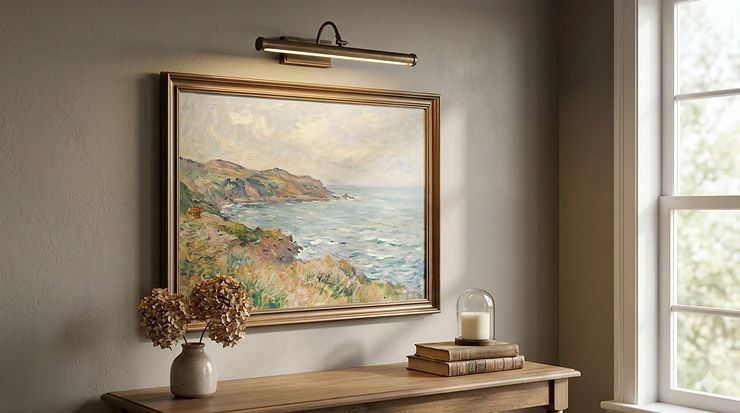
Here’s an uncomfortable truth about that gallery wall you spent a weekend perfecting: under your overhead lighting, it’s probably flat. Washed out. A little sad, even. Ceiling lights scatter illumination everywhere except where you actually want it, and the result is artwork that looks like a poster instead of a painting.
A good picture light fixes this in about fifteen minutes, no electrician required. The right fixture pulls focus, deepens contrast, and makes a $40 print look like it belongs in a Chelsea gallery — while the wrong one either floods your frame with glare or barely outshines a nightlight.
I went looking for the picture lights for artwork that actually earn their spot on a wall, sorting through battery-powered upstarts, old-school plug-in classics, and a few genuinely clever American-made fixtures. What follows are seven real, currently available options, what makes each one tick, and — because lighting touches conservation as much as decor — a look at how light itself can quietly damage the art you’re trying to celebrate. The Energy.gov breakdown of LED museum lighting is a good rabbit hole if you want the science; I’ll keep things practical here.
Quick Comparison: Picture Lights at a Glance
| Light | Power Type | Color Accuracy (CRI) | Best For |
|---|---|---|---|
| Craftersmark 16″ Cordless | Rechargeable battery | 95+ | Renters, no-drill installs |
| Westinghouse 7501300 | Plug-in LED | 90 | Budget-conscious traditionalists |
| EZVALO 16″ Wireless | Rechargeable battery | Standard | Wide/large frames |
| LEONLITE 3CCT | Plug-in or hardwired | 90 | Mixed color-temp rooms |
| Tassuowell 15.7″ Brass | Rechargeable battery | Standard | Style-first gallery walls |
| House of Troy T14-1 | Plug-in (incandescent) | N/A (warm tungsten) | Heirloom frames, period homes |
| Situ Micro Series | Rechargeable battery | 93+ | Small art, zero visible hardware |
A pattern jumps out fast: battery-powered fixtures dominate the affordable end, while anything with a cord (or, in the Situ’s case, genuinely thoughtful engineering) costs more. CRI — the Color Rendering Index, which measures how honestly a light source reproduces color — separates the contenders from the pretenders here, and it’s worth learning to read on a spec sheet before you buy anything. Worth noting: only one fixture on this list still uses old-fashioned incandescent bulbs, and that’s a deliberate choice for buyers chasing a specific period look rather than raw efficiency.
💬 Just one click — help others make better buying decisions too! 😊
💬 Found a light you like already?
Click through to check current availability — these picks move fast.
The 7 Best Picture Lights for Artwork in 2026
1. Craftersmark Dimmable Cordless Picture Light (16″)
The Craftersmark 16-inch cordless picture light is the one I’d hand to a friend who just wants this solved without thinking about it twice. It runs on a 5,000mAh rechargeable battery, throws 350 lumens through a 95+ CRI LED strip, and detaches from its wall bracket in seconds for charging — no fumbling with AA batteries every few months.
What that CRI number actually means in practice: colors in your artwork render close to how they’d look under natural daylight, instead of the slightly greenish or blue-shifted cast you get from cheaper LEDs. For a painting with subtle warm undertones, that’s the difference between looking intentional and looking off.
Buyers consistently point to the easy no-drill mounting and the long runtime as the draws here; the most common gripe is that the remote occasionally needs re-pairing after a recharge.
✅ Rechargeable, no cord clutter
✅ High CRI for accurate color
✅ Simple wall-bracket install
❌ Remote can be finicky after charging
❌ 16″ length won’t suit very wide canvases
Best for: renters and anyone who wants gallery-quality light without touching a drill. Price sits in the $30-45 range, making it the easiest “just buy it” recommendation on this list.
2. Westinghouse 7501300 14″ Adjustable LED Picture Light
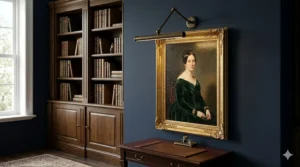
If you want a light that looks like it’s always belonged on your wall, the Westinghouse 7501300 is the move. It’s a plug-in fixture in an antique brass finish, pivoting 120 degrees on a decorative hinge, pulling just 4 watts to produce roughly 206 lumens — about the punch of an old 40-watt incandescent bulb, minus the heat and the electric bill.
What most buyers overlook about this one: the 90 CRI rating and UV-filtered LED aren’t just nice-to-haves, they’re genuinely protective. Incandescent bulbs throw off both heat and UV that slowly fade pigment over years; this fixture sidesteps both problems while still giving that classic warm-brass, slightly traditional look.
It comes from Westinghouse, a name that’s been in lighting long enough to back the fixture with a five-year warranty — reassuring for a wall fixture you’re not planning to swap out every season.
✅ Trusted brand with real warranty backing
✅ UV-safe LED protects artwork over time
✅ Classic antique brass aesthetic
❌ Plug-in only — needs a nearby outlet or visible cord
❌ Fixed warm 3000K color temperature, no adjustment
Best for: anyone furnishing a traditional or transitional room who wants a “set it and forget it” plug-in fixture. Expect to pay in the $35-55 range depending on retailer and finish.
3. EZVALO 16″ Wireless Picture Light (6000mAh)
The EZVALO 16-inch wireless picture light is built for one specific problem: art that’s too wide for a typical 8-12 inch battery bar to cover evenly. Its longer light bar and 6,000mAh battery (noticeably bigger than most competitors in this category) mean it can spread illumination across a landscape painting or a large framed photo without leaving dark patches at the edges.
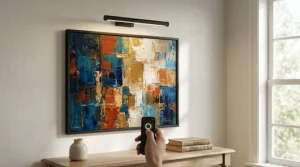
The remote handles three color temperatures and full dimming, plus a timer that auto-shuts the light off — a small feature that matters more than it sounds, since forgetting to switch off a picture light overnight is the most common way people drain these batteries dry.
Reviewers tend to highlight the even spread across wide canvases and the responsive remote; some note the gold finish reads a bit bright/yellow in certain lighting versus true brass.
✅ Long bar suits wide or panoramic art
✅ Larger battery means fewer recharges
✅ Three color temps via remote
❌ Larger size is overkill for small frames
❌ Finish can look more “gold paint” than true metal in photos
Best for: wide canvases, panoramic prints, or anyone illuminating a single statement piece rather than a gallery wall. Typically priced in the $30-45 range.
4. LEONLITE 3CCT Dimmable LED Picture Light
The LEONLITE 3CCT picture light earns its spot by refusing to commit to one installation method — it works plug-in out of the box, or hardwired into a junction box if you want zero visible cord at all. That flexibility alone makes it worth a look for anyone mid-renovation who isn’t sure yet whether they’ll have an outlet exactly where they need one.
The real party trick is the selectable color temperature: flip between 2700K, 3000K, and 4000K to match whatever the rest of the room is doing. A north-facing room with cooler ambient light pairs better with 4000K; a cozy reading nook wants 2700K. Most fixtures lock you into one choice forever — this one doesn’t.
Full metal construction and a swivel head round it out, with 90 CRI keeping color rendition honest across all three settings.
✅ Plug-in or hardwired — your choice
✅ Three selectable color temperatures
✅ Solid full-metal build quality
❌ Hardwiring requires an electrician or real DIY confidence
❌ Antique brass finish shows fingerprints more than matte options
Best for: renovators and design-conscious buyers who want to match color temperature across a whole room. Generally falls in the $35-55 range.
5. Tassuowell Wireless Picture Light (15.7″, Brass)
For a gallery wall where every fixture is visible and none of them can look cheap, the Tassuowell wireless picture light leans hard into style without sacrificing function. The brass-finish body rotates for precise aiming, runs on rechargeable battery power, and offers three color temperatures through its remote — essentially splitting the difference between the EZVALO’s coverage and the Craftersmark’s simplicity.
What sets it apart on a crowded gallery wall is the rotatable head specifically; most battery picture lights only tilt up and down, but this one lets you angle light sideways too, which matters if your frame sits slightly off-center from where you mounted the fixture.
✅ Rotatable head for precise aim
✅ Genuine brass-look finish
✅ Remote-controlled color temp and dimming
❌ Mid-pack battery capacity vs. larger competitors
❌ 15.7″ length splits awkwardly between “small” and “wide” frame categories
Best for: multi-frame gallery walls where aesthetics matter as much as output. Price typically lands in the $30-45 range.
6. House of Troy T14-1 Classic Traditional Picture Light
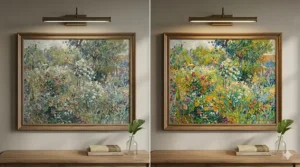
Here’s where the list takes a hard turn toward heirloom territory. House of Troy has been hand-assembling lighting fixtures in Vermont since the 1940s, and the T14-1 is about as far from a battery-powered gadget as picture lighting gets — a 14-inch gold-finish plug-in fixture with a telescoping arm and a ball-swivel shade, built to run on two 40-watt incandescent T10 bulbs you’ll need to source separately.
In my experience, this is the fixture you choose specifically because you don’t want it to look modern. The warm tungsten glow off incandescent bulbs has a richness LEDs still struggle to fully replicate, especially over gold-framed oil paintings or family portraits in a traditional dining room. That said, you’re trading efficiency for atmosphere — incandescent bulbs run hotter and use more power than anything else on this list, and over years of constant use, heat proximity to a frame is worth monitoring.
✅ Genuinely handcrafted in the USA, decades of brand history
✅ Telescoping arm adjusts reach to the frame
✅ Period-correct warm glow for traditional decor
❌ Requires incandescent bulbs (not included, not LED)
❌ Heat output means more caution near delicate or antique frames
Best for: traditional interiors, antique frames, and anyone willing to trade efficiency for authenticity. Sits in the $80-95 range — a real jump from the battery options, but it’s a fixture built to outlast multiple house moves.
7. Situ Lighting Rechargeable Micro Series
If budget isn’t the deciding factor and you want the smallest, least-visible picture light made, the Situ Lighting Rechargeable Micro Series is the one to know about. It’s an American-designed fixture — built in Sarasota, Florida — that simply rests atop your artwork using gravity and a counterweighted battery pack. No mounting hardware, no cord, no wall bracket. You lift it off to recharge and set it back down.
The 93+ CRI rating and NiMH battery chemistry (rated for up to 45 hours per charge) put it in a different performance class than typical battery picture lights, and the company’s deliberate choice to skip remote control isn’t laziness — it’s because remote-receiver circuits draw power even when “off,” slowly degrading battery packs over time. Some long-term owners have reported inconsistent battery life on certain units, so it’s worth registering your warranty and keeping an eye on performance in the first few months.
✅ Zero visible mounting hardware, ever
✅ Genuinely high color accuracy (93+ CRI)
✅ No parasitic battery drain from remote circuitry
❌ Significant price jump from every other option here
❌ No remote control, and occasional reports of inconsistent long-term battery performance
Best for: small to medium artwork in design-forward spaces where literally nothing should be visible but the light itself. Pricing runs notably higher than the rest of this list, typically in the $200-360 range depending on model and finish — squarely a premium, design-object purchase rather than a casual upgrade.
🔍 Ready to light up your walls?
Take your gallery to the next level with any of the picks above — click through to compare current availability and finishes before you commit.
Practical Usage Guide: Getting It Right the First Time
Buying the right fixture is half the job; installing it badly undoes the other half. A few things nobody tells you up front: aim for a picture light that spans roughly half to two-thirds of your frame’s width — too short and you get a hot spot in the middle with dark edges; too long and the light visually overwhelms smaller pieces.
Mounting height matters more than people expect. Center the fixture so the light source sits just above the top edge of the frame, angled to clear any glass or acrylic glazing — direct light hitting glass at the wrong angle creates a glare patch that defeats the entire purpose. If your piece is behind glass, tilt the fixture slightly more aggressively forward than you think you need to.
For battery units, get into a charging rhythm rather than waiting for total drain. Lithium and NiMH batteries both last longer with partial, frequent top-offs instead of full depletion cycles. And for any plug-in fixture, route the cord behind the frame or down a wall corner with adhesive clips — visible cords are the single fastest way to make an expensive light fixture look like an afterthought.
Real-World Scenarios: Matching Light to Life
Picture a renter in a 600-square-foot apartment with strict no-drill lease terms and three framed prints she actually cares about. The Craftersmark or Tassuowell solve this instantly — battery power, adhesive or light hardware mounting, and the ability to take the fixture with her when she moves.
Now picture a homeowner restoring a 1920s dining room around an inherited oil painting in its original gilt frame. Modern LED color temperature would clash with the room’s character. The House of Troy T14-1, with its incandescent warmth and handcrafted Vermont pedigree, is built for exactly this situation — a fixture that looks like it’s always been there.
Finally, consider a design-conscious couple finishing a minimalist living room where every visible wire is a small failure of the aesthetic. The Situ Micro Series, resting invisibly atop a single statement piece with zero hardware in sight, justifies its premium price precisely because “nothing to see” is the entire point.
How to Choose Picture Lights for Artwork
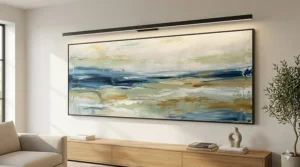
- Measure your frame width first. Your fixture should span roughly 50-65% of it — write this number down before you shop.
- Decide battery vs. plug-in early. Battery wins for flexibility and no-drill installs; plug-in wins for unlimited runtime and typically better light output.
- Check the CRI rating. Anything below 90 will subtly mute colors, especially reds and warm tones — fine for casual decor, not ideal for art you actually love.
- Match color temperature to the room. 2700-3000K reads warm and cozy; 4000K+ reads crisp and gallery-like. Mismatched temperature across a room looks chaotic.
- Factor in glazing. Glass or acrylic over your art changes the ideal mounting angle — steeper isn’t always better, but flat-on almost always creates glare.
- Consider UV exposure for valuable pieces. LED fixtures marketed as “UV-safe” genuinely reduce long-term fading risk compared to old incandescent setups.
- Budget for the right tier, not just the cheapest option. A $35 battery light and a $250 Situ fixture solve different problems; buying the wrong tier for your actual need wastes money either direction.
Common Mistakes When Buying Picture Lights
The single most common error: buying a fixture sized for the frame’s height instead of its width. Picture lights run horizontally above the piece, so width is what determines coverage — a tall, narrow portrait still needs a light sized to its width, not its height.
Second: ignoring glare on glazed pieces entirely until after installation. If your art lives behind glass, test the fixture’s angle with a flashlight before committing to permanent mounting hardware.
Third, and this one’s sneaky: choosing based on lumens alone. A higher lumen count sounds better on paper, but combined with low CRI, it just means a brighter, less accurate wash of light. CRI and lumens need to be evaluated together, not separately.
Finally, people frequently underestimate battery drain from remote controls. As the Situ Lighting team has pointed out, always-on remote receivers create what’s called parasitic drain — a real factor if you’re choosing between two otherwise similar battery fixtures.
LED Picture Lights vs. Traditional Incandescent Picture Lights
This is genuinely the biggest fork in the road on this whole list. LED picture lights — six of the seven fixtures above — run cooler, sip far less power, last tens of thousands of hours, and increasingly filter out the UV radiation that causes long-term fading. The Northeast Document Conservation Center’s guidance on light damage is blunt about this: light exposure damage is cumulative and irreversible, regardless of source, but UV content makes that damage accelerate faster.
Incandescent fixtures like the House of Troy pick produce a warmth that’s genuinely harder to fake with LEDs, and for certain antique or gilt-framed pieces, that authenticity matters more than efficiency. But incandescent bulbs run hot, draw meaningfully more power, and contain more UV and infrared content relative to their visible light output — a real consideration if the art behind that glass is irreplaceable.
The honest answer: choose LED for almost everything, and reserve incandescent for pieces where period authenticity is the entire point of the display.
What to Expect: Real-World Performance
Spec sheets promise a lot; rooms have opinions of their own. In practice, a 90+ CRI LED fixture in a room with warm ambient lighting will look noticeably better than the same fixture in a cold, fluorescent-lit space — context matters as much as the bulb itself.
Battery runtime claims (45+ hours, in the Situ’s case) generally hold up close to advertised numbers if you’re running at moderate brightness; cranking any battery fixture to max output for hours daily will shorten both the runtime per charge and the battery’s overall lifespan faster than the spec sheet implies. Dimming isn’t just an ambiance feature — it’s a battery-life feature.
Expect a short adjustment period with any new fixture’s beam angle. Almost every picture light needs a small angle tweak after the first night, once you actually see how it falls across the piece in real evening light rather than daytime glare.
Long-Term Cost & Maintenance
Battery fixtures involve essentially zero electrical cost — a full recharge runs pennies — but the rechargeable cells themselves have a finite lifespan, typically 300-500 full charge cycles before capacity noticeably drops. That’s roughly 2-4 years of regular use before you’re looking at a replacement battery or a new fixture entirely.
Plug-in LED fixtures cost a little more in standing electrical draw but effectively nothing in bulb replacement, since the LEDs are usually rated for 25,000-35,000 hours — decades of normal use. Incandescent fixtures like the House of Troy sit at the opposite end: bulbs need periodic replacement, and total energy cost over a decade will run meaningfully higher than any LED option here.
Dust and fingerprints are the real maintenance burden across the board — a soft, dry cloth every month or two keeps brass and metal finishes looking sharp without scratching the coating.
Features That Actually Matter (And Those That Don’t)
CRI rating matters. Dimmability matters, both for ambiance and battery life. Adjustable color temperature matters if your room’s lighting isn’t uniform. Solid mounting hardware matters, because nobody wants a $40 fixture crashing onto a $400 frame.
RGB color modes, on the other hand, are mostly marketing flourish on a fixture meant to illuminate static artwork — nice for a party trick, irrelevant for actually displaying a painting well. Remote-control range beyond about 15 feet is also overkill for a fixture you’ll basically never operate from across the room. And “smart home compatibility” on a picture light is, in most real households, a feature that gets set up once and never touched again.
Picture Lighting Fixtures for Every Room (and Every Gallery Wall)
Frame lighting options shift depending on where they’re going. Hallways and stairwells favor battery fixtures for the no-drill flexibility — running an electrician’s line down a stairwell for one light is rarely worth the cost. Dining rooms and formal living spaces lean toward plug-in or hardwired options, since outlets are usually closer and the fixture can be more permanent.
For a true home gallery wall — multiple frames, consistent spacing, consistent lighting — picking one fixture model across every piece matters more than picking the “best” individual light. A wall mixing battery warmth at 2700K next to plug-in fixtures at 4000K reads as visually disjointed, even if each light is excellent on its own. Consistency, not just quality, is what makes a gallery wall actually look like a gallery.
Safety Considerations: Cords, Wattage & Wall Mounting
Plug-in fixtures with long cords (the House of Troy ships with an 8-foot cord) should be secured along the wall with cord clips rather than left to dangle — both for appearance and because a loose cord near a frame is a real snag-and-fall risk, especially around kids or pets. Always check a fixture’s mounting hardware weight rating against your wall type; adhesive or magnetic battery mounts typically cap out around 1.5 lbs, fine for the fixtures themselves but worth confirming before assuming any mount will hold extra weight.
Frequently Asked Questions
❓ What is the best type of picture light for artwork?
❓ How far should a picture light be from the wall?
❓ Are battery-operated picture lights bright enough?
❓ Do picture lights damage artwork over time?
❓ Can I install a picture light without an electrician?
Final Verdict: Which Picture Light Should You Buy?
If you want the safest, easiest recommendation, start with the Craftersmark — it’s affordable, rechargeable, and color-accurate enough to do justice to almost anything you hang. If your room runs traditional and your frame deserves a little theater, the House of Troy T14-1 brings real craftsmanship and warmth that LEDs still can’t fully fake. And if budget genuinely isn’t the constraint and invisible installation is the goal, the Situ Micro Series is the rare premium product that actually earns its price tag through engineering rather than branding.
Whatever you choose, the underlying lesson holds: light isn’t decoration layered on top of your art, it’s the thing that determines whether anyone notices the art at all. A $35 fixture aimed correctly will outperform a $300 fixture mounted wrong, every time. Measure your frame, pick your power source, and actually look at the result for a few nights before deciding it’s “good enough.” For deeper background on why museums obsess over this stuff, the Getty Conservation Institute’s lighting research and the basics of Color Rendering Index are both worth a skim.
Recommended for You
- 7 Best Battery Operated Wall Sconces That Actually Work (2026)
- 7 Best Brass Wall Sconces Modern Homes Need in 2026
- 7 Best Farmhouse Wall Sconces Living Room (2026 Buyer’s Guide)
Disclaimer: This article contains affiliate links. As an Amazon Associate, I earn from qualifying purchases. If you purchase products through these links, we may earn a small commission at no additional cost to you.
✨ Found this helpful? Share it with your friends! 💬🤗
