

In This Article
Stand in a lighting aisle for more than thirty seconds and you’ll start hearing a quiet argument happening inside your own head: golden and inviting, or crisp and wide-awake? That tug-of-war has a name, and it’s warm white vs cool white lighting — the single decision that does more to shape how a room feels than paint color, furniture, or that expensive rug you agonized over. Get it wrong and your cozy reading nook looks like a dentist’s waiting room. Get it right and a $12 bulb outperforms a $2,000 sofa in the “does this room feel good” department.

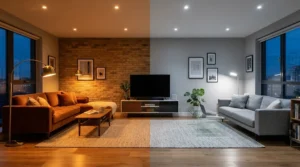
Here’s the short version, because you deserve one up front: warm white sits in the 2700K–3000K range and mimics the amber glow of a sunset or an old incandescent bulb, while cool white lives at 4000K–6500K and reads closer to overcast daylight or a hospital hallway. Neither is objectively “better” — they’re tools for different jobs, and according to Minnesota’s Department of Commerce, labeling standards now make it easier than ever to match the Kelvin number on the box to the mood you’re actually going for.
This guide skips the marketing fluff and gets into the real stuff: seven actual bulbs you can buy today, spanning budget selectable-white options to premium tunable smart bulbs, plus the room-by-room reasoning that separates a living room that glows from one that just… has lights on. We’ll cover color temperature guide living room specifics, walk through choosing light color for different zones, settle the cozy vs bright lighting debate once and for all, and show you how ambient color selection actually works in practice. By the end, you’ll know exactly which Kelvin range — and which bulb — belongs in your living room.
Quick Comparison Table
Before diving into individual products, here’s the cheat sheet. Bookmark this table if you only have sixty seconds to decide what to buy.
| Attribute | Warm White (2700K–3000K) | Cool White (4000K–6500K) |
|---|---|---|
| Visual character | Amber, golden, candle-like | Crisp, neutral-to-blue |
| Best living room zones | Sofa seating, lamps, accent lighting | Home office corners, craft/reading tasks |
| Emotional effect | Relaxed, intimate, slower pace | Alert, focused, energized |
| Evening suitability | Excellent — minimal circadian disruption | Use with caution close to bedtime |
| Standout picks | Philips Hue White Ambiance A19, Feit Electric 5CCT Color Choice A19 | LIFX Color A19 SuperColor, TP-Link Tapo L535E Multicolor |
What jumps out here is that this isn’t really an either-or choice — it’s a zoning question. Most living rooms actually benefit from both temperatures working together, warm near the seating and lamps, cooler near task areas like a desk or kitchen pass-through. Tunable bulbs like the ones in the right-hand column let you skip the debate entirely and just dial in whichever mood the moment calls for.
Found this comparison useful? A quick share helps other readers land on the right bulb the first time. 💬
Top 7 Warm White vs Cool White Bulbs: Expert Analysis
We dug through real specs, real aggregated review sentiment, and current retail listings to land on seven bulbs that actually deliver on their color temperature claims — not just the ones with the flashiest packaging. Coverage spans budget, mid-range, and premium, plus one deliberately low-tech pick for anyone who doesn’t want an app involved in turning on a lamp.
1. Philips Hue White Ambiance A19 — the gold standard for tunable living room light
If there’s a “safe bet” in this entire list, it’s the Philips Hue White Ambiance A19. This is the bulb most smart-home reviewers reach for first, and for good reason: it covers roughly 2200K to 6500K in smooth, stepless increments, so you’re never stuck choosing between two fixed presets.
Specs-wise, you’re looking at around 800 lumens (a 60W incandescent equivalent) from roughly 9 watts of draw, dimmable down to a genuinely dark 0.2% via the Hue ecosystem, and a rated lifespan north of 25,000 hours — call it over two decades at typical evening usage.
What most buyers overlook about the White Ambiance line is that its real advantage isn’t the color range itself, it’s the scene-scheduling: you can have your living room shift from a 2700K wind-down glow at 9 p.m. to nothing at all by 11, automatically, without touching your phone. Reviewers consistently note fast, reliable pairing and describe the accuracy of the white tones as noticeably better than off-brand tunable bulbs, though a few flag that full scheduling features require the separate Hue Bridge rather than working purely over Bluetooth.
Pros:
- ✅ Smooth stepless tuning across the full warm-to-cool range
- ✅ Rock-solid ecosystem with Alexa, Google Home, and Apple HomeKit
- ✅ Genuinely dims low enough for late-evening ambiance
Cons:
- ❌ Full scheduling and automation needs the separate Hue Bridge
- ❌ Priced above most competitors on this list
Expect to pay in the $45–$60 range for a two-pack at the time of research, prices may vary by retailer. For anyone building a serious tunable-white setup rather than just testing the waters, this is the bulb that justifies the premium.

2. LIFX Color A19 SuperColor — no hub, no compromise on range
The LIFX Color A19 SuperColor takes the opposite approach to hub dependency: everything runs over direct Wi-Fi, no bridge required, and the tunable white range is the widest on this list at roughly 1500K (deep candlelight) to 9000K (well past standard daylight). At 1,100 lumens from 11 watts, it’s also the brightest single bulb here, which matters if your living room fixture is a single overhead can rather than several lamps. Here’s what to weigh: LIFX built this as a color bulb first and a tunable-white bulb second, so you’re paying for RGB capability (1 trillion colors, per LIFX’s own spec sheet) even if you only ever plan to use the white end of the spectrum. Aggregated reviewer sentiment is largely positive on brightness and setup speed — testers consistently mention the two-minute Wi-Fi pairing — with occasional complaints about the companion app feeling cluttered compared to simpler competitors.
Pros:
- ✅ Widest tunable white range of any bulb in this roundup
- ✅ No hub or bridge needed, ever
- ✅ Brightest single-bulb output for larger rooms
Cons:
- ❌ App experience is less polished than Hue’s
- ❌ You’re paying for color capability you may not use
Pricing generally falls in the $30–$50 range depending on pack size, at the time of research. If your living room only has one or two sockets to work with and you want maximum output without a hub, this is the pick.
3. Wyze Bulb Color — the budget tunable bulb that punches above its price
Wyze built its whole brand on undercutting premium smart-home pricing without gutting the feature set, and the Wyze Bulb Color is a clean example. Its tunable range runs from an unusually warm 1800K up to 6500K — most competing color bulbs won’t go warmer than about 2500K, so this one edges out even some pricier options for genuine candlelight-style coziness. Brightness tops out at 1,100 lumens, on par with LIFX, from a bulb that typically costs a fraction as much per unit. Reviewers testing it against pricier alternatives have described the color accuracy and brightness ceiling as surprisingly competitive, particularly for anyone already inside the Wyze ecosystem via a security camera or plug. The honest trade-off: Wyze’s cloud infrastructure has had rockier uptime history than Philips or LIFX, so local-network reliability isn’t quite as bulletproof.
Pros:
- ✅ Warmest available tuning point (1800K) on this list
- ✅ 1,100-lumen brightness at a budget price point
- ✅ No hub required, works over Wi-Fi and Bluetooth
Cons:
- ❌ Cloud reliability has drawn more complaints than premium rivals
- ❌ App feature depth trails Hue’s automation tools
Multi-packs typically land around $9–$13 per bulb depending on bundle size, at the time of research. For a first foray into tunable lighting without a big financial commitment, this is the sensible entry point.
4. Feit Electric Smart Wi-Fi RGBW A19 (3-Pack) — dependable mid-range tuning
The Feit Electric Smart Wi-Fi RGBW A19 occupies the sensible middle ground: 800 lumens, roughly 9 watts, a 2700K–6500K tunable range, and a 90+ CRI rating that Feit has built its reputation on across its entire catalog. What the spec sheet won’t tell you, but user reports suggest, is that Feit’s dimming curve is unusually smooth at low brightness — a detail that matters more than raw lumen count once you’re actually trying to wind a room down for the evening. It connects over 2.4GHz Wi-Fi directly to Alexa and Google Home without a hub, and ships in three-packs, which conveniently matches the “lamp, lamp, overhead” layout most living rooms actually use. Based on the spec comparison with pricier tunable bulbs, you’re not sacrificing much color accuracy for the savings — you’re mostly giving up brand-name polish and a slightly narrower ecosystem of accessories.
Pros:
- ✅ Full 2700K–6500K range at a mid-range price
- ✅ 90+ CRI keeps colors and skin tones looking natural
- ✅ Three-packs are priced for whole-room setups
Cons:
- ❌ No HomeKit support out of the box
- ❌ Fewer third-party integrations than Hue or LIFX
A three-pack generally runs in the $30–$40 range at the time of research, roughly $10–$13 per bulb. This is the pick for anyone furnishing an entire living room without paying premium-brand tax on every socket.
Quick Product Snapshot
| Product | Tunable Range | Brightness | Price Range | Best For |
|---|---|---|---|---|
| Philips Hue White Ambiance A19 | ~2200K–6500K | ~800 lm | $45–$60 (2-pack) | Whole-room scheduled ambiance |
| LIFX Color A19 SuperColor | ~1500K–9000K | ~1,100 lm | $30–$50 | Single-fixture, no-hub brightness |
| Wyze Bulb Color | ~1800K–6500K | ~1,100 lm | $9–$13/bulb | Budget-conscious first upgrade |
| Feit Electric Smart Wi-Fi RGBW | ~2700K–6500K | ~800 lm | $30–$40 (3-pack) | Furnishing a whole living room |
| TP-Link Tapo L535E Multicolor | ~2700K–6500K | ~1,100 lm | $40–$55 (4-pack) | Matter-based multi-device homes |
| Sengled Dual Mode Color Changing | ~2700K–6500K | ~800 lm | $25–$35 (4-pack + remote) | No-app, remote-first control |
| Feit Electric 5CCT Color Choice A19 | 2700K/3000K/4000K/5000K/6500K | ~800 lm | $15–$20 (multi-pack) | Rentals and switch-only fixtures |
Looking at the table as a whole, the split between smart tunable bulbs and the single selectable option (Feit Electric 5CCT Color Choice A19) tells its own story: if you want to drift between warm and cool through the day, you need a smart bulb, but if you just want to set it once and forget it, the non-smart selectable option saves real money without sacrificing the core benefit. Budget shoppers should note that per-bulb cost drops significantly with multi-packs across nearly every brand here, so buying for the whole room at once is usually the better math.
5. TP-Link Tapo L535E Multicolor — Matter-certified flexibility for mixed ecosystems
TP-Link’s Tapo sub-brand has quietly become one of the more reliable budget-adjacent smart lighting lines, and the TP-Link Tapo L535E Multicolor is a strong example why. It’s Matter-certified, meaning it plays nicely across Apple Home, Google Home, Amazon Alexa, and SmartThings without needing brand-specific workarounds — a genuinely useful feature if your household has mixed devices. Specs land at 1,100 lumens, a 2700K–6500K tunable range, 16 million RGBW colors, and a CRI above 90. Reviewers consistently point to the pairing process as one of the smoothest in the budget-to-mid tier, largely thanks to Matter’s standardized QR-code setup. On paper this means less fiddling and fewer app downloads than legacy smart bulbs required just a couple of years ago; the trade-off is that Tapo’s own app still lags Hue’s in terms of advanced scene design.
Pros:
- ✅ Matter certification means broad ecosystem compatibility
- ✅ 1,100-lumen output rivals pricier premium bulbs
- ✅ Fast, standardized QR-code pairing
Cons:
- ❌ Scene and automation tools are more basic than Hue’s
- ❌ Four-pack minimum limits smaller purchases
Four-packs typically run $40–$55 at the time of research, or roughly $10–$14 per bulb. If your living room shares a smart home ecosystem with a mix of Apple and Android users, this is the practical peacekeeper.

6. Sengled Dual Mode Color Changing A19 — remote-first control without the app requirement
Not everyone wants to unlock their phone to change a light bulb, and the Sengled Dual Mode Color Changing A19 bulb is built around that exact frustration. It ships with a physical remote and supports local group control, meaning multiple bulbs can be synced without touching Wi-Fi or a hub at all — a genuinely different approach from everything else on this list. The tunable range covers 2700K–6500K at roughly 800 lumens per bulb (60W equivalent), and the four-pack bundle including the remote keeps the entry cost low. Here’s the honest trade-off, framed plainly: this particular dual-mode line does not support Alexa or Google Assistant, so if voice control is non-negotiable for your household, look elsewhere on this list. Aggregated review sentiment reflects exactly that split — strong marks for remote responsiveness and price, recurring notes about the missing voice-assistant layer.
Pros:
- ✅ Physical remote means zero app setup required
- ✅ Local group control without a hub or Wi-Fi dependency
- ✅ Budget-friendly four-pack including the remote
Cons:
- ❌ No Alexa or Google Assistant support on this model
- ❌ Lacks the fine-grained scheduling smart-hub bulbs offer
Expect to pay in the $25–$35 range for the four-pack plus remote, at the time of research. This is the pick for households that want tunable light without buying further into a voice-assistant ecosystem.
7. Feit Electric 5CCT Color Choice A19 — the no-app, no-hub selectable-white workhorse
Not every bulb on this list needs to be “smart,” and the Feit Electric 5CCT Color Choice A19 proves the point nicely. There’s no Wi-Fi radio, no app, and no hub — instead, you cycle through five fixed color temperatures (2700K soft white, 3000K bright white, 4000K cool white, 5000K daylight, and 6500K cool daylight) using either a switch on the bulb base or, on some units, a rapid power-cycle at the wall switch.
At roughly 800 lumens from 8.8 watts, Feit claims about 95% energy savings versus an equivalent incandescent, and a rated lifespan around 15,000 hours.
What most buyers overlook about selectable-CCT bulbs like this one is that they solve a very specific problem smart bulbs can’t: rental properties, guest rooms, or any fixture where you want flexibility without introducing an app dependency a future tenant or houseguest won’t want to deal with. Reviewers frequently mention the switch mechanism as slightly fiddly to learn at first, but reliable once you get the timing down.
Pros:
- ✅ Five selectable temperatures with zero app or hub needed
- ✅ Roughly 95% energy savings versus incandescent bulbs
- ✅ Ideal for rentals or fixtures you don’t want networked
Cons:
- ❌ No smooth in-between tuning — five fixed steps only
- ❌ Switch-cycling mechanism has a slight learning curve
Multi-packs generally run $15–$20 at the time of research, among the most affordable options here. If you like the idea of tunable lighting but don’t want another device on your Wi-Fi network, this is the sensible compromise.
What Is Warm White vs Cool White Lighting?
Warm white vs cool white lighting refers to a bulb’s correlated color temperature (CCT), measured in Kelvin: warm white sits around 2700K–3000K and produces an amber, candlelight-like glow, while cool white ranges from about 4000K to 6500K and produces a crisper, bluer-toned light closer to overcast daylight. Neither temperature is “brighter” by definition — that’s a separate measurement, in lumens.
It’s a common mix-up, and an understandable one, since Wikipedia’s entry on color temperature explains that the Kelvin scale actually runs in reverse of intuition: lower numbers look warmer, higher numbers look cooler, even though higher Kelvin values technically describe hotter physical temperatures on the underlying blackbody radiation scale the measurement borrows from. You don’t need the physics to use it well, but it explains why the number on the box can feel backwards the first few times you shop for bulbs.

What’s the Best Color Temperature for a Living Room?
For most living rooms, 2700K–3000K warm white is the best default color temperature, since it supports relaxation, conversation, and screen time without the harsh contrast cooler light creates against a dark evening room. Rooms that double as home offices or craft spaces benefit from adding a 4000K zone near the task area specifically.
The honest analytical answer is a little more nuanced than “always go warm,” though. If your living room gets heavy natural daylight and you spend daytime hours there working or reading, a bulb in the 3500K–4000K neutral zone can actually feel more balanced than true warm white, which can look muddy or dim under bright midday sun. This is exactly why tunable bulbs like the Philips Hue White Ambiance A19 and LIFX Color A19 SuperColor solve a problem fixed-temperature bulbs simply can’t: they let the room’s Kelvin setting track the actual light conditions and activity, rather than locking you into one mood regardless of what’s happening at 2 p.m. versus 9 p.m.
Color Temperature Guide for Living Room: The Room-by-Room Kelvin Chart
A full color temperature guide living room shoppers can actually use needs to go zone by zone, not room by room, because most living rooms have multiple functions happening in the same four walls.
| Living Room Zone | Recommended Kelvin | Why It Works |
|---|---|---|
| Main sofa/seating area | 2700K–3000K | Supports relaxed conversation and evening wind-down |
| TV or media wall | 2700K–3200K, dimmable | Reduces eye strain contrast against the screen |
| Reading chair or lamp | 3000K–4000K | Enough clarity for text without feeling clinical |
| Home office corner | 4000K–5000K | Mimics daylight to support focus and alertness |
| Shelving or accent lighting | 2700K–3500K | Warm tones flatter wood, books, and decor objects |
Reading the chart, the clearest pattern is that anything doubling as a workspace pulls toward cooler light, while anything meant for lingering pulls warm. A single Feit Electric 5CCT Color Choice A19 in a floor lamp near a reading chair lets you toggle between the 3000K and 4000K rows on the fly, which is a cheaper fix than rewiring separate fixtures for separate purposes.
How to Choose Light Color for Every Corner of Your Room
Choosing light color room by room gets a lot easier with a repeatable process instead of guesswork. Here’s the expert-reasoned version:
- Identify the primary activity per zone. Conversation and relaxing call for warmer light; reading fine print or doing hobby work calls for cooler, higher-CRI light.
- Check your natural light exposure. Rooms with lots of daytime sun can tolerate — and often benefit from — slightly cooler bulbs than a windowless room would.
- Match undertones in your decor. Warm wood tones and earthy palettes look richer under 2700K–3000K; cooler grays and whites hold up better under 3500K–4000K.
- Decide if you need flexibility or simplicity. If the room serves multiple purposes, a tunable smart bulb earns its price; if it’s single-purpose, a fixed or selectable bulb saves money.
- Prioritize CRI alongside Kelvin. A high Kelvin number with poor color rendering (below 80 CRI) can look worse than a lower-CRI warm bulb — CRI, not just temperature, determines how “true” colors look.
- Test before committing the whole room. Buy one bulb, live with it for a few evenings, then scale up rather than replacing every socket at once.
- Layer, don’t rely on one fixture. Combining a warm lamp with a cooler overhead option gives you more control than any single bulb ever will.
Cozy vs Bright Lighting: Which One Actually Wins?
The cozy vs bright lighting debate isn’t really a competition — it’s a mismatch of expectations. Cozy lighting, generally 2700K and below with softer, more diffused output, wins for evening relaxation, entertaining, and anything meant to slow a room down. Bright lighting, typically 4000K and above paired with higher lumen counts, wins for tasks: cooking, cleaning, working, or anywhere visual accuracy and alertness matter more than ambiance.
What most buyers overlook is that “bright” and “cool” aren’t actually the same axis, even though they’re often bundled together in marketing copy. You can have a bright warm room (high lumens, low Kelvin) or a dim cool one (low lumens, high Kelvin) — they’re independent variables. A living room lit by three 2700K bulbs at full 800-lumen output can feel both cozy and plenty bright; the coziness comes from the color temperature, not a dimmer switch. This is worth internalizing before you assume you need cooler light just because a room feels dim — sometimes more lumens at the same warm temperature solves it without sacrificing atmosphere at all.
Ambient Color Selection: Layering Warm and Cool Light Like a Pro
Good ambient color selection rarely comes from a single bulb — it comes from layering. Interior lighting designers commonly reference a three-layer model: ambient (general room fill), task (focused work light), and accent (decorative highlighting). Each layer can carry its own Kelvin value without clashing, as long as the transitions are intentional rather than accidental.
A practical starting formula for a living room: set your ambient overhead fixture to 2700K–3000K, keep a task lamp near any reading or work surface at 3500K–4000K, and use accent lighting — shelf lights, picture lights, LED strips — at whatever temperature best flatters what’s being lit (warm for wood and books, neutral for art with true-color printing). The trick that separates a professionally lit room from an accidentally lit one is consistency within each layer: mixing three different warm-white Kelvin values across three lamps reads as sloppy, even if none of them are individually wrong. If budget allows, standardizing on tunable bulbs like the TP-Link Tapo L535E Multicolor across all three layers means you can shift the entire room’s mood with one app tap instead of physically swapping bulbs.
Practical Usage Guide: Setting Up Your Living Room Lighting Right
Getting a new bulb home is the easy part. Here’s where most people leave value on the table in the first thirty days:
During setup: Match bulb shape and base (A19/E26 is standard for most living room fixtures, but check enclosed fixtures for heat-rating compatibility before installing a smart bulb, since sealed housings can shorten driver lifespan). Pair smart bulbs on 2.4GHz Wi-Fi specifically — most, including several on this list, won’t connect to a 5GHz-only network, a surprisingly common first-setup snag.
In the first week: Resist the urge to leave every bulb on its default Kelvin setting. Spend a few evenings adjusting the warm-to-cool balance per zone using the guidance above, and save it as a preset once it feels right rather than re-adjusting nightly.
Ongoing maintenance: Selectable and smart LED bulbs need essentially zero maintenance, but firmware updates on smart bulbs are worth checking quarterly — outdated firmware is a common, overlooked cause of “my smart bulb stopped responding to voice commands” complaints in aggregated user reviews.
Common first-30-days mistakes: Installing a single Kelvin value across an entire open-plan room, skipping the dimmer-compatibility check on non-smart selectable bulbs, and forgetting that CRI, not just color temperature, is what makes a room’s colors look natural rather than washed out.

Real-World Scenarios: Matching Bulbs to How You Actually Live
The remote worker with one shared living room. If your living room doubles as your office from 9 to 5 and your relaxation space every evening, a tunable smart bulb earns its keep fast. The Philips Hue White Ambiance A19 paired with a scheduled scene — cooler during work hours, warm after 6 p.m. — removes the need to manually manage the shift at all.
The renter who can’t commit to smart infrastructure. If you’re not planning to stay long-term, or don’t want a future tenant inheriting your smart home app, the Feit Electric 5CCT Color Choice A19 delivers most of the flexibility without any network dependency, and it moves with you when you move out.
The budget-conscious first-time buyer testing the waters. Rather than committing to a whole-room smart lighting overhaul, buying a single Wyze Bulb Color for the main lamp lets you experience tunable lighting for the cost of a nice dinner out, before deciding whether to expand.
Common Mistakes When Choosing Warm vs Cool White Lighting
The most frequent misstep is buying based on Kelvin alone and ignoring lumens entirely — a warm 400-lumen bulb in a large room will feel dim regardless of how “cozy” its color temperature is. A close second is assuming one Kelvin value fits an entire open floor plan, when in reality kitchens, living rooms, and hallways sharing sightlines often benefit from slightly different temperatures without looking mismatched, as long as the differences are modest (staying within roughly 500K of each other looks intentional; jumping from 2700K to 6500K in adjoining rooms looks jarring).
Another common error is ignoring CRI in favor of Kelvin and lumens alone — a cheap bulb can hit the “right” color temperature number on the box while still rendering skin tones and fabric colors poorly. Finally, plenty of shoppers skip checking dimmer compatibility on non-smart bulbs, which can cause buzzing or flickering that has nothing to do with the bulb’s color temperature and everything to do with an incompatible dimmer switch.
Long-Term Cost & Maintenance: Is Tunable Lighting Worth It?
Here’s where a comparison table earns its keep. Traditional fixed-temperature bulbs still dominate impulse purchases, but the long-term math often favors flexible options.
| Feature | Traditional Fixed-CCT LED | Selectable/Tunable LED (e.g. Feit Electric 5CCT Color Choice A19) |
|---|---|---|
| Flexibility | None — locked to one Kelvin forever | 5 presets or full tunable range |
| Typical lifespan | 15,000–25,000 hours | 15,000–25,000 hours (comparable) |
| Cost if mood changes | Buy a new bulb entirely | No additional cost — just switch settings |
| Energy use | Comparable wattage for comparable lumens | Comparable — CCT doesn’t meaningfully affect draw |
| Best for | Fixtures that will never change purpose | Any room whose use might evolve |
The analysis here is straightforward: energy costs are essentially a wash between fixed and tunable bulbs of similar lumen output, since color temperature has minimal impact on efficiency — the real cost difference is the upfront price premium for tuning capability. Over a bulb’s 15–20 year expected lifespan, though, that premium amortizes to just a few cents per month, and it buys you the freedom to completely change a room’s mood without an electrician or a return trip to the store. For a living room specifically — the room in most homes that gets used for the widest variety of activities — that flexibility tends to pay for itself in convenience alone.
Features That Actually Matter (And Those That Don’t)
Marketing copy loves to bury the features that actually affect your day-to-day experience under ones that mostly affect a spec sheet. Here’s the honest filter, based on the spec comparison across all seven bulbs above: CRI (color rendering index) matters enormously and gets mentioned least — anything below 90 will make skin tones and rich colors look subtly off regardless of Kelvin. Dimming range and smoothness matters more than most buyers expect going in; a bulb that dims to 1% feels dramatically different at night than one that bottoms out at 10%. Wi-Fi versus Bluetooth-only connectivity matters if you want voice control from anywhere in the house rather than just nearby.
What matters less than the marketing suggests: the total number of “millions of colors” a bulb supports, since living rooms overwhelmingly get used in white-light modes rather than RGB party-lighting modes; and headline lumen numbers in isolation, since a 1,100-lumen bulb in a small lamp will feel harsher than an 800-lumen bulb properly diffused through a shade. Read past the big numbers on the box and check CRI and dimming specs specifically — that’s where the real differences between similarly priced bulbs tend to live.
Safety and Circadian Health: What the Research Says About Light at Night
This is the one place where warm white vs cool white lighting stops being purely aesthetic. Research on artificial light and the body’s internal clock has found that blue-heavy, cooler-toned light in the evening can suppress melatonin production and delay the onset of sleep more than warmer light does, as reviewed in a study on protecting the melatonin rhythm through light exposure. None of this means cool white bulbs are dangerous — during the day, that same alerting effect is a genuine benefit for focus and productivity. The practical takeaway is timing: cooler light in the morning and midday can support alertness, while shifting toward 2700K or warmer in the two to three hours before bed supports a more natural wind-down.
This is exactly the scenario tunable bulbs solve elegantly. Rather than remembering to swap bulbs by time of day, a scheduled scene on something like the LIFX Color A19 SuperColor or Philips Hue White Ambiance A19 can automatically shift a living room from daylight-adjacent cool white in the afternoon to a dim, warm glow after dinner, no manual intervention required.
Frequently Asked Questions
❓ Is warm white or cool white better for a living room?
❓ What Kelvin is considered warm white lighting?
❓ Can I mix warm and cool white bulbs in the same room?
❓ Do cool white bulbs use more electricity than warm white bulbs?
❓ What's the best smart bulb for switching between warm and cool white?
Conclusion
Warm white vs cool white lighting isn’t a debate you need to settle once and live with forever — it’s a decision you can revisit zone by zone, evening by evening, once you understand what each Kelvin range is actually good at. Warm light earns its keep in conversation areas and wind-down corners; cool light earns its keep wherever focus and visual accuracy matter more than mood. The seven bulbs covered here, from the flexible Philips Hue White Ambiance A19 down to the refreshingly simple Feit Electric 5CCT Color Choice A19, cover nearly every budget and every appetite for “smart” features.
If there’s one habit worth taking from this guide, it’s zoning instead of guessing: match the Kelvin to the activity, layer your ambient, task, and accent lighting deliberately, and let a tunable bulb do the heavy lifting in any room that serves more than one purpose throughout the day. Get that right, and the lighting in your living room stops being an afterthought and starts doing real work for how the space feels, every single evening.
Recommended for You
- LED vs Incandescent Living Room Lights: 7 Best Bulbs For 2026
- Floor Lamp vs Table Lamp: 7 Picks That Settle the 2026 Debate
- Choosing Ceiling Light Type: 7 Best Fixtures for 2026
Disclaimer: This article contains affiliate links. As an Amazon Associate, I earn from qualifying purchases. If you purchase products through these links, we may earn a small commission at no additional cost to you.
✨ Found this helpful? Share it with your friends! 💬🤗
