
In This Article
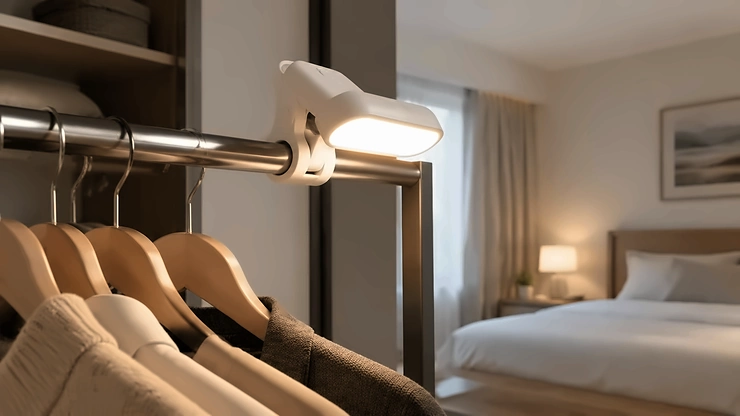
A closet rod light for hanging clothes is a slim LED fixture mounted on, under, above or inside the rod area so light lands directly on garments, not on the ceiling. It fixes the classic problem: a ceiling bulb casts shadows because the clothes themselves block the light. Think of it as a headlamp for your wardrobe.
Here’s the thing most buyers miss. A closet can be “lit” and still be useless. One overhead bulb shines on the tops of shoulders and leaves the middle of the rail in permanent dusk, which is exactly where navy gets mistaken for black. A January 2026 Bob Vila closet lighting roundup describes why wireless bars and strips have become the go-to fix, and that matches what the spec sheets suggest.
This guide narrows the field to seven real products, from battery-powered stick-ons to a premium lighted rod. We also cover mounting styles like the under-rod closet light and the clip-on closet rod light, plus the clamp mount question. I’ll stay honest throughout: where I couldn’t verify customer reviews, I say so instead of inventing them.
Quick Comparison: 7 Closet Rod Light Options at a Glance
| Product | Power | Mount | Standout | Price range | Best For |
|---|---|---|---|---|---|
| Mcgor Under Cabinet Lighting | USB rechargeable | Magnetic | Auto motion mode, dimmable | Budget tier | Most renters and DIYers |
| Joyzy Automatic Motion Sensor Closet Lights | Battery | Magnet + 3M pads | Angled beam | Budget tier | Reach-in closets |
| Desunlux Battery-Powered Closet Lights | Battery | Magnet/adhesive | Motion + ambient sensing | Around $20 each | Long shelves |
| Brilliant Evolution BRRC113 | Battery | Adhesive/magnet | Responsive PIR sensor | $30-$40 per pair | Slim, simple upgrades |
| Litever 12″ Under Cabinet Light Bar | Plug-in | Brackets/adhesive | Dimmer, CRI above 80 | Around $16 | No-battery setups |
| Lightkiwi Modular LED Under Cabinet Kit | Plug-in | Brackets | UL-listed, 0.35″ thin | Roughly $25-$60 | Tidy permanent look |
| Task Lighting Lighted Closet Rod | Hardwired/driver | Rod brackets | Rod and light in one | Low $100s to $400s+ | Remodels |
Looking at the table, the first four are all about convenience: no wiring, fast setup, and motion sensing. The Litever 12″ Under Cabinet Light Bar and Lightkiwi Modular LED Under Cabinet Kit trade battery freedom for steady plug-in power, which suits a closet you use every day. The Task Lighting Lighted Closet Rod is the outlier: it costs several times more, but it is the only one here that is the rod, which matters for a clean remodel.
💬 Just one click — help others make better buying decisions too!😊
Top 7 Closet Rod Light for Hanging Clothes: Expert Analysis
Prices below are ranges at the time of research, so check current price before buying. Where a product has no verifiable pool of customer reviews, I rely on editorial testing and say which.
1. Mcgor Under Cabinet Lighting — rechargeable magnetic bars that behave
The standout here is simplicity. The bars snap onto included magnets, so setup needs no tools, which suits a rented closet where drilling is off the table. In Auto mode, the motion sensor wakes the light as you enter and shuts it off after about 20 seconds of stillness. That is long enough that you won’t be waving at the ceiling mid-outfit.
In Bob Vila’s hands-on testing, the bars were dimmable, came in warm or white, and lasted about 10 days on a charge. On paper, that means a weekly top-up if you open the closet constantly, so plan a charging habit. Mounted on the shelf above the rod and aimed at the garments, a bar like this lifts garment visibility considerably.
I couldn’t verify a large pool of customer reviews for this exact listing, so treat the editorial result as your main evidence. Expect budget-tier pricing, likely under $40 for a pack; check current price.
Pros:
- ✅ Tool-free magnetic setup, renter-friendly
- ✅ Motion Auto mode with sensible 20-second timeout
- ✅ Dimmable, warm or white options
Cons:
- ❌ Roughly 10-day battery life needs recharging
- ❌ Magnets need steel or the included strip
2. Joyzy Automatic Motion Sensor Closet Lights — angled beam aimed at the clothes
Where plain bars spill light everywhere, this three-pack uses an angled design that sends more of the beam onto hanging garments. That angle is the whole point of a closet rod light for hanging clothes: light should hit fabric, not your eyes. Installation uses magnetic strips plus 3M adhesive pads, so you can try a spot and move it.
Bob Vila’s tester found the sensor shut the lights off after about 12 seconds of inactivity, which felt right in a small closet. The catch is that you must pick your color temperature when you buy; there’s no switching later. If you sort black from navy, lean toward a neutral white over a very warm tone.
Three bars means you can light a long rail in segments, which is more even than one long bar. For a standard reach-in closet, that coverage is a sweet spot between cost and quality. Review sentiment from retail pages wasn’t verifiable here, so the editorial test is the evidence I’m citing. Pricing sits in the budget tier for the multi-pack.
Pros:
- ✅ Angled beam targets hanging garments directly
- ✅ Three-pack covers a long rail evenly
- ✅ Magnet and adhesive mounting options
Cons:
- ❌ Color temperature is fixed at purchase
- ❌ 12-second timeout can feel short
3. Desunlux Battery-Powered Closet Lights — motion plus ambient-light sensing
This is the only bar in Bob Vila’s test group with both a motion sensor and an ambient light sensor. Translation: it ignores you in daylight and wakes only when the closet is actually dark, which stretches battery life. That is a rare, useful brain for a battery bar.
It is sold individually at around $20 each, in two length options, so you can match a long shelf or a tight section without overbuying. Thoughtful shielding keeps the glow on the clothes rather than in your face, which matters more than people expect when you open a door at 6 a.m. Battery life matched the other top wireless bars in that test.
Who is it for? Anyone with an oddly sized closet, or a bright room where an always-motion sensor would fire constantly. The per-unit cost climbs if you need several bars, so price a full setup before committing. I found no dependable customer review tally, so I’m leaning on that editorial test.
Pros:
- ✅ Dual motion and ambient light sensing
- ✅ Two length options for custom fit
- ✅ Shielding keeps light off your face
Cons:
- ❌ Per-unit cost adds up for long rails
- ❌ Batteries still need replacing eventually
4. Brilliant Evolution BRRC113 — a responsive PIR sensor in a slim profile
The Brilliant Evolution BRRC113 earns its place on a single spec: a highly responsive passive infrared (PIR) motion sensor in a slim, unobtrusive body, according to one renter-focused roundup. A roundup describing the brand’s rod light bar lists 12-inch and 18-inch options at 200-300 lumens on four AA batteries, but the brand sells several bars, so confirm the exact model on the listing.
What does 200-300 lumens mean in practice? Enough to read a care label from arm’s length, but not enough to light a whole walk-in alone. For hanging clothes, that is plenty at a one-rod closet.
Reviews from outlets I found were broadly positive: one roundup called the brand’s bars its benchmark, while another listed it as the best-value buy for most homeowners at $30 to $40 per pair. Those are editorial opinions, not a verified customer tally. The brand uses adhesive or magnetic backings, so the mounting-surface warning from earlier applies.
Pros:
- ✅ Responsive PIR sensor wakes quickly
- ✅ Slim profile stays discreet on shelves
- ✅ Strong editorial reputation for value
Cons:
- ❌ Several similar models, easy to mix up
- ❌ Battery-powered, so periodic replacements
5. Litever 12″ Under Cabinet LED Light Bar — plug-in power, zero battery fuss
If batteries annoy you, this is the antidote. It plugs in, includes a power adapter, switch and dimmer, and delivers about 5W and roughly 300 lumens, with a CRI above 80. In plain English, CRI above 80 means colors look reasonably true, which helps when separating charcoal from black.
The semi-diffused cover softens the output so you don’t see harsh LED dots, and brackets with screws or self-adhesive pads give two mounting routes. You can add a second 12-inch bar, and optional motion or door-open switches exist for DIYers. That upgrade path is what moves it past a basic stick-on.
A retailer listing I found shows about 4.1 stars from roughly 50 reviews, which is decent but a small sample. The trade-off is a visible cord, so plan your outlet and cable route before you stick anything down. At around $16, the value verdict is strong for a steady, always-ready closet rod light for hanging clothes.
Pros:
- ✅ Plug-in power means no battery changes
- ✅ Built-in dimmer from 0 to 100 percent
- ✅ Soft, even diffused light
Cons:
- ❌ Needs a nearby outlet and cord management
- ❌ No built-in motion sensor
6. Lightkiwi Modular LED Under Cabinet Kit — UL-listed and 0.35 inches thin
The pitch is polish. The 12-inch panel measures roughly 11.75 by 1.30 by 0.35 inches, about 9 mm thick, so it disappears under a shelf edge. Panels and power supplies are UL listed, which gives it a safety credential many marketplace bars can’t claim. Plug-in design means no wiring into household circuits, handy for renters.
It’s modular, so you can link panels and add rotary or wireless dimmer controls. That modularity makes it the best fit when your closet has several awkward zones. On paper, the wide beam spread helps with garment visibility across a rail, though you must keep the fixture out of direct line of sight.
A reviewer on the brand’s own site notes it has more than enough light for a pantry or closet but looks bright if it’s in direct view. That’s a real placement lesson: tuck it behind a shelf lip. Pricing runs roughly $25-$60 depending on panel count; check current price. Beyond that site comment, I couldn’t verify a large review pool.
Pros:
- ✅ UL-listed panels and power supply
- ✅ Ultra-thin 0.35-inch body hides well
- ✅ Modular linking and dimmer options
Cons:
- ❌ Glare if mounted in direct view
- ❌ Plug-in setup needs cable routing
7. Task Lighting Lighted Closet Rod — the rod and the light, fused
This is the rod-mounted fixture of the group: an aluminum profile with a frosted lens, 24V LED, and listings of 400 lumens per foot in 3000K or 4000K versions. Tunable-white options span 2700K to 5000K, and lengths run from about 18 inches to 90. Because the light sits under the rod itself, hangers and garments are lit from directly above with minimal shadow.
Pricing reflects that engineering: roughly the low $100s for an 18-inch length, the mid-$300s for 72 inches, and $450-$500 for the longest runs, at the time of research. It needs a driver and wiring, so budget for an electrician if you’re not comfortable.
Before buying, confirm the load rating and bracket spacing for your span. Lighted-rod suppliers commonly recommend intermediate supports for longer runs. I found retailer listings but no verifiable customer review summary, so the spec sheet is my evidence. For a full remodel, the value is real; for a quick fix, it is overkill.
Pros:
- ✅ Light and rod in one clean fixture
- ✅ 400 lumens per foot on listed models
- ✅ Tunable-white versions available
Cons:
- ❌ Several times the cost of stick-on bars
- ❌ Needs driver and wiring to install
Setup Guide: Installing Your Closet Rod Light for Hanging Clothes in 15 Minutes
Amazon listings rarely tell you how to place these, so here is a practical routine.
- Measure first. Note rod length, shelf depth and the distance from rod to shelf. A bar that sits too far back lights the wall, not the garments.
- Dry-fit before sticking. Hold each bar in place with painter’s tape and sweep the hangers across. Check for glare in your eyeline.
- Aim forward of the rod. Place the bar slightly in front of the hanging line on the shelf above, angled down and slightly back. This reduces shadows between hangers.
- Clean the surface. Wipe with isopropyl alcohol so adhesive pads grip. Skip this and the bar falls off.
- Set the sensor. For motion models, test from the doorway; many listings quote a range around 10 feet at 120 degrees.
- Create a charging habit. For rechargeable bars, pick a weekly or monthly reminder.
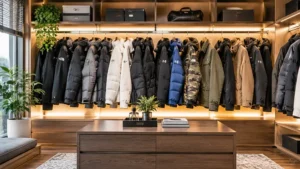
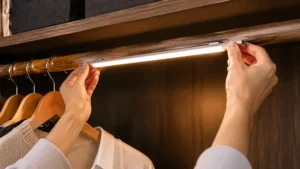
In the first 30 days, the common mistakes are mounting above the shelf lip where the beam is blocked, buying cool white for warm wood interiors, and skipping the dry-fit. One more trick: if the rod is steel, a magnetic bar can cling to its underside as an under-rod closet light, but test the grip first, because a round tube gives a magnet far less contact area than a flat surface.
Real-World Scenarios: Which Closet Rod Light for Hanging Clothes Fits Your Life?
Scenario 1: The renter in a reach-in closet. One 4-foot rail, a landlord who frowns at drill holes, and getting dressed before sunrise. A motion bar like the Mcgor Under Cabinet Lighting or Joyzy Automatic Motion Sensor Closet Lights fits: magnetic or adhesive mounting, no wiring, and the light is on before you reach the door.
Scenario 2: The shared walk-in, opposite schedules. One partner leaves at 5 a.m., the other sleeps in. The Desunlux Battery-Powered Closet Lights add ambient sensing, so lights stay off in daylight and wake only when it’s dark. Its two lengths let you light a long side without overbuying.
Scenario 3: The homeowner finishing a closet remodel. You’re already opening walls. Here the Task Lighting Lighted Closet Rod or a plug-in Lightkiwi Modular LED Under Cabinet Kit gives a finished look with steady power. If your budget is tight, the Litever 12″ Under Cabinet LED Light Bar is a sensible middle path with a visible cord and zero battery upkeep.
Match your scenario to your tolerance: batteries are convenient but need attention; plug-in is dependable but fussier to route; hardwired is the cleanest and costs the most.
✨ Don’t Miss These Closet-Brightening Picks!
🔍 Take your wardrobe from guesswork to glance-and-go with these carefully selected lights. Click any highlighted product name to check current pricing and availability. These tools will help you create a closet where every garment is easy to see and every morning starts smoother!
How to Choose a Closet Rod Light for Hanging Clothes
What should you look for in a closet rod light for hanging clothes? Choose a light that fits your closet’s length, runs on a power source you’ll actually maintain, aims at the garments, and renders color accurately. Then add motion sensing if you want hands-free use.
- Measure your rail. Long rails benefit from multiple shorter bars, which spread light more evenly than one long bar.
- Pick a power type. Battery and rechargeable bars need no outlet; plug-in options never need recharging.
- Check brightness in lumens, not watts. Around 200-300 lumens per bar is common for stick-ons; lighted rods list higher per foot.
- Choose color temperature deliberately. Warm white feels cozy; neutral or cooler white helps with color sorting.
- Look for motion plus ambient sensing. It saves battery and avoids pointless daytime triggers.
- Confirm the mount. Magnet, adhesive, bracket or rod fixture. Match it to your surfaces.
- Check safety listings. UL-listed products carry extra assurance.
Why does motion sensing pair so well with LEDs? As Wikipedia’s LED lamp entry notes, frequent switching does not shorten LED life the way it does with fluorescent tubes, so short on-off cycles aren’t a penalty.
Garment Visibility: What to Expect in Real-World Performance
Garment visibility is the whole game, and it depends on three things: beam direction, shadow control and color rendering. Spec sheets list lumens; your eyes care about where those lumens land.
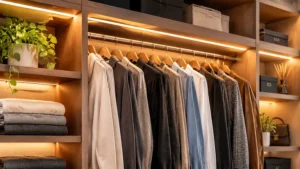
A bar mounted on the shelf above the rail and aimed down-and-back washes the fronts of garments. A bar mounted deep against the back wall lights the wall instead. In practice, the difference is the gap between spotting a stain at the shelf and discovering it in office light.
Expect shadows between tightly packed hangers no matter what. Bars at both ends of a long rail, or a rod-mounted fixture that lights from directly overhead, minimize them. Expect warm white to flatter wood tones and flatten blues; expect cooler white to make whites crisp and wood look cold.
On paper a 300-lumen bar sounds weak next to a 60-watt-equivalent ceiling bulb. But it sits inches from the fabric, so the effective light on the garment is far higher than a distant fixture’s. Patent literature for illuminated rods makes the same observation: ceiling lamps get blocked by the clothes they’re meant to light, wasting energy, while a short-range source avoids that.
Under-Rod Closet Light vs Clip-On Closet Rod Light: Which Mounting Style Works?
Let me be candid: true clip-on closet rod light products are rarer than the keyword suggests. Most closet-friendly bars use magnets, adhesive pads or small brackets, not clips.
Under-rod closet light: The ideal beam position because light falls directly onto garments. The catch is attachment. On a steel rod, a magnetic bar may cling; on wood or aluminum, you need a bracket, a strap or a purpose-built lighted rod. Without a dependable hold, a falling bar becomes a nuisance.
Clip-on closet rod light: A clip or clamp can grip a round rod and be repositioned, which is appealing in theory. In practice, check clip diameter against your rod (commonly around 1-1/4 to 1-3/8 inches) and test load so the bar doesn’t twist and aim at the ceiling.
Shelf-mounted bar: The most common compromise. Lower risk, easier install, and still decent coverage when angled.
Bottom line: if you want the best garment visibility with the least engineering, mount above on the shelf; if you want a clean, built-in look, a lighted rod wins; if you love tinkering, test a magnetic or clip approach first, and keep the receipt.
Clothes Rod LED Light Bar vs Traditional Closet Lighting
| Option | Light on clothes | Install effort | Cost tier | Best For |
|---|---|---|---|---|
| Clothes rod LED light bar (e.g., Mcgor Under Cabinet Lighting) | Direct, close range | Minutes, no wiring | Budget | Renters, reach-ins |
| Ceiling disc or fixture | Overhead, blocked by clothes | Moderate to high | Low to mid | Whole-room lighting |
| LED strip behind the rod | Backlit, accent-style | Moderate (planning needed) | Budget to mid | Custom walk-ins |
| Task Lighting Lighted Closet Rod | Directly above garments | Hardwired | Premium | Remodels |
| Puck lights | Spot pools, uneven | Minutes | Budget | Shelves, corners |
The comparison points to a simple rule: ceiling fixtures light the room, but a clothes rod LED light bar lights the clothes. Strips behind the rod can look stylish, yet closetworld-style guidance notes they work best as accent or backlighting rather than primary task light. Pucks are cheap but leave bright circles and dark gaps.
If your closet already has a decent ceiling light, adding bars is a layering move, not a replacement. If your closet has none, a bar or two usually gives better results per dollar than a new overhead fixture.
Clamp Mount, Rod-Mounted Fixture, and Built-In Lighted Rods
A clamp mount sounds ideal: grip the rod, aim the light, done. The honest picture is mixed. A clamp that fits one rod diameter may slip on another, and a heavy bar can rotate toward the ceiling. Check the clamp range and the bar’s weight before relying on it. Desk-style clamp lamps exist, but one retailer review summary of a bar clamp lamp pointed to brightness as a recurring complaint, which suggests clamp designs aren’t automatically strong lighting.
A rod-mounted fixture solves the problem by being the rod. Manufacturers describe aluminum extrusions with a diffusing lens that supports hanging clothes while washing everything below in even light. Some rod products are sold as 1-3/8 inch outside-diameter luminaires with remote drivers and machined mounting cups, plus intermediate supports for longer spans.
What to verify before buying:
- Load rating. Figures are quoted per foot of rod and vary by maker, so confirm yours.
- Support spacing. Spans beyond about two feet usually want a center bracket.
- Driver location. Remote drivers need a place to live.
- Lens finish. Frosted lenses hide LED dots; clear lenses are brighter but more glaring.
If your wardrobe is heavy with coats, don’t assume a lighted rod carries the same load as a solid steel one. Measure, then buy.
Features That Actually Matter (And Those That Don’t)
Matters: Color rendering. CRI describes how faithfully a light shows colors. According to NIST research on color rendering, CRI is currently the only internationally standardized way to assess it, though critics note it has limits with white LEDs. For a closet, a listing quoting CRI above 80, as the Litever 12″ Under Cabinet LED Light Bar does, is a reasonable floor.
Matters: Beam placement and shielding. Light that glares into your eyes is worse than less light. The Desunlux Battery-Powered Closet Lights earned credit for shielding.
Matters: Sensor logic. Timeout length and daylight sensing change daily life more than a peak lumen number.
Doesn’t matter much: Giant lumen claims. A 300-lumen bar placed correctly outperforms a 1,000-lumen glow placed badly.
Doesn’t matter much: RGB color modes. Fun at parties, useless for choosing socks.
Doesn’t matter much: App control. Unless you want scheduling, it adds friction to a closet you open in two seconds.
Trade-offs exist too. Higher CRI often costs some efficiency, so a spec sheet that boasts both extreme brightness and extreme color accuracy deserves skepticism. Pick what your closet needs: sorting colors, finding a belt in the dark, or just not stubbing toes.
Common Mistakes When Buying a Closet Rod Light for Hanging Clothes
Buying by lumens alone. A high number aimed at the wall helps nobody. Placement beats peak output.
Ignoring the mounting surface. Magnets need steel; adhesive needs clean, flat, non-textured surfaces. Retail review excerpts for similar bars mention weak magnets and adhesive that didn’t hold, and one rechargeable bar’s reviewers described units falling out from under cabinets.
Trusting every motion sensor. Another retailer thread on a motion bar included a complaint that the sensor triggered when the user was far away but not when moving directly underneath. Sensor angle matters, so test it from the doorway and from under the bar.
Skipping color temperature. The Joyzy Automatic Motion Sensor Closet Lights require choosing upfront. Wrong choice, wrong mood.
Forgetting the cord path. Plug-in bars look tidy until a cable crosses a doorway.
Overbuying length. A single long bar can leave dark gaps; two shorter bars often light better.
Skipping a dry-fit. Spend ten minutes testing with tape; it saves the afternoon you’d spend scraping adhesive.
Safety and Regulations: What Closet Lighting Codes Actually Say
Battery and USB bars mostly sit outside wiring rules, but the logic behind closet codes is worth knowing, and it matters if you hardwire.
According to the IAEI’s UL Question Corner on clothes closet luminaires, NEC 410.16 permits certain types of luminaires in clothes closets, including surface-mounted or recessed LED luminaires with completely enclosed light sources. It also allows surface-mounted fluorescent or LED luminaires identified as suitable for installation within the closet storage space. For the latter, the installation instructions must state that suitability.
Two practical takeaways. First, the NEC doesn’t require a closet to have a light at all, but if you install one, 410.16 governs how. Second, open-lamp incandescent fixtures are prohibited in closets, one reason LEDs, which run cool, dominate this niche.
If you’re hardwiring something like the Task Lighting Lighted Closet Rod, confirm closet suitability on the instructions and consult a licensed electrician and your local code. For plug-in options like the Lightkiwi Modular LED Under Cabinet Kit, look for UL listing, avoid overloading outlets, and keep cords away from hanging fabric.
Long-Term Cost and Maintenance: Which Closet Rod Light Really Costs Less?
| Tier | Example | Upfront range | Ongoing cost | Value verdict |
|---|---|---|---|---|
| Battery bars | Desunlux Battery-Powered Closet Lights | Around $20 each | Batteries over time | Cheap start, small recurring cost |
| Rechargeable bars | Mcgor Under Cabinet Lighting | Budget tier | Charging time | Best convenience-to-cost balance |
| Plug-in bars | Litever 12″ Under Cabinet LED Light Bar | Around $16 | Pennies of electricity | Lowest long-run hassle |
| Modular plug-in | Lightkiwi Modular LED Under Cabinet Kit | Roughly $25-$60 | Pennies of electricity | Cleanest non-hardwired look |
| Lighted rod | Task Lighting Lighted Closet Rod | Low $100s to $400s+ | Electrical install | Best for remodels |
The analysis is straightforward: stick-on battery bars win on day-one cost but cost attention forever. One roundup warned that battery-only options get expensive fast if you replace cells every few months. Rechargeables fix that, though their roughly 10-day battery life in testing means a charging routine.
Plug-in bars lose the battery chore and gain a cable. Total cost of ownership, including your time, often favors plug-in or rechargeable models. Maintenance is light everywhere: wipe lenses with a dry cloth, recheck adhesive every few months, and replace adhesive pads rather than forcing a drooping bar back up.
FAQ: Closet Rod Light for Hanging Clothes
❓ What is the best closet rod light for hanging clothes without drilling?
❓ Can a magnetic closet light bar attach to a metal clothes rod?
❓ How many lumens does a closet rod light for hanging clothes need?
❓ Is a battery or plug-in clothes rod LED light bar cheaper to run?
❓ Do closet lights need to be UL listed?
Conclusion: Light the Clothes, Not Just the Closet
A good closet rod light for hanging clothes is a small purchase with an outsized payoff: faster mornings, fewer wardrobe mix-ups and fewer dark corners. The pattern across these seven picks is consistent. Convenience lives with the motion-sensing bars like the Mcgor Under Cabinet Lighting, Joyzy Automatic Motion Sensor Closet Lights, Desunlux Battery-Powered Closet Lights and Brilliant Evolution BRRC113. Steady power belongs to the Litever 12″ Under Cabinet LED Light Bar and Lightkiwi Modular LED Under Cabinet Kit. The polished, permanent answer is the Task Lighting Lighted Closet Rod.
My short rule: renters start with a rechargeable motion bar, daily-use closets lean plug-in, and remodelers consider a lighted rod. Whatever you pick, dry-fit it, aim it at the clothes, and mind the mounting surface. Also keep your expectations honest: where I couldn’t verify customer reviews, I said so, so lean on current listings and recent buyer feedback before you commit.
✨ Ready to brighten your closet?
🔍 Click any highlighted product above to check current pricing and availability, and give your wardrobe the light it deserves! 💡
Recommended for You
- Wireless Motion Sensor Closet Light: 7 Proven Picks For 2026
- Motion Sensor Closet Light Battery Operated: 7 Best Picks (2026)
- LED Closet Light For Walk-In Closet: 7 Best Picks 2026
Disclaimer: This article contains affiliate links. As an Amazon Associate, I earn from qualifying purchases. If you purchase products through these links, we may earn a small commission at no additional cost to you.
✨ Found this helpful? Share it with your friends! 💬🤗
