
In This Article
You know the moment. It’s 6:40 a.m., you’re hunting for the navy sweater, and the single bare bulb overhead has turned your walk-in closet into a cave of suspicious shadows. Black pants look navy. Navy looks black. Somebody leaves the house in one brown shoe and one black one. That’s not a wardrobe problem. It’s a lighting problem.
The right LED closet light for walk-in closet spaces fixes it fast, and without the sticker shock of a full remodel. A walk-in is a strange room: deep, narrow, packed with surfaces that swallow light. One ceiling fixture rarely reaches the back corner or the lower shelves. Layering a few lights does, and that layering is what this guide is about.
I researched real products and real reviewer sentiment, and I’m not claiming I installed any of them myself. This guide covers seven genuinely different ways to light a closet, from hardwired ceiling fixtures to peel-and-stick motion bars. It also explains what the numbers mean in practice. One example is color rendering, which the U.S. Energy Information Administration describes as how faithfully a light depicts colors, including skin tones. That matters more in a closet than almost anywhere else in the house.
Prices below are ranges, never exact figures. They shift constantly, so check current listings before you buy.
Quick Comparison Table: LED Closet Light for Walk-In Closet Options
Here’s the fast version before the deep dive. All seven options are real, currently sold products, and the specs come from listings and published reviews.
| Product | Type | Power / Install | Standout Spec | Price Range | Best For |
|---|---|---|---|---|---|
| Lithonia FMLWL 24 840 | Ceiling wraparound | Hardwired | 1,200 lumens, 4000K | Under $50 | Bright overhead base layer |
| Maxxima Hardwired LED Strip | Hardwired strip | Hardwired | Strong, permanent output | Mid-range | Permanent built-in look |
| Hyper Tough 18″ Linkable Under Cabinet Light | Linkable bar | Plug-in | 925 lumens, linkable | Around $15 | Shelf runs and linking |
| Govee White LED Strip Lights (16.4 ft) | LED strip | Plug-in 12V | 2,000 lumens total | Budget | Shelf edges and rods |
| MCGOR 14.7″ Motion Sensor Light | Rechargeable bar | USB-C battery | 5 dimming levels | Budget | Larger closets, no wiring |
| EZVALO 5-Pack Motion Sensor Lights | Rechargeable bars | Battery + remote | Timer and dimming | Budget | Many zones, one purchase |
| Desunlux Battery-Powered Closet Lights | Battery bars | Battery | Pack of three | Budget | Renters, quick upgrades |
The table shows a clear split. The two hardwired options win on brightness and permanence, while the battery bars win on speed and zero electrical work. The Hyper Tough and Govee sit in the middle, offering real output for very little money as long as an outlet is nearby. If you only buy one thing, make it the overhead Lithonia, then add shelf light where the shadows persist.
💬 Just one click — help others make better buying decisions too!😊
Top 7 LED Closet Light for Walk-In Closet Picks: Expert Analysis
1. Lithonia FMLWL 24 840 — brightest hardwired overhead fix
Every good closet starts with a base layer, and this is a strong one. The Lithonia FMLWL 24 840 is a 2-foot low-profile wraparound with an enclosed polycarbonate diffuser, rated around 1,200 lumens at 4000K. In practice, that neutral-white 4000K reads clean and clear without the hospital chill of 6500K. The enclosed lens also matters for code, which I’ll cover in the safety section.
Based on the spec comparison, 1,200 lumens comfortably handles a standard walk-in of roughly 6 by 8 feet, and a second unit would cover a longer closet. It’s also listed as UL and CSA certified and damp rated. That makes it a sensible choice for a bathroom-adjacent closet. The catch is obvious: it needs a junction box or an existing fixture to replace.
Reviewer sentiment on wraparound fixtures like this one generally praises even coverage and simple swap-in installation. I couldn’t verify a large pool of reviews specific to this exact model, so treat that as a category-level pattern.
Pros:
- ✅ 1,200 lumens floods the whole closet
- ✅ Enclosed diffuser avoids glare and hot spots
- ✅ UL and CSA listed, damp rated
Cons:
- ❌ Requires hardwiring or an existing ceiling box
- ❌ Casts no light into deep lower shelves
Price range: under $50 at the time of research. For a bright closet ceiling light LED anchor, that’s a bargain.
2. Maxxima Hardwired LED Light Strip — most polished permanent upgrade
If wireless bars feel flimsy to you, this is the grown-up option. Bob Vila’s testing team called the Maxxima Hardwired LED Light Strip a clear step up in brightness and permanence over wireless bars or pucks. That’s a reviewer’s framing, but it matches the physics. Hardwired power means no batteries to charge, no adhesive to fail, and no dimming as cells drain.
What does that mean for you? Install it along the front edge of a ceiling or soffit and it washes light down across hanging clothes, which is exactly where a single center fixture fails. Aimed at shelves, it behaves like a clean, continuous under-shelf glow.
The tradeoff is labor. Hardwiring means either an electrician or real comfort with household wiring, and in some homes it triggers permit questions. For a new build or a full closet renovation, that’s easy to justify. For a rental, skip it.
Pros:
- ✅ Permanent, consistent output with no batteries
- ✅ Clean, built-in look when wired properly
- ✅ Stronger brightness than wireless bars
Cons:
- ❌ Needs hardwiring, so not renter-friendly
- ❌ Higher upfront cost than plug-in strips
Price range: mid-range, so check current price. The value verdict: worth it if you’re renovating, overkill if you’re not.
3. Hyper Tough 925 Lumen 18″ Under Cabinet Light — best linkable value
Here’s the sleeper of the group. The Hyper Tough 925 Lumen 18″ LED Slim Under Cabinet Light is linkable, meaning you chain several fixtures from one power source. That solves a real walk-in problem: running lights along three walls without three outlets.
At 925 lumens per 18-inch bar, this is considerably brighter than the battery bars in this list. Link two or three along a shelf run and you’ve built a proper task-lighting line for roughly the cost of a sandwich lunch. Retail listings show it as a best seller at around 4.6 out of 5 stars across about 450 reviews, though ratings from a single retailer should be read with caution.
The compromise: it’s a plug-in cord setup. You’ll need outlet access and a plan for hiding the cable, which I’ll address in the usage guide.
Pros:
- ✅ Linkable design chains several bars together
- ✅ 925 lumens beats most battery options
- ✅ Very low cost per foot of light
Cons:
- ❌ Needs outlet access and cable management
- ❌ Fixed color temperature, so choose carefully
Price range: around $15 per bar at the time of research. Excellent value.
4. Govee White LED Strip Lights (16.4 ft) — best LED strip light for closet shelves
When someone asks for an LED strip light for closet shelves, this is the shape of what they usually mean. The Govee White LED Strip Lights run 16.4 feet with 300 LEDs and a listed output of about 2,000 lumens on a plug-in 12V supply. A roll that long can wrap the front edge of several shelves in one go.
Strips behave differently than bars. They give edge-to-edge, shadow-free light, so a folded sweater at the back of a shelf is actually visible. Reviewers on listings repeatedly cite the strong brightness as the headline strength. The weak spot is the adhesive. On textured or dusty surfaces, strips can peel, so clean with isopropyl alcohol first and add small clips for insurance.
A reminder from the spec sheet: total lumens are spread across 16 feet, so per-foot output is modest. That’s ideal for glow, less so for primary light.
Pros:
- ✅ Even, shadowless light along shelf edges
- ✅ Cuttable length fits odd shelf runs
- ✅ Strong total output for the cost
Cons:
- ❌ Adhesive can fail on rough or dusty surfaces
- ❌ Needs a plug-in power supply and cable routing
Price range: budget tier, so check current price. A fine value for shelf accent light.
5. MCGOR 14.7″ Rechargeable Motion Sensor Light — wireless option for larger closets
Most battery closet bars run 8 to 10 inches. The MCGOR 14.7-Inch Motion Sensor Light stretches longer, which gives noticeably broader coverage. Listings describe a 2,500mAh battery, five dimming levels, magnetic mounting, and a 120-degree detection range, and one review roundup cites about 180 lumens and USB-C charging.
Think of it as a polite doorman: it lights up when you walk in and clicks off when you leave. That’s genuinely useful when your arms are full of laundry. The five brightness levels also let you trade runtime against brightness, which is a feature worth using.
One honest caveat: 180 lumens is task-light territory, not overhead floodlight. Pair it with an overhead fixture for best results. A review roundup that gave this model a 4.7 rating is one source among several, so verify recent buyer feedback yourself before purchasing.
Pros:
- ✅ Longer 14.7-inch body covers more shelf
- ✅ Five brightness levels extend battery life
- ✅ Magnetic mounting needs no wiring
Cons:
- ❌ Output suits task lighting, not primary light
- ❌ Battery needs periodic USB-C charging
Price range: budget tier. Strong value for renters.
6. EZVALO 5-Pack Motion Sensor Lights — most zones for the money
Five lights in one box is how you cover a big closet without rationing them. The EZVALO 5-Pack lists 2,400mAh batteries, 6500K light, dimming, a timer, magnetic mounting, and a remote control. A rotatable sensor head, which one roundup mentions, helps aim detection toward the doorway.
Here’s why that remote matters. Battery lights hidden up high or behind shelves are annoying to reach for adjustments. A remote lets you tune brightness without climbing a step stool. Meanwhile, the timer helps prevent lights from staying on after a false trigger.
The cool-white 6500K output is the main thing to weigh. It’s crisp, but it can make warm wardrobes look a little clinical. If your clothing leans earthy and warm, that may bother you. Reviewers note good value for the count, with the usual battery-light caveat of recharging every few weeks depending on use.
Pros:
- ✅ Five lights cover multiple closet zones
- ✅ Remote adjusts brightness without ladders
- ✅ Timer and dimming add real control
Cons:
- ❌ 6500K can feel cold with warm clothing
- ❌ Five batteries means five charging chores
Price range: budget tier. Great per-light value.
7. Desunlux Battery-Powered Closet Lights — easiest no-tools upgrade
Bob Vila’s testers named the Desunlux Battery-Powered Closet Lights their best wireless pick, calling the three-pack a polished upgrade over puck lights without the cost of hardwired fixtures. The review also notes you must pick your color temperature upfront, which matters because you can’t change it later.
That’s the honest tradeoff. You get quick, tidy lighting for three zones, but you commit to a color temperature at checkout. If you’re unsure, choose a neutral white rather than very warm or very cool.
Compared to puck lights, bars spread light across a longer surface instead of a single hot dot. For a closet with a long hanging rod, that’s a notable improvement. Battery life depends on use, and I could not verify exact runtime numbers, so assume periodic recharging or battery swaps.
Pros:
- ✅ Three-pack covers three zones immediately
- ✅ Better coverage than basic puck lights
- ✅ No wiring, drilling, or outlets needed
Cons:
- ❌ Color temperature is fixed at purchase
- ❌ Battery maintenance never goes away
Price range: budget tier. A solid value for renters and starter setups.
Closet Zoning for Walk-In Closets: A Practical Usage Guide
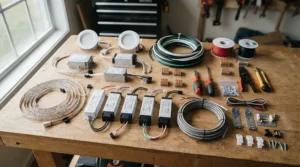
Closet zoning means treating your walk-in as a set of lighting jobs rather than one big room. It’s the difference between a closet that’s technically lit and one that actually works.
Think in three layers. First, ambient: the overhead fixture that gets you in and out, such as the Lithonia FMLWL 24 840. Second, task: lights aimed at the hanging rod, shelves, and drawers, handled by bars like the Hyper Tough or MCGOR. Third, accent: soft glow on shoes, bags, or a mirror, where strips like the Govee shine.
Here’s a simple setup sequence:
- Map your closet on paper and mark where you actually look: rod, shelves, shoes, mirror.
- Install the ambient layer first, then live with it for two days.
- Add task lights wherever shadows persist, usually deep corners and low shelves.
- Add accent lighting last, and only if you want it.
Aim lights slightly forward of the shelf edge, not straight down, to avoid glare on shiny packaging. Place motion sensors near the door side, so they trigger as you walk in. In the first 30 days, the common mistakes are mounting too high, ignoring cable routing, and choosing different color temperatures across zones. Pick one white and stay with it.
Maintenance is light but real. Wipe dust off diffusers every few months. Recharge battery bars on a calendar reminder rather than waiting for them to die mid-search.
Real-World Scenarios: Matching Lights to Real Closets
Specs only matter in context. Here are three profiles, so you can see how the logic plays out.
The renter with a 5 by 7 closet. No hardwiring allowed, limited outlets, and a six-month horizon. A pack of EZVALO or Desunlux lights gives motion-activated coverage in an afternoon. Total effort: a few minutes per light, plus a charging habit. Peel-and-stick bars also leave minimal evidence when you move out.
The homeowner finishing a 9 by 10 primary closet. Budget is flexible and the walls are open. Here, the Lithonia overhead plus a Maxxima hardwired strip creates a permanent, clean look, with the Hyper Tough linkable bars running along shelf walls. Daily use is heavy, so the lack of batteries is a real quality-of-life win.
The shoe collector with a long, narrow closet. Floors and lower shelves are the shadow zones. A Govee strip along shoe-shelf edges, paired with one MCGOR bar near the door, gives light exactly where it’s needed. Frequent use favors plug-in strips here, because battery cycling would get old fast.
Problem → Solution Guide for Closet Lighting
Problem: The back corner is still dark. Add a task light aimed into that corner rather than brightening the ceiling. A 14.7-inch bar like the MCGOR can do this job without wiring.
Problem: Colors look off, and black socks look brown. Check color rendering. A low-CRI light distorts colors, and the choice between 3000K and 5000K also changes the perception. Aim for neutral white and check whether the listing publishes CRI.
Problem: Battery lights keep dying. Lower the brightness level, shorten the sensor timeout, and relocate sensors away from foot traffic that triggers them needlessly. The five dimming levels on the MCGOR exist for precisely this reason.
Problem: Strip lights peel off. Clean the surface with isopropyl alcohol, press firmly for 30 seconds, and add plastic clips every foot or so.
Problem: Visible cables ruin the look. Use adhesive cable channels and route cords behind shelf edges. For Hyper Tough bars, link them in sequence so only one cord reaches the outlet.
What Is an LED Closet Light for Walk-In Closet Spaces?
An LED closet light for walk-in closet use is a low-heat, energy-efficient fixture, strip, or bar designed to brighten clothing storage areas. It can be hardwired, plug-in, or battery-powered, often with motion sensing or dimming, and typically layers overhead and shelf lighting for even, shadow-free visibility.
The “walk-in” part matters. Compared to a reach-in closet, a walk-in has more depth, more surfaces, and more shadow, so one light rarely suffices. LED matters because it runs cool and sips power, which is especially valuable around fabric. Wikipedia’s explainer on the color rendering index is a useful primer on why color accuracy varies between LED products.
How to Choose an LED Closet Light for Walk-In Closet Projects
Use this seven-step checklist:
- Measure your closet. Length, width, and ceiling height decide how many fixtures you need. Bigger spaces need layered light.
- Pick your power style. Hardwired for permanence, plug-in for balance, battery for flexibility. Rentals favor battery and plug-in.
- Check lumens, not watts. Lumens measure brightness. A 1,200-lumen overhead covers a standard walk-in; bars at 100 to 200 lumens are task lights.
- Choose color temperature. Around 3000K feels warm, 4000K neutral, and 5000K to 6500K crisp. Stay consistent across the closet.
- Look at CRI. Aim for 80 or higher; 90 or higher is better if color matching matters to you.
- Decide on controls. Motion sensors, remotes, timers, and dimming change daily convenience more than you’d expect.
- Confirm safety listing. Look for UL or similar listings, and check closet clearance rules for anything near stored items.
Features That Actually Matter (And Those That Don’t)
Dimmable LED: worth it, with caveats
Dimmable LED control matters more in a closet than people expect. Bright full power helps you hunt for things at midday. Low dim helps at 5 a.m. without waking a partner. On battery models, dimming also stretches runtime, so it’s a double benefit. For hardwired fixtures, confirm the driver and dimmer are compatible, or you’ll get flicker.
Bright closet ceiling light LED: the foundation
A bright closet ceiling light LED sets the stage for everything else. Without a solid overhead layer, accent lights end up doing a job they weren’t designed for. A single well-chosen fixture like the Lithonia often does more for visibility than five stick-on bars.
Linkable LED strips: smart for wiring-averse people
Linkable LED strips and bars let you chain multiple lights from one outlet. That matters in a walk-in, where outlets are typically scarce. The Hyper Tough is the clearest example here. Check the maximum link count before buying, since exceeding it can overload a driver.
What you can skip
Skip RGB color effects unless you truly want them; they rarely improve usability. Also skip ultra-high lumen claims on tiny pucks, since the numbers often reflect best-case measurements. And ignore “lifetime” ratings that don’t specify conditions.
LED Closet Lighting vs Traditional Alternatives
Traditional closet lighting usually means a bare incandescent bulb or a pull-chain fixture. LED beats both on nearly every axis: lower energy use, less heat, and longer life. One industry-oriented source estimates switching to LED can cut energy use in a walk-in by up to 80% compared with incandescent or halogen bulbs, though your actual savings depend on bulb wattage and hours of use.
| Feature | LED Closet Lighting | Traditional Bare Bulb | Best For |
|---|---|---|---|
| Heat output | Low, safer near fabric | High | LED for clothing storage |
| Energy use | Very low | Higher | LED for long-term savings |
| Lifespan | Long, often tens of thousands of hours | Short | LED for low maintenance |
| Light distribution | Strips, bars, and overheads | Single point | LED for layered coverage |
| Upfront cost | Low to moderate | Very low | Bare bulb only for temporary fixes |
The takeaway is plain. A bare bulb wins only on upfront price, and even that advantage disappears after you replace a few bulbs. For clothing storage specifically, lower heat is a real safety bonus.
Long-Term Cost & Maintenance: Is a Walk-In Closet Lighting Kit Worth It?
A walk-in closet lighting kit, meaning a bundled set of bars or strips, tends to cost less per light than buying singles. The EZVALO 5-pack and the Desunlux three-pack are prime examples. The tradeoff is flexibility, since kits often share one color temperature and style.
Here’s a simple total-cost frame. Battery lights are cheap upfront but cost you attention: charging, replacing, and occasional cell failure. Plug-in options like the Hyper Tough and Govee cost a bit more in cords and cable management but nearly nothing in upkeep. Hardwired fixtures cost the most to install and the least over a decade.
| Setup | Upfront Cost | Ongoing Effort | Best For |
|---|---|---|---|
| Battery kit | Low | Regular charging | Renters |
| Plug-in strips and bars | Low to moderate | Minimal | Most homeowners |
| Hardwired fixtures | Moderate to high | Almost none | Renovations |
Looking at the table, plug-in setups are the sweet spot for most households, while hardwired wins only for people who value set-and-forget. If you’re undecided, start with one Hyper Tough bar and test the result before expanding.
Common Mistakes When Buying LED Closet Lights
Buying only battery bars. They’re convenient, but at 100 to 200 lumens each, they don’t replace overhead light.
Mixing color temperatures. A warm strip next to a cool bar looks patchy, and clothing colors shift between zones.
Ignoring CRI. Bright isn’t the same as accurate. A harsh, low-CRI light can make a navy suit look black.
Forgetting about clearance. Fixtures too close to stored items can create real fire-safety concerns. See the next section.
Skipping the layout plan. Buying first and planning later usually results in dark corners and extra returns.
Safety and Code Considerations for Closet Lighting
Closets are one of the few places the National Electrical Code gets specific about luminaires. Lighting isn’t required, but if you install a fixture, there are placement rules. According to a municipal handout summarizing the code, surface-mounted fixtures should keep at least 12 inches of clearance from the nearest point of the closet storage space. It also notes that surface-mounted LED luminaires may be installed within the storage space only when identified for that use.
The logic is simple: keep hot parts away from clothing, boxes, and paper. LEDs run far cooler than incandescent bulbs, which is why enclosed, closet-rated LED fixtures are now widely accepted. Practical steps:
- Choose fixtures explicitly marked suitable for closets.
- Keep bare strips and bars off stored items where possible.
- Check your local code office, because rules vary by jurisdiction.
- Use hardwired fixtures only with proper permits or a licensed electrician.
Battery and low-voltage strips generally sidestep much of the wiring complexity, but they still should not rest against flammable stacks.
FAQ
❓ How many lumens do I need for a walk-in closet?
❓ Is motion sensor lighting good for a walk-in closet?
❓ What color temperature is best for a closet?
❓ Can I install closet LED strips on a rental?
❓ Do LED closet lights get hot?
Conclusion
Closet lighting rewards layering. Start with a bright overhead fixture, add task lights where shadows hide, and finish with a little accent glow if you want one. The Lithonia FMLWL 24 840 handles the foundation, the Hyper Tough and Govee cover shelves affordably, and the MCGOR, EZVALO, and Desunlux bars give renters real options without a single wire.
If you’re renovating, the Maxxima hardwired strip is worth a look. If you’re renting, a battery kit gets you most of the benefit in an afternoon. Whichever route you choose, keep color temperature consistent, check clearance rules, and plan your zones before you stick anything to a wall. A well-lit LED closet light for walk-in closet setup is one of those small upgrades you notice every single morning, usually right around the time you find the navy sweater on the first try.
✨ Ready to light up your closet?
🔍 Click on any highlighted product above to check current pricing and availability, then pick the setup that matches your space. Your mornings will thank you!
Recommended for You
- LED Closet Light For Small Closet: 7 Brilliant Picks (2026)
- Motion Sensor Closet Lights: 7 Best Picks
- Dimmable Bedside Table Lamp For Reading In Bed: 7 Smart Picks (2026)
Disclaimer: This article contains affiliate links. As an Amazon Associate, I earn from qualifying purchases. If you purchase products through these links, we may earn a small commission at no additional cost to you.
✨ Found this helpful? Share it with your friends! 💬🤗
