
In This Article
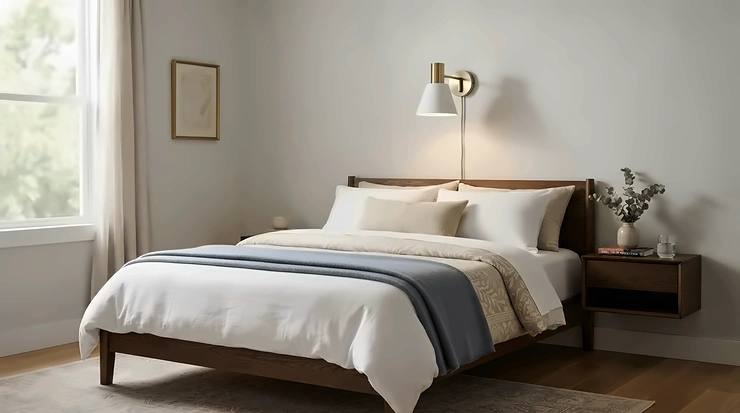
Every couple knows the standoff. One person wants to finish chapter twelve; the other wants darkness, immediately, in the name of marriage. The nightstand lamp, bless its shade, floods the whole room in the process. A wall-mounted reading light for bed breaks the stalemate by doing something deceptively simple. It puts a small, aimable pool of light on the page and nowhere else.
That’s the whole pitch, and it’s why this category keeps taking over bedrooms in 2026. Your nightstand gets its surface back. Your phone gets a charging port on many models. Your partner gets to sleep. And the light sits at shoulder height instead of hovering at hip level like a nervous houseguest.
This guide compares seven real, currently listed options across budget, mid-range, and premium tiers. They range from gooseneck units you can fit in an afternoon to a hardwired bedside reading sconce you can hand to an electrician. Everything here rests on published specs and aggregated reviewer sentiment, not invented hands-on claims. Prices drift constantly, so treat every price range below as approximate and check the current listing.
What Is a Wall-Mounted Reading Light for Bed?
A wall-mounted reading light for bed is a fixed or semi-fixed fixture, usually with a gooseneck or swing arm, that attaches to the wall or headboard and aims a focused beam at your book or tablet. It frees nightstand space and limits light spill, following the basic task-lighting principles of putting light where the job is, not everywhere else.
Quick Comparison: Wall-Mounted Reading Light for Bed Options at a Glance
| Product | Type | Power | Standout Spec | Approx. Price Range | Best For |
|---|---|---|---|---|---|
| SANKEDOU LED Wall Mounted Reading Light | Gooseneck, wall plate | Cord + USB output | 60° beam, 5 dim levels, 3000K–6000K | Budget ($20–$40) | Couples sharing a bed |
| NoeiiT Wall Mounted Reading Light | Gooseneck | Cord + USB output | 36 LEDs, night-light mode | Budget ($20–$35) | Tight budgets |
| MOLUOLA LED Wall Lamp (Set of 2) | Plug-in headboard sconce | Plug-in | USB-C + USB-A, 9W + 3W night light, 3000K | Mid-range ($80–$110 per pair) | Both sides of a double bed |
| VATONI Brushed Brass Swing Arm Sconces | Swing arm, globe shade | Plug-in or hardwired | Dimmer knob, 2 bulbs included | Mid-range ($40–$75) | Dimmable mood plus reading |
| CADUKE Plug in Wall Light Set of 2 | Swing arm, fabric shade | Plug-in or hardwired | 270° arm, soft diffused glow | Mid-range ($35–$70) | Soft, shadow-free ambiance |
| Kira Home Cambridge Swing Arm Sconce | Swing arm | Plug-in or hardwired | 3-way bulb compatible, UL listed | Mid-to-premium ($60–$125) | Long reach, flexible wiring |
| George Kovacs Reading Room LED Swing Arm | Swing arm | Plug-in | 3000K, 84 CRI, about 24 in. reach | Premium ($250–$330) | Built-in LED quality |
Looking at the comparison above, SANKEDOU and NoeiiT win on price and USB convenience, but only SANKEDOU advertises a 60° beam, which is what protects a sleeping partner. The MOLUOLA pair and the swing-arm sconces from VATONI, CADUKE, and Kira Home Cambridge trade a tighter beam for softer, more decorative light. At the top, George Kovacs Reading Room costs several times more, which only makes sense if you want built-in LED quality and long reach rather than a bargain.
💬 Just one click — help others make better buying decisions too!😊
Top 7 Wall-Mounted Reading Lights for Bed: Expert Analysis
Each pick below gets the same treatment: what stands out, what the specs mean in practice, who it suits, what reviewers keep saying, and an honest price tier. Listings and wiring variants change, so confirm the details on the current listing before you buy.
1. SANKEDOU LED Wall Mounted Reading Light — narrowest beam for shared beds
The headline here is a 60° narrow beam, the kind of tight cone that keeps light on your page and off your partner’s pillow. In a category full of floodlights wearing a gooseneck, that discipline is rare.
Translated from the spec sheet: five dimming levels and five color temperatures spanning roughly 3000K to 6000K let you read warm at 10 p.m. and go cooler for a daytime paperback session. Two timer settings handle the fall-asleep-mid-chapter problem, and the USB output charges a phone without hogging an outlet. The lamp head rides on a bendable gooseneck arm, so you can aim it from a seated or reclined position.
Here’s the honest take: this suits couples with mismatched bedtimes and renters who want a headboard-level light without calling an electrician. What the spec sheet won’t tell you, but roundups repeatedly raise, is leverage. A gooseneck is a lever, and tugging it can stress drywall anchors. Hit a stud or use sturdy anchors, because adhesive mounting may struggle on textured walls.
Aggregated review sentiment across several roundups is broadly positive. Beam focus and the timer earn the most praise, while mounting stability draws the most caution. Review counts weren’t consistently verifiable across listings, so treat that as a theme rather than a score.
Pros:
- ✅ Narrow 60° beam protects a sleeping partner
- ✅ Five dim levels plus wide color-temperature range
- ✅ Timer and USB output add everyday convenience
Cons:
- ❌ Gooseneck leverage can loosen weak wall anchors
- ❌ Adhesive mounting may fail on textured walls
Roughly the $20–$40 range; check current price. Strong value if you mount it into a stud.

2. NoeiiT Wall Mounted Reading Light — budget pick with a built-in night light
The standout feature is the built-in night-light mode, which turns one fixture into both a reading lamp and a gentle path light for midnight bathroom trips.
On paper, it offers five color temperatures, five dimming levels, a USB output, a timer, and a 36-LED array. That LED count deserves a skeptical eye. More diodes usually means a wider, softer spread than the tighter, lower-count design on SANKEDOU, so this one is better at gently filling your corner of the bed than at carving out a sharp circle of light. The listed beam angle is the number to compare before you buy.
Who is it for? Budget shoppers, dorm dwellers, and anyone who wants a nightstand-free setup without spending much. If you sleep alone, the wider spread barely matters. If your partner is a light sleeper, it matters a lot, so aim the head downward and run it at a low dim level.
Reviewer sentiment in roundups frames it as the sensible low-cost option, valued for the night light and USB output. Cautions mirror the rest of the gooseneck class: it works best on a solid, flat surface, and adhesive-only mounting isn’t ideal on textured walls. As always, a verified review count wasn’t available across listings.
Pros:
- ✅ Night-light mode adds real bedroom utility
- ✅ Five color temperatures and five brightness steps
- ✅ USB output and timer at a budget tier
Cons:
- ❌ High LED count suggests a broader beam
- ❌ Mounting stability depends on your wall surface
Roughly the $20–$35 range; check current price. Good value for solo sleepers.
3. MOLUOLA LED Wall Lamp (Set of 2) — matched pair with USB-C and a night-light mode
The standout is the matched pair. Two plug-in headboard sconces mean each side of the bed gets its own switch, its own aim, and its own opinion about bedtime.
Each unit pairs a 9W reading light with a separate 3W night light, both at a warm 3000K, which is the right color for evening reading. USB-C and USB-A ports mean a modern phone and an older tablet can charge from the same wall. The two light functions run independently, so you can leave the soft glow on while the reading beam sleeps.
This is the best fit for a shared double or queen bed where both people read. One lighting roundup that physically compared options named it the best wall-mounted solution it found, while noting that the pair isn’t cheap. That’s a fair read: you’re paying for two fixtures, dual USB, and a finish that looks intentional rather than improvised.
The trade-offs are practical. It needs a nearby outlet for the cord, and the fixed warm color means no cool-white option for daytime tasks. For bedtime that’s a feature, not a flaw.
Pros:
- ✅ Two fixtures cover both sides of the bed
- ✅ USB-C and USB-A ports on the unit
- ✅ Separate reading and night-light functions
Cons:
- ❌ Costs more than single gooseneck units
- ❌ Fixed 3000K, with no cool-white option
Roughly the $80–$110 range for the pair; check current price. Fair value for two.
4. VATONI Brushed Brass Swing Arm Sconces — dimmer knob and bulbs included
The standout is the cord-side dimmer knob. Brightness sits within reach, which matters when you’re horizontal and your arm is the only thing still awake.
These plug-in-or-hardwired sconces include two LED bulbs and a swing arm that moves about 180 degrees. In practice, that means you can buy them for a plug-in setup today and have an electrician hardwire them if you remodel later. A bedroom wall-sconce roundup gave them its Editor’s Choice for exactly that combination of built-in dimming, included bulbs, and flexibility.
My analytical caveat is the globe shade. A globe spreads light in many directions, so it’s lovely for ambiance but less disciplined than a narrow-beam gooseneck. Think of it as a dimmable bedside glow that happens to be adjustable, not a laser pointer for paragraphs. For a partner-friendly setup, run it low and angle the arm toward your lap.
Reviewer themes in the roundup coverage focus on the finish, the smooth dimming, and the ease of swapping between plug-in and hardwired use. The practical limits are the 180° swing and the diffuse globe.
Pros:
- ✅ Built-in dimmer knob within reach of the pillow
- ✅ Two LED bulbs included in the box
- ✅ Works plug-in or hardwired
Cons:
- ❌ Globe shade spreads light rather than focusing it
- ❌ Swing range is narrower than some rivals
Roughly the $40–$75 range for a pair; check current price. Good value for dimmable ambiance.
5. CADUKE Plug in Wall Light Set of 2 — 270° swing arm with a soft fabric glow
The standout is the generous 270° arm range paired with a fabric shade that diffuses light into a soft, shadow-free glow.
That diffusion is the key trade-off. A fabric shade smooths out harsh edges and glare, which is gentle on tired eyes at the end of the day. But it also means the light is more ambient than directional. If your priority is a tight spotlight, this isn’t the tool. If you want an adjustable wall reading light for your bedroom that doubles as warm mood lighting, it’s a very good one.
Like the VATONI sconces, it works plug-in or hardwired, so it adapts to a rental now and a remodel later. Reviewers consistently point to the soft light as the main appeal. A common complaint is the on/off push button on the wall plate: it’s simple but awkward to reach from bed, and some users wish the switch lived on the cord. You’ll also need an outlet near the bed for the plug-in version.
Pair it with a warm 2700K–3000K LED bulb and you’ll have a lamp that reads like a hotel suite.
Pros:
- ✅ Wide 270° arm movement for aiming
- ✅ Soft fabric diffusion reduces glare
- ✅ Plug-in or hardwired flexibility
Cons:
- ❌ Switch on the wall plate is hard to reach in bed
- ❌ Soft glow offers less partner protection than a narrow beam
Roughly the $35–$70 range for a pair; check current price. Solid value for soft light.

6. Kira Home Cambridge Swing Arm Sconce — long reach and flexible wiring
The standout is reach. Roundups cite an arm that extends about 25 inches, which lets you pull light out over the pillow and then fold it flat against the wall when you’re done.
Under the hood, it works plug-in or hardwired, accepts 3-way bulbs up to 150W (bulb sold separately), and ships with cord covers to hide the plug-in wire. Listings describe it as UL listed for dry locations and smart-plug compatible. In plain English: you can get stepped brightness from a 3-way LED bulb and add schedule control with a smart plug. Just remember the bulb isn’t included.
Who should buy it? Anyone who wants a designer-ish look and the longest reach in the mid-range. A roundup’s editor’s pick cited a large pool of verified reviews. One retailer reviewer mentioned the swing feels tight at first and loosens up after a few adjustments, which is a typical break-in note for friction joints.
The fabric shade, like other shaded sconces here, throws softer light than a bare spotlight. Choose a bulb carefully: warm 2700K–3000K for bedtime, and check the lumen rating, not just the wattage.
Pros:
- ✅ Roughly 25-inch reach across the bed
- ✅ Plug-in or hardwired, with cord covers included
- ✅ Smart-plug and 3-way bulb compatible
Cons:
- ❌ Bulb not included in the box
- ❌ Swing joint can feel stiff at first
Roughly the $60–$125 range depending on pack size; check current price. Strong value for flexibility.
7. George Kovacs Reading Room LED Swing Arm — integrated 3000K LED and a 24-inch reach
The standout is the Reading Room’s integrated 8W LED, listed at about 438 lumens, 3000K, and 84 CRI, on an arm that extends roughly 24¼ inches from the wall.
Those numbers say a lot. Around 438 lumens lands inside the 300–500 lumen window that lighting guides suggest for comfortable page reading. A 3000K color is bedtime-friendly. An 84 CRI clears the 80 baseline, though it falls short of the 90+ that color-sensitive readers prefer. The plug-in style means no electrician, and the integrated LED means you never hunt for the right bulb.
That last point cuts both ways. Integrated LEDs are tidy and consistent, but you can’t swap in a different color temperature, and if the module ever fails, you replace the fixture. This is the premium choice for buyers who value finish and optical design over flexibility.
The review pool is the weak spot. The retailer page I found showed only a single review, 4 out of 5 stars, praising it as a great bedside reader. That’s a data point, not a consensus, so weigh it accordingly.
Pros:
- ✅ About 438 lumens suits comfortable page reading
- ✅ Plug-in installation, no electrician needed
- ✅ Long, flexible arm with an adjustable head
Cons:
- ❌ Premium price versus nearly everything here
- ❌ Integrated LED limits color-temperature swaps
Roughly the $250–$330 range at retailers; check current price. Worth it only if you want this specific design.
Side-by-Side Spec Snapshot
| Product | Arm Style | Color Temp | Wiring | Review Theme | Best For |
|---|---|---|---|---|---|
| SANKEDOU | Gooseneck | 3000K–6000K | Cord + USB | Focused beam; anchor caution | Shared beds |
| NoeiiT | Gooseneck | 5 settings | Cord + USB | Value, night light | Solo sleepers |
| MOLUOLA | Adjustable headboard | 3000K | Plug-in | Premium pair, dual USB | Two readers |
| VATONI | Swing, 180° | Bulb-dependent | Plug-in or hardwired | Dimming praised | Dimmable ambiance |
| CADUKE | Swing, 270° | Bulb-dependent | Plug-in or hardwired | Soft glow; switch location | Soft light |
| Kira Home Cambridge | Swing, long reach | Bulb-dependent | Plug-in or hardwired | Large review pool; stiff at first | Reach, flexibility |
| George Kovacs Reading Room | Swing, ~24 in. | 3000K, 84 CRI | Plug-in | Tiny review sample | Premium finish |
The table makes the real divide obvious: the gooseneck units and MOLUOLA focus light and add USB, while the shaded swing-arm sconces trade focus for softness and wiring flexibility. If you can only remember one rule, pick the SANKEDOU style for tight beams and the Kira Home Cambridge or VATONI style for décor-friendly, dimmable light. George Kovacs Reading Room is the outlier, buying you optical consistency at a steep premium.
Wall Sconce Mounting for Bed Reading Lights: A Step-by-Step Guide
Wall sconce mounting is where good lights go to die, usually crooked and a little too low. Here’s the sequence that avoids both fates.
- Sit up first. Prop yourself against the headboard the way you actually read. Mark a spot a couple of inches above your shoulder. Lighting guides typically land at about 30–36 inches above the top of the mattress, which often works out to roughly 55–60 inches from the floor.
- Paper-template the fixture. Cut cardboard to the back plate, tape it up, and check it from a seated and a lying position. Moving a junction box later costs far more than moving paper now.
- Find a stud or use real anchors. Gooseneck leverage and swing-arm weight pull on fasteners. Drywall needs a stud or heavy-duty toggle bolts, not the plastic anchors from the junk drawer.
- Measure the cord. For a plug-in wall reading light for bed, the cord length decides your maximum mounting height. Measure to the outlet before drilling.
- Test before you commit. Plug in, aim the beam at your page, and then at your partner’s pillow. The second test is the one that keeps the peace.
If you plan to hardwire, switch off the breaker and bring in a licensed electrician for new boxes or in-wall runs. Plug-in wall sconce mounting is a comfortable DIY job, but fixed wiring is not.
Real-World Scenarios: Matching a Wall-Mounted Reading Light for Bed to Your Life
Here are three hypothetical but realistic buyers, matched to products with reasoning.
The renter couple with a queen bed and mismatched schedules. Budget is around $40–$110, the room has textured walls, and one person reads past midnight. The SANKEDOU earns the first look for its narrow 60° beam, but only if you can hit a stud. If you’d rather not mount a gooseneck at all, the MOLUOLA pair gives each side its own plug-in unit and independent night light. Either way, nightly use means the timer and a low dim level are your friends.
The homeowner mid-remodel. Walls are open, an electrician is booked, and you want clean lines with no cords. A hardwired bedside reading sconce makes sense here. The Kira Home Cambridge and VATONI fixtures are both sold as plug-in-or-hardwired designs, and the Kira Home Cambridge‘s longer reach suits a bigger bed. Put the switch within arm’s reach of the pillow.
The print-book purist. You read paperbacks for hours and care about contrast. The George Kovacs Reading Room‘s roughly 438 lumens at 3000K lands right in the comfortable-reading zone, though its 84 CRI sits below the 90+ ideal. If CRI is your priority, a swing-arm fixture with a replaceable high-CRI bulb, like CADUKE, VATONI, or Kira Home Cambridge, gives you more control than any integrated design.
Common Problems and How to Fix Them
Problem: light spills onto your partner. Narrow the beam and lower the brightness. Aim the head down at your lap so your own body blocks stray light, and favor a tighter focused beam angle like the SANKEDOU‘s 60° design.
Problem: glare in your eyes. The fixture is probably too low. Mount it a couple of inches above shoulder height and tilt the head away from your line of sight.
Problem: the arm droops. On swing-arm fixtures, loosen the stud, set the angle, and tighten it again. Some manufacturers specify this process, and Kira Home Cambridge reviewers report the joint loosens with use.
Problem: the wrong wiring variant arrives. Retailer reviewers of hardwired swing-arm sconces have reported receiving plug-in cord versions, and one noted their contractor converted it. Check the listing photos and the “hardwired” versus “plug-in” label before opening the box.
Problem: a tiny switch you can’t find in the dark. Buyers have grumbled about small toggles on wall plates. Look for a cord-side or dimmer-knob switch, like the VATONI‘s, or a touch control.
✨ Don’t Miss These Exclusive Deals!
🔍 Take your bedtime reading to the next level with these carefully selected lights. Click on any highlighted product name to check current pricing and availability. A well-aimed beam turns “one more chapter” into a habit your whole household can live with!
How to Choose a Wall-Mounted Reading Light for Bed
A wall-mounted reading light for bed should deliver focused, dimmable, warm-toned light at a comfortable height. Use these seven steps to narrow the field.
- Decide how it gets power. Plug-in is renter-friendly and quick. Hardwired is cleaner but needs an electrician.
- Check the beam angle. A narrow beam of about 60° keeps light on the page. Wider beams flood the bed.
- Match the color temperature. Aim for 2700K–3000K at night. Government guidance suggests 2700K–3600K for most indoor task lighting, and warmer is gentler before sleep.
- Look at CRI. At least 80 is a floor, and 90+ is ideal. CRI measures how faithfully a source renders colors, and good contrast makes text crisper.
- Target 300–500 lumens on the page. Several lighting guides land in that window. Dimming matters more than raw brightness.
- Pick the arm style. A gooseneck arm is flexible and compact. A swing arm reaches farther and folds flat.
- Check the switch location. If you can’t reach it in the dark, you’ll hate the light by week two.
Rank these by your own situation. A solo sleeper can relax steps 2 and 3, while a couple should treat them as non-negotiable.
Focused Beam Angle: The Spec That Decides Everything
If you remember one number from this guide, make it the beam angle. A focused beam angle determines how much of the bed your light claims.
The geometry is easy to sketch. A beam’s diameter at distance d is about 2 × d × tan(half the angle). With a 60° beam held 24 inches from the page, the circle is roughly 28 inches across, about the width of a newspaper spread. Stretch that to a 120° floodlight at the same distance and the circle balloons to around 83 inches, wider than a king bed’s standard 76-inch width. That, in numbers, is why a partner wakes up.
Shades complicate things. A fabric or globe shade diffuses light, which feels pleasant but widens the effective spread. A bare, narrow-beam LED head gives you the most control, as with SANKEDOU‘s 60° design, while shaded designs like CADUKE and Kira Home Cambridge give a softer envelope.
Practical rule: if your partner is a light sleeper, shop by focused beam angle first and décor second. If you sleep alone, a softer beam is a luxury, not a problem.
Adjustable Wall Reading Light Bedroom: Gooseneck Arm vs Swing Arm
The adjustable wall reading light bedroom market splits into two arm families. Each moves differently and fails differently.
The Gooseneck Arm
A gooseneck arm is a flexible, bendable stalk that holds any position you bend it into. Listings for gooseneck reading lights tout lengths around 15 inches that stay put without sagging. It’s compact, easy to aim from any posture, and ideal for narrow-beam LED heads. The downside is leverage: pulling a bendy lever against a headboard or wall can stress weak anchors, which is why roundups warn about drywall.
The Swing Arm
A swing arm uses hinged joints to pivot out and fold flat against the wall. Many swing-arm sconces advertise roughly 180° horizontal movement and up to 270° of vertical tilt. The Kira Home Cambridge adds long reach, and the CADUKE adds a wide tilt range. The cost is friction joints that may feel stiff at first and loosen over time, so tightening the stud occasionally is part of ownership.
Which Should You Buy?
Choose a gooseneck arm for tight, partner-friendly beams and quick aim changes. Choose a swing arm for reach, a folded-flat look, and shaded, softer light. For maximum adjustability in a small bedroom, a gooseneck arm usually wins. For a larger bed or a decorative scheme, swing-arm sconces make more sense.
Hardwired Bedside Reading Sconce vs Plug-In Wall Reading Light for Bed
This is the great practical fork in the road. Both routes can be excellent, and the right answer usually depends on your walls and your lease.
Plug-In Wall Reading Light for Bed
A plug-in wall reading light for bed is the low-friction option. It mounts to the wall, runs a cord to a nearby outlet, and needs no electrician. It’s perfect for renters, easy to relocate, and often cheaper. The compromises are the visible cord and the need for an outlet near the bed. Cord covers help, as the Kira Home Cambridge includes, and a smart plug can add scheduling.
Hardwired Bedside Reading Sconce
A hardwired bedside reading sconce connects directly to in-wall wiring, hiding the cord and often a wall switch. Many fixtures, including VATONI, CADUKE, and Kira Home Cambridge, are sold in dual plug-in-or-hardwired designs. The wiring should go to a licensed electrician if it involves new junction boxes or in-wall runs. Installer advice from one lighting guide suggests separate switched circuits for each side of the bed so each reader controls their own light.
The Bottom Line
If you rent or want zero commitment, a plug-in design is the easy yes. If you own the home and care about clean lines, a hardwired bedside reading sconce pays you back in tidiness. Watch the fine print either way, because some buyers have received plug-in cords when they expected hardwired.
Wall-Mounted Reading Light for Bed vs Nightstand Lamp vs Clip-On Light
| Feature | Wall-Mounted | Nightstand Lamp | Clip-On Light |
|---|---|---|---|
| Surface space used | None | Takes nightstand space | None, but clamps to something |
| Beam control | High with narrow-beam designs | Often wide, ambient | Medium to high |
| Placement flexibility | Fixed height, adjustable aim | Moves freely | Moves freely |
| Cord clutter | Moderate, can be hidden | Moderate | Often rechargeable |
| Best for | Permanent, tidy setups, like SANKEDOU or MOLUOLA | Ambient glow | Travel, temporary use |
The comparison above shows why wall-mounted lights win for permanent bedrooms: they reclaim the nightstand and let you set a fixed, repeatable reading position. Nightstand lamps remain good for ambient light but tend to spill. Clip-ons are wonderfully portable and a decent trial run before you commit to drilling holes.
Long-Term Cost and Maintenance
Wall-mounted reading lights are cheap to run. An 8W LED used one hour a night draws about 2.9 kWh a year, which costs well under a dollar at typical U.S. electricity rates. LEDs also use far less energy than incandescents and last far longer, a point ENERGY STAR’s bulb purchasing guide makes while steering shoppers toward lumens instead of watts. For reference, about 450 lumens replaces a 40W incandescent and roughly 800 lumens replaces a 60W.
So the real lifetime cost is the fixture, not the electricity. Replaceable-bulb sconces like VATONI, CADUKE, and Kira Home Cambridge let you change color temperature or replace a dead bulb for a few dollars. Integrated designs like the George Kovacs Reading Room are neater but turn a failed LED module into a fixture replacement.
Maintenance is minor: dust the shade monthly, check that mounting screws and swing-arm studs are snug every few months, and replace any bulb that flickers.
Safety, Regulations, and Compliance Guide
Three things keep a bedside light from becoming a hazard: certification, cords, and wattage.
Certification. Look for a listing from a recognized testing laboratory. Retail listings describe the Kira Home Cambridge as UL listed for dry locations, and one gold swing-arm two-pack listing cites ETL certification. A fixture with no certification mark deserves suspicion.
Cords. The Consumer Product Safety Commission’s household cord guidance warns against running cords under carpets or through doorways, and says to replace damaged cords and check for a recognized laboratory listing. Don’t staple or nail a plug-in sconce’s cord to the wall, and avoid chaining extension cords to a bedside light.
Wattage. Respect the bulb limit. One two-pack listing recommends a maximum 12W LED, and another sconce caps bulbs at 60W. Use LED bulbs, which run cooler than incandescents.
For hardwired work, always hire a licensed electrician and follow local code. A hot outlet or wall plate means shut off the circuit and call a professional.

Frequently Asked Questions
❓ Can I use a wall-mounted reading light for bed in a rental?
❓ What bulb wattage does a bedside swing-arm sconce need?
❓ Is a hardwired bedside reading sconce worth the electrician cost?
❓ Will a gooseneck arm sag over time?
❓ Do I need two lights for a double bed?
Conclusion
The best wall-mounted reading light for bed is the one that matches how you live. If you share a bed and want the tightest control, SANKEDOU‘s 60° beam is the focused choice, provided you secure it properly. If you want matched lights for both sides, the MOLUOLA pair delivers dual USB and independent night lights. Prefer soft, dimmable ambiance? VATONI and CADUKE swing-arm sconces trade focus for glow, and both can be hardwired later. Kira Home Cambridge is the long-reach, flexible-wiring pick, NoeiiT is the economical solo option, and George Kovacs Reading Room is the splurge for buyers who want integrated LED polish.
Whatever you choose, remember the fundamentals: warm 2700K–3000K light, roughly 300–500 lumens on the page, a mounting height just above your shoulder, and secure wall sconce mounting. Check current listings before you commit, because wiring variants and prices move.
✨ Ready to Give Your Nightstand Its Retirement Party?
🔍 Tap any highlighted product name above to check current pricing and availability, then pick the light that lets you read and lets everyone else sleep. Your future self, mid-chapter at midnight, will thank you!
Recommended for You
- Bedside Table Lamp For Small Nightstand: 7 Ultimate Picks For 2026
- Modern Bedside Table Lamp For Master Bedroom: 7 Best Picks 2026
- USB Bedside Lamp With Charging Port: 7 Best Picks (2026)
Disclaimer: This article contains affiliate links. As an Amazon Associate, I earn from qualifying purchases. If you purchase products through these links, we may earn a small commission at no additional cost to you.
✨ Found this helpful? Share it with your friends! 💬🤗
