
In This Article
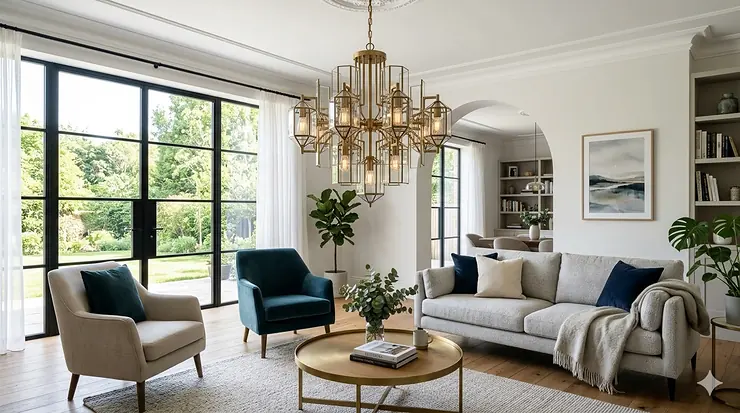
Picture this: you walk into a beautifully furnished living room, but something feels off. The sofa’s positioned perfectly, the artwork’s hung just right, but when you glance up, that chandelier? It’s either swallowed by the ceiling or hanging so low you’re ducking like you’re dodging rain. I’ve been there, and let me tell you—getting your living room chandelier right isn’t just about lighting. It’s about creating that moment when someone walks in and thinks, “This person has their life together.”

The truth is, choosing the right chandelier for your living room involves more than picking something that looks pretty in the showroom. You need to consider room dimensions, ceiling height, furniture placement, and yes, even the personalities who’ll be gathering underneath it. According to lighting design principles, proper fixture selection significantly impacts both functionality and aesthetics. A chandelier that works brilliantly in a 10×12 room will look ridiculously lost in a 20×20 space with vaulted ceilings.
Here’s what most people get wrong: they either go too small (and the fixture disappears into the ceiling like a forgotten afterthought) or too large (turning their cozy living room into an obstacle course). But when you nail the size, placement, and style? Magic happens. The room feels balanced, the lighting creates ambiance rather than glare, and that chandelier becomes the conversation piece you’ve always wanted.
In this guide, I’m walking you through everything you need to know about how to choose living room chandelier that actually works for your space. We’ll cover the mathematical formulas designers swear by, the placement rules that prevent disasters, and real product recommendations across every budget range. Whether you’re working with standard 8-foot ceilings or a dramatic two-story space, you’ll walk away knowing exactly what size chandelier you need and where to hang it.
Quick Comparison Table: Top Living Room Chandeliers at a Glance
| Product | Style | Lights | Diameter | Price Range | Best For |
|---|---|---|---|---|---|
| Yunnix 8-Light Black | Farmhouse | 8 x E12 | 26-30″ | $80-$120 | Budget-conscious buyers |
| TongLan LED Crystal 4-Ring | Modern LED | 67W Integrated | 19.7″ | $150-$200 | Contemporary spaces |
| Vodcrindax Gold Crystal | Luxury Crystal | 10 x E12 | 20″ | $180-$250 | Elegant formal rooms |
| Neorubeo Flower Gold | Floral Design | 6 x G9 | 17″ | $120-$160 | Unique aesthetics |
| WELAKI Chrome Crystal | Versatile Chrome | 6 x E12 | 20″ | $130-$180 | Multi-height installation |
| Modern Sputnik 6-Light | Contemporary | 6 x E26 | 22″ | $60-$90 | Modern minimalist |
| RUIYEY 12-Light Sputnik | Statement Gold/Black | 12 x E26 | 33″ | $140-$190 | Large rooms, high ceilings |
💬 Just one click – help others make better buying decisions too!😊
Top 7 Living Room Chandeliers: Expert Analysis
1. Yunnix 8 Light Black Chandelier – Best Budget Farmhouse Style
If you’re after that modern farmhouse vibe without liquidating your savings account, the Yunnix 8 Light Black Chandelier hits that sweet spot beautifully. This matte black beauty arrives fully assembled—just unfold the arms and you’re basically done—which means you’re not spending your Saturday afternoon deciphering confusing instruction manuals.
Key Specifications:
- 8 x E12 candelabra base sockets
- Height adjustable: 18.33″ to 54.33″
- Diameter: approximately 26-30″ when fully extended
- Dimmable with compatible bulbs
- UL certified for safety
The construction quality surprised me. We’re talking thickened metal hardware with a rust-resistant finish that actually looks like it’ll survive more than a season. The candle-style design works in everything from rustic farmhouse to industrial spaces, and customers consistently mention how the adjustable height saved them when they realized their initial calculations were… optimistic.
Real Customer Feedback: Buyers love that it arrives pre-assembled and the installation takes under 30 minutes. A few mentioned the arms need tightening during installation to ensure they stay straight, but once secured, they stay put. The fixture provides excellent illumination for rooms 120-180 square feet.
✅ Pre-assembled design saves installation time
✅ Adjustable height fits various ceiling types
✅ Works with flat, vaulted, or sloped ceilings
❌ Bulbs sold separately
❌ Chain style may not suit all decor preferences
Price Range: $80-$120
Best For: Budget-conscious homeowners wanting farmhouse charm with reliable quality
2. TongLan LED Crystal Chandelier – Best Modern LED Option
The TongLan LED Crystal Chandelier takes a completely different approach with its integrated 67W LED system and those four adjustable rings that you can angle however you like. This one’s for you if you’re tired of changing bulbs every few months and want something that screams “I live in 2026, not 1996.”
Key Specifications:
- 67W integrated LED (approximately 5600 lumens)
- Four rings: 19.7″, 15.8″, 11.8″, 7.9″ diameter
- Height adjustable: 12″ to 47″
- K9 crystal with stainless steel construction
- 6000K cool white (non-dimmable)
What makes this chandelier brilliant is its energy efficiency combined with that wow factor. The K9 crystals catch light beautifully—even when turned off, they create visual interest. The adjustable rings let you customize the look from perfectly aligned circles to an artistic asymmetrical arrangement. Perfect for rooms 120-240 square feet.
Real Customer Feedback: Customers appreciate the bright, clear light output and the fact that they’ll never buy another bulb for this fixture. Some note that 6000K runs cooler than warm white—great for modern spaces but potentially too clinical for cozy traditional rooms. Installation requires two people due to weight.
✅ Never replace bulbs—integrated LED
✅ Extremely energy efficient
✅ Customizable ring arrangement
❌ Not dimmable (standard version)
❌ Cool white may feel too stark for some tastes
Price Range: $150-$200
Best For: Modern homes prioritizing energy efficiency and contemporary aesthetics
3. Vodcrindax Gold Crystal Chandelier – Best Luxury Option
When you want guests to walk in and immediately know you’ve got taste, the Vodcrindax Gold Crystal Chandelier delivers that luxe moment without requiring a second mortgage. This three-tier beauty combines high-grade K9 crystals with a handmade golden metal frame that catches light from every angle.
Key Specifications:
- 10 x E12 sockets (max 40W each)
- 20″ diameter, three-tier design
- Height adjustable: 11″ to 29″
- Premium K9 crystal construction
- 3-color changing capability with compatible bulbs
The precision-cut crystals create that sparkling effect that cheaper alternatives just can’t match. Each crystal bar has multiple-angle cuts that refract light beautifully whether the chandelier’s on or off. The golden frame uses electroplating rather than paint, so you’re not dealing with chipping or fading after a year.
Real Customer Feedback: Buyers consistently mention the quality feels significantly higher than the price suggests. The adjustable height works perfectly for spaces with varying ceiling heights. A few customers recommend professional installation due to the chandelier’s weight and the importance of proper leveling for visual balance.
✅ Museum-quality crystal clarity
✅ Works with flat, beveled, vaulted, or sloped ceilings
✅ Three-color changing with appropriate bulbs
❌ Requires 10 bulbs (sold separately)
❌ Heavier than standard fixtures
Price Range: $180-$250
Best For: Formal living rooms and anyone wanting a dramatic, elegant focal point
4. Neorubeo Flower Semi Flush Mount – Best Unique Design
If cookie-cutter chandeliers make you yawn, the Neorubeo Flower Semi Flush Mount offers something genuinely different. Those crystal petals arranged like blooming hydrangeas create visual interest that works across surprisingly diverse decor styles—from modern glam to transitional to even bohemian spaces.
Key Specifications:
- 6 x G9 bulb sockets
- 17″ diameter x 10.2″ height
- Flush/semi-flush mount design
- Crystal petals with gold metal frame
- Recommended for 15-25 square meters
The flush-mount design solves a common problem: what do you do with standard 8-foot ceilings where hanging chandeliers create headroom issues? This fixture sits close to the ceiling while still providing that chandelier aesthetic. The crystal petals catch ambient light throughout the day, creating shifting patterns on your ceiling.
Real Customer Feedback: Customers love how it transforms spaces without overwhelming them. The semi-flush design makes it ideal for rooms where a traditional hanging chandelier would hang too low. Several buyers mentioned it arrived in one piece—no assembly nightmare—and installation took under an hour with clear instructions.
✅ Perfect solution for standard ceiling heights
✅ No assembly required
✅ Versatile design suits multiple decor styles
❌ G9 bulbs less common than E12/E26
❌ Smaller scale limits use in very large rooms
Price Range: $120-$160
Best For: Standard ceiling heights and anyone wanting artistic flair without traditional hanging fixtures
5. WELAKI Chrome Crystal Chandelier – Best Versatile Installation
The WELAKI Crystal Chandelier earned its spot on this list by solving a problem most chandeliers ignore: what if you’re not sure exactly how you want to hang it? This 2-way installation design lets you mount it as a semi-flush ceiling light or hang it as a pendant—basically future-proofing your purchase.
Key Specifications:
- 6 x E12 sockets (max 40W per bulb)
- 20″ diameter, round drum design
- Adjustable chain up to 50″
- Premium K9 crystal prisms
- Chrome finish with dual installation options
The flexibility here is genius. Maybe you’re living with 8-foot ceilings right now but planning to move to a home with vaulted ceilings next year. This fixture adapts. The K9 crystals create that classic chandelier sparkle, and the chrome finish works with both warm and cool color palettes—significantly easier to design around than brass or matte black.
Real Customer Feedback: Buyers appreciate the dual installation flexibility and report that the crystal quality exceeds expectations for the price point. The chrome finish maintains its shine without tarnishing. Some customers note that proper leveling during installation is crucial for the best visual effect.
✅ Two installation methods in one fixture
✅ Adapts to different ceiling heights
✅ Chrome finish suits multiple color schemes
❌ Requires careful leveling during installation
❌ Six bulbs may not provide enough light for very large spaces
Price Range: $130-$180
Best For: Renters, frequent movers, or anyone wanting maximum installation flexibility

6. Modern Sputnik 6-Light Chandelier – Best Contemporary Budget Option
For minimalists who want that mid-century modern vibe without spending like it’s actually 1955, the Modern Sputnik 6-Light Chandelier in matte black delivers clean lines and contemporary edge at a price that won’t make your credit card weep.
Key Specifications:
- 6 x E26 standard base sockets
- 22″ diameter, semi-flush mount
- Adjustable direction arms
- Matte black finish
- Pre-wired for easy installation
The sputnik design has staying power precisely because it’s simultaneously retro and futuristic. This particular model keeps things simple with six arms rather than the overwhelming 12-16 light versions that can feel busy. The matte black finish hides dust better than chrome or brass (trust me, this matters), and the semi-flush design works brilliantly for standard ceiling heights.
Real Customer Feedback: Customers consistently mention the easy installation—everything’s pre-wired, so you’re not dealing with a rat’s nest of connections. The adjustable arms let you customize the look, though several buyers recommend adjusting before final installation for best results. Provides excellent lighting for 150-200 square foot spaces.
✅ Under $100 price point
✅ Standard E26 bulbs (widely available)
✅ Pre-wired simplifies installation
❌ Semi-flush may not work for very high ceilings
❌ Simpler design lacks the drama of larger fixtures
Price Range: $60-$90
Best For: Contemporary spaces, first-time chandelier buyers, and budget-conscious design enthusiasts
7. RUIYEY 12-Light Sputnik Chandelier – Best Statement Piece
When subtle isn’t in your vocabulary and you want a chandelier that announces itself the moment someone walks in, the RUIYEY 12-Light Sputnik Chandelier in black and gold commands attention like few fixtures can. This 33-inch diameter beauty works its magic in large living rooms with high ceilings where smaller fixtures would disappear.
Key Specifications:
- 12 x E26 standard base sockets
- 33″ diameter, dramatic scale
- Height adjustable up to 53.8″
- Black powder-coated arms with brass-plated sockets
- Pre-wired arms for easier installation
The black and gold finish creates that mid-century industrial vibe that’s dominated design magazines for the past few years, and with good reason—it works. The substantial size means this chandelier needs room to breathe (we’re talking 18+ foot ceilings or large open-concept spaces), but when you’ve got the space, it transforms the entire room into something that feels designed rather than decorated.
Real Customer Feedback: Buyers love the dramatic visual impact and report that the build quality justifies the price. The adjustable height with three extension poles provides excellent flexibility for different ceiling heights. Some customers recommend professional installation due to size and weight, though detailed instructions are included.
✅ Dramatic 33″ diameter creates major impact
✅ 12 lights provide excellent illumination
✅ Black and gold finish suits multiple design styles
❌ Requires significant ceiling height
❌ Large scale may overwhelm smaller rooms
Price Range: $140-$190
Best For: Large living rooms, high ceilings, and anyone wanting an unforgettable focal point
https://amzn.to/4v3y3dw
✨ Don’t Miss These Exclusive Deals!
🔍 Take your living room lighting to the next level with these carefully selected chandeliers. Click on any highlighted product above to check current pricing and availability. These fixtures will help you create authentic designer-quality illumination your family will love!
Understanding Living Room Chandelier Size Guide: The Math That Actually Works
Let’s talk about the formula that’ll save you from chandelier regret. Designers don’t just eyeball these things—they use actual math that’s been refined over decades of trial and error (mostly error, if we’re being honest).
The Basic Diameter Formula Everyone Should Know
Here’s the simple part: add your room’s length and width (in feet), then convert that number to inches. That’s your ideal chandelier diameter. So if your living room measures 14 feet by 16 feet, you’re looking at 14 + 16 = 30 inches. Search for chandeliers in the 28-32 inch diameter range.
This formula works because it maintains proportionality between your floor space and ceiling fixture. A 200-square-foot living room automatically gets a smaller recommendation than a 400-square-foot space, which is exactly how it should work.
Professional lighting designers and retailers recommend this room dimension formula as the most reliable method for determining appropriate chandelier diameter. It’s not arbitrary—it’s based on how human perception processes spatial relationships. Leading interior design resources like Architectural Digest consistently reference these proportional calculations in their lighting guides.
When to Adjust the Standard Formula
But here’s where it gets interesting. That formula gives you a baseline, not a law. You’ll want to adjust in these situations:
Open-Concept Spaces: If your living room flows directly into the dining area or kitchen with no walls separating them, add 10-20% to your calculated diameter. The extra vertical and horizontal space draws the eye upward, so you need additional visual weight to prevent the chandelier from disappearing.
High Ceilings (10+ feet): For every foot of ceiling height above 8 feet, add 2.5 to 3 inches to your chandelier diameter. A 10-foot ceiling in that 14×16 room? You’re now looking at 34-36 inches rather than 30.
Narrow Rectangular Rooms: If your living room is significantly longer than it’s wide (think 12×20), consider a linear chandelier instead of round. The length should be roughly one-third to one-half the room’s length.
Room Dimensions Calculator Logic
Understanding why this formula works helps you adapt it intelligently. Your chandelier needs to:
- Fill enough visual space that it doesn’t look like an afterthought
- Avoid overwhelming the room and making ceilings feel lower
- Relate proportionally to your furniture arrangement below
Living rooms typically have more flexible placement options than dining rooms, so you can position the chandelier over a coffee table or in the center of a seating arrangement for maximum impact. This affects your size calculation—a chandelier over a furniture grouping should relate to that grouping’s dimensions, not just the overall room.
Chandelier Height for Living Room: Getting the Vertical Dimension Right
Calculating diameter is only half the battle. Hang your perfectly-sized chandelier at the wrong height and you’ll either be ducking constantly or staring at a distant sparkle on the ceiling.
The 7-Foot Rule and Why It Matters
For rooms where people walk under the fixture, the bottom of the chandelier should hang at least 7 feet above the floor—ideally 7.5 to 8 feet for optimal visual balance. This isn’t arbitrary safety theater. It’s about creating comfortable circulation space while maintaining visual presence.
Think about it: the average person is somewhere between 5’4″ and 6’2″, and when people walk through a room, they’re not necessarily looking where they’re going (especially if they’re scrolling Instagram). That 7-foot minimum provides comfortable clearance even for your tallest guests.
But here’s the detail most guides skip: if you have enough room and want optimal visual impact, aim for 7 feet 6 inches from the floor to the bottom of the fixture. That extra six inches makes a noticeable difference in how grounded and intentional the fixture feels.
Adjusting Height for Ceiling Heights Above 8 Feet
Standard 8-foot ceilings are becoming rare. Most newer homes have at least 9 or 10-foot ceilings, and many living rooms feature dramatic double-height spaces. The hanging height needs to scale accordingly.
For every foot of ceiling height above 8 feet, raise the chandelier 3 inches from standard height. So:
- 8-foot ceiling: chandelier bottom at 7-7.5 feet from floor
- 9-foot ceiling: add 3 inches = 7.25-7.75 feet
- 10-foot ceiling: add 6 inches = 7.5-8 feet
- 12-foot ceiling: add 12 inches = 8-8.5 feet
This adjustment accounts for the extra vertical space drawing your eye upward. Without it, your perfectly-proportioned chandelier looks lost in a tall room even though its diameter matches the floor dimensions.
Special Considerations for Vaulted and Cathedral Ceilings
Vaulted ceilings present unique challenges because you’re dealing with sloped surfaces and potentially massive vertical space. When hanging from vaulted or sloped ceilings, measure from the highest point of the ceiling where the chandelier mounts, then determine hanging height based on desired visual impact and clearance requirements.
Many modern chandeliers include swivel canopies specifically designed for sloped ceiling installation. These ensure the chandelier hangs perfectly vertical even when mounted on an angled surface—crucial for both aesthetics and function.
For two-story living rooms with 16-20 foot ceilings, consider multi-tiered chandeliers that fill the vertical space without looking disproportionate. A single-tier design, no matter how wide, can feel like a hockey puck in all that vertical volume.
Chandelier Placement Living Room: Strategic Positioning for Maximum Impact
Where you hang your chandelier matters almost as much as what you hang. Position it thoughtfully and it anchors your entire room design. Get it wrong and it’s just awkward ceiling jewelry.
Centering Options: Room vs. Furniture Arrangement
Here’s where people get confused: should you center the chandelier in the room or over your furniture grouping? The answer is: it depends on your room’s layout.
Center of the room works when:
- Your living room is a contained space with clearly defined walls
- Furniture is arranged symmetrically around a central point
- The room functions as a single conversation area
- You have a formal living room that’s not part of an open floor plan
Center of furniture grouping works when:
- Your living room is part of an open-concept space
- The room has multiple seating areas or furniture groupings
- Your seating arrangement is distinctly off-center
- You want to visually anchor a specific conversation area
In open-concept homes, centering over the furniture grouping almost always looks better. This helps anchor the conversation area and provides layered lighting in conjunction with other sources such as sconces or floor lamps.
Avoiding Placement Mistakes That Ruin the Look
The most common placement disasters I see:
Hanging too close to walls: Avoid placing the chandelier too close to walls—particularly in narrow rooms—as this creates shadowing and visual crowding. Aim for at least 3-4 feet of clearance from any wall.
Ignoring sightlines: Stand at your room’s entry points and check the chandelier placement from each angle. Can you see it clearly? Does it block views into adjacent spaces? Walk through your normal traffic patterns to ensure it’s not positioned where it’ll constantly draw your eye in an awkward way.
Forgetting about ceiling fans: If you need both a chandelier and ceiling fan, they need to be coordinated carefully. Either choose a chandelier that incorporates fan blades (yes, these exist) or position them far enough apart that they feel intentional rather than competitive.
Over Furniture vs. Open Space Installation
Installing a chandelier directly over furniture (like a coffee table or sectional grouping) creates intimacy and defines zones in open spaces. But you need to adjust your calculations:
Over a coffee table: Position the chandelier approximately 18 to 24 inches above the table surface. This provides enough clearance to avoid hitting it when reaching across but low enough to create that intimate glow.
Over a seating arrangement: Maintain that 7-7.5 foot clearance from the floor, but consider the visual relationship to your furniture. The chandelier should feel like it belongs to that grouping, not like it’s randomly floating above it.
Open space installation: When there’s no furniture directly beneath, focus on ceiling height and traffic flow. That standard 7-7.5 foot clearance becomes your primary guide.

Living Room Chandelier Size Guide by Room Dimensions
Theory is great, but let’s get practical. Here’s exactly what you need for common living room sizes.
Small Living Rooms (10×12 to 12×14 feet)
For a 10×12 living room, your formula gives you 22 inches. For a 12×14 room, you’re looking at 26 inches. At this scale, you want:
Recommended diameter: 20-26 inches
Recommended height: 7-7.5 feet from floor
Best styles: Semi-flush mounts, compact crystal chandeliers, or simple farmhouse designs
Small rooms benefit from fixtures that provide excellent light without visual bulk. Consider the Neorubeo Flower or the 6-light Sputnik designs—both deliver style without overwhelming the space.
Avoid: Large multi-tiered designs, fixtures with wide spreading arms, or anything over 30 inches in diameter. These will make your ceiling feel lower and your room feel cramped.
Medium Living Rooms (14×16 to 16×18 feet)
The 14×16 sweet spot gives you 30 inches, while 16×18 pushes to 34 inches. This is where you have real flexibility:
Recommended diameter: 28-34 inches
Recommended height: 7.5-8 feet from floor (assuming 9-10 foot ceilings)
Best styles: Traditional crystal chandeliers, farmhouse candelabras, modern sputnik designs
This size range handles most standard chandelier styles beautifully. The Yunnix 8-Light and Vodcrindax Gold Crystal both work perfectly in this range. You have enough ceiling real estate to showcase the fixture without it dominating.
Pro tip: If you have 10-foot ceilings, this is the perfect opportunity for a statement piece that hangs lower and creates a more intimate feel.
Large Living Rooms (18×20 feet and above)
When you’re working with 18×20 (38 inches) or 20×22 (42 inches), you need chandelier scale to match:
Recommended diameter: 36-44 inches
Recommended height: 8-8.5 feet from floor (for 12+ foot ceilings)
Best styles: Large multi-tiered crystal, grand farmhouse designs, dramatic sputnik chandeliers
The RUIYEY 12-Light Sputnik (33 inches) works here, though you might even consider going larger. Large rooms with high ceilings can handle—and often need—fixtures in the 40-50 inch range to avoid looking underwhelming.
Consider: Multiple chandeliers in very large spaces. Two smaller fixtures can work better than one huge one, especially in long rectangular rooms.
Open Concept Considerations
Open concept throws a wrench in simple calculations because you’re dealing with visual flow between spaces. Your living room might be 16×18, but if it opens to a kitchen and dining area with no walls, the perceived space is much larger.
Strategy: Calculate based on the living room’s defined space, then add 10-20% to the diameter recommendation. For a 16×18 open-concept living room, start looking at 36-38 inch fixtures rather than 34 inches.
Multiple fixture approach: Consider how your living room chandelier relates to lighting in adjacent spaces. If your dining room has a 30-inch fixture, your living room chandelier should be roughly proportional—either similar in size or deliberately larger to denote the primary gathering space.
Chandelier Diameter Formula: The Professional Designer’s Secret
Let’s dig deeper into that diameter calculation because understanding the why behind it helps you adapt intelligently to your specific situation.
The Length + Width Method Explained
The formula—room length plus width in feet equals chandelier diameter in inches—maintains proportion between floor space and fixture size. But why does this work so consistently?
It’s rooted in how human visual perception processes scale. When you walk into a room, your brain unconsciously calculates volume and expects lighting fixtures to relate proportionally to that volume. A fixture that’s too small registers as insignificant—your brain categorizes it as “decorative” rather than “functional.” Too large, and it triggers a claustrophobic response.
The length + width method captures the room’s footprint, which correlates surprisingly well with perceived volume even when ceiling heights vary. For standard 8-9 foot ceilings, this formula alone gets you 90% of the way there.
Advanced Calculations for Irregular Spaces
Not all living rooms are perfect rectangles. L-shaped rooms, rooms with alcoves, and spaces with furniture-defined zones all need adjusted thinking.
L-Shaped Rooms: Calculate the diameter based on the section where you’ll hang the chandelier. If your L-shape includes a 14×16 living area and a 10×12 reading nook, use 30 inches for the main space and consider a smaller fixture or floor lamp for the nook.
Rooms with Alcoves: Treat alcoves as separate zones. Your main chandelier calculation should be based on the primary room dimensions, not including alcove square footage.
Multiple Seating Areas: If you have distinct furniture groupings, you might need multiple smaller fixtures rather than one large central chandelier. Calculate based on each grouping’s footprint.
Digital Tools and Why They Sometimes Fail
Online chandelier size calculators are everywhere, and they’re useful starting points. But they typically fail to account for:
- Visual weight of different chandelier styles
- Open vs. closed designs (a 30-inch drum chandelier looks much larger than a 30-inch sputnik)
- Room color and furniture density
- Personal aesthetic preferences
Use calculators as starting points, but trust your eye too. If a recommended size feels wrong, it probably is for your specific circumstances.
Hanging Height Standards: Professional Installation Guidelines
Getting the vertical placement right separates amateur installations from professional-looking results.
The 2.5-3 Inches Per Foot Rule
For chandelier height (not hanging position—we’re talking about the fixture’s own vertical dimension), allow 2.5 to 3 inches per foot of ceiling height. So:
- 8-foot ceiling: 20-24 inch tall chandelier
- 9-foot ceiling: 22-27 inch tall chandelier
- 10-foot ceiling: 25-30 inch tall chandelier
- 12-foot ceiling: 30-36 inch tall chandelier
This ensures the fixture has appropriate vertical presence without appearing too small (dinky hockey puck) or too large (overwhelming visual weight).
Clearance Requirements for Different Activities
Not all living rooms function the same way, and your hanging height should reflect how the space is used:
High-traffic areas: Maintain that 7-foot minimum religiously. People should be able to walk under comfortably even while carrying things, wearing hats, or not paying attention.
Conversation areas: Can drop to 7-7.5 feet if positioned over furniture where walking traffic is minimal. This creates more intimate lighting and better visual balance with seated eye level.
Children’s play spaces: If your living room doubles as a play area, consider going higher—7.5 to 8 feet minimum. Kids throwing balls, jumping, and generally creating chaos need more clearance.
Chain, Rod, and Canopy Adjustments
Most chandeliers come with adjustable hanging hardware—chains, rods, or both. Understanding how to work with these saves you headaches:
Chain-hung fixtures: Can be shortened easily by looping excess chain inside the canopy. Can’t be lengthened beyond included chain length without purchasing additional chain (make sure to match the finish and gauge exactly).
Rod-hung fixtures: Usually come with multiple extension rods. Plan your configuration before installation—swapping rods after mounting is annoying.
Canopy size matters: Larger canopies (6+ inches diameter) create a more finished look but require more ceiling space. Small canopies (4-5 inches) work better in crowded ceiling situations where you’re working around beams, fans, or speakers.
Common Mistakes to Avoid When Choosing Your Living Room Chandelier
Let’s talk about the mistakes that’ll haunt you for years.
The “Looks Good in the Store” Trap
Lighting showrooms have 12-16 foot ceilings and massive floor space specifically designed to make every chandelier look good. That gorgeous fixture hanging in 400 square feet of showroom will translate very differently to your 200-square-foot living room.
Solution: Take photos of fixtures you like, then measure their dimensions. Go home and use painter’s tape to mock up the actual size on your ceiling. Sounds ridiculous, looks ridiculous while you’re doing it, but it prevents expensive mistakes.
Ignoring Visual Weight and Style Density
A 30-inch diameter drum chandelier with a fabric shade appears much larger than a 30-inch diameter sputnik with thin metal arms. The drum is visually dense—solid, opaque, heavy-looking. The sputnik is visually light—open, transparent, airy.
Solution: Consider visual weight when applying the diameter formula. For dense, enclosed designs, subtract 2-4 inches from your calculated diameter. For open, airy designs, you can add 2-4 inches without overwhelming the space.
Choosing the Wrong Bulbs and Brightness Levels
Your beautiful chandelier can become an eyesore if the lighting itself fails. Too bright, and you’re living in an interrogation room. Too dim, and you’re stumbling around in cave-like gloom.
For living rooms, the Illuminating Engineering Society suggests between 10 and 20 foot-candles of measured light, which translates to 1,500-3,000 lumens for an average-sized space. The IES provides comprehensive lighting standards that professional designers reference when calculating appropriate illumination levels for residential spaces.
Solution: Calculate your room area (length × width), multiply by 15 foot-candles for a balanced brightness level. That gives you total lumens needed. Your chandelier doesn’t need to provide all of this—ambient lighting from floor lamps and sconces contributes—but it should supply 40-60% of the total.
Bulb selection tips:
- Use warm white (2700-3000K) for traditional, cozy spaces
- Use neutral white (3500-4000K) for contemporary, active spaces
- Always buy dimmable bulbs even if you don’t have a dimmer now
- LED bulbs save money long-term but check CRI ratings—anything below 80 makes colors look weird
Style Selection: Matching Chandelier Design to Your Living Room
Size and placement are crucial, but style is what makes or breaks the overall aesthetic.
Traditional vs. Modern vs. Transitional Approaches
Traditional Chandeliers (crystal, candelabra styles):
- Work best in formal living rooms with classic furniture
- Often feature multiple tiers, ornate detailing, and premium materials
- Examples from our list: Vodcrindax Gold Crystal, WELAKI Chrome Crystal
- Best with: Formal furniture, traditional architecture, neutral or rich color palettes
Modern Chandeliers (sputnik, geometric, LED designs):
- Perfect for contemporary spaces with clean lines
- Feature minimal ornamentation, innovative materials, and geometric shapes
- Examples from our list: TongLan LED Crystal, RUIYEY 12-Light Sputnik
- Best with: Mid-century modern furniture, open floor plans, bold color choices
Transitional Chandeliers (blending traditional and modern):
- The Swiss Army knife of chandelier styles—works almost anywhere
- Combines classic forms with simplified detailing or modern materials
- Examples from our list: Yunnix Farmhouse, Neorubeo Flower
- Best with: Mixed furniture styles, transitional homes, safe choices for resale
Finish Selection: Matching to Your Existing Decor
Your chandelier finish should coordinate with (not necessarily match exactly) other metallic elements in the room:
Black/Matte Black: Works with everything, hides dust, creates dramatic contrast. Pairs beautifully with stainless steel appliances, modern furniture, and both light and dark walls.
Brass/Gold: Adds warmth and luxury. Coordinates with gold-tone hardware, warm wood tones, and creates that currently-trendy luxe aesthetic. Can feel dated if poorly executed.
Chrome/Polished Silver: Clean, contemporary, slightly formal. Works well with cool color palettes, modern furniture, and minimalist aesthetics. Shows water spots and requires more maintenance.
Brushed Nickel: The ultimate neutral—works everywhere, coordinates with everything, pleases everyone (including future buyers if you’re concerned about resale).
Crystal vs. Metal vs. Fabric: Material Considerations
Crystal Chandeliers:
- Create maximum sparkle and light reflection
- Work in both traditional and modern spaces (depending on design)
- Require occasional cleaning but worth the maintenance
- Best for: Formal spaces, rooms with excellent natural light, dramatic statements
Metal Chandeliers:
- Most versatile material—works across style categories
- Easier maintenance than crystal or fabric
- Can range from rustic (aged iron) to contemporary (polished chrome)
- Best for: High-traffic homes, casual living spaces, low-maintenance preferences
Fabric Drum Chandeliers:
- Soften light for a more diffused, gentle glow
- Create intimate, cozy ambiance
- Require regular dusting and eventual shade replacement
- Best for: Traditional or transitional spaces, bedrooms, rooms needing softer lighting
Installation Tips: DIY vs. Professional Help
Let’s be realistic about what installation involves and when to call in help.
When You Can Handle It Yourself
DIY chandelier installation is realistic if:
- You’re comfortable working with electrical wiring
- Your existing ceiling box is rated for the chandelier’s weight
- The chandelier weighs under 50 pounds
- You have a reliable helper (chandeliers require two people)
- Your ceiling height doesn’t require scaffolding or extension ladders
Basic DIY steps:
- Turn off power at the breaker (not just the switch)
- Remove existing fixture and verify box mounting
- Assemble chandelier components per instructions
- Mount bracket to ceiling box
- Connect wiring (ground, neutral, hot)
- Secure chandelier to bracket
- Install bulbs and test
Critical safety note: If you’re not 100% confident about electrical work, hire a professional. Electricity isn’t forgiving, and improper installation causes house fires. The U.S. Consumer Product Safety Commission reports that electrical system failures remain a leading cause of residential fires, making professional installation a worthwhile investment for safety.
When to Call a Professional Electrician
Absolutely hire a professional if:
- Your ceiling box needs reinforcement or replacement
- The chandelier weighs over 50 pounds
- You’re installing on a vaulted or cathedral ceiling
- You need new wiring run to the location
- You’re adding a dimmer switch or other controls
- Your insurance policy requires professional installation
Professional installation typically costs $150-$400 depending on complexity and location. That’s money well spent for safety and perfect results.
Testing and Final Adjustments
After installation (DIY or professional), do these final checks:
Leveling: Stand back 10-15 feet and verify the chandelier hangs level. Most fixtures have adjustment screws that allow minor leveling corrections.
Height verification: Have someone sit in your primary seating area while you verify sightlines and clearance feel right. Adjust height if needed—easier to do now than later.
Light testing: Test with all bulbs at full brightness, then with a dimmer (if installed) through the full range. Verify no flickering, buzzing, or other issues.
Function check: If your chandelier has adjustable arms or movable elements, make final adjustments to visual arrangement.
Maintenance and Cleaning: Keeping Your Chandelier Looking Brilliant
Your beautiful chandelier won’t stay beautiful without occasional maintenance.
Regular Cleaning Schedule
Weekly: Use an extendable duster to remove surface dust from accessible areas. Takes 2-3 minutes and prevents major buildup.
Monthly: For crystal chandeliers, spray with chandelier cleaner (drip-dry formula) and let air dry. No wiping needed—the cleaner evaporates leaving crystals sparkling.
Annually: Deep clean all chandelier components. This involves removing delicate parts (or the entire fixture), hand washing with mild soap solution, and carefully drying and reassembling.
Cleaning Different Materials
Crystal: Use chandelier-specific cleaning spray or a 1:3 solution of rubbing alcohol and water. Never use ammonia-based cleaners—they leave streaks and can damage crystal clarity over time.
Metal Finishes: Dust regularly with microfiber cloth. For deeper cleaning, use appropriate metal polish (brass polish for brass, chrome cleaner for chrome, etc.). Always follow grain direction.
Fabric Shades: Use vacuum attachment with soft brush setting for routine maintenance. For stains, spot clean with upholstery cleaner. Replace shades that become dingy—they’re inexpensive and make the chandelier look new.
Bulb Replacement and Upgrades
Replace bulbs promptly when they burn out—running a chandelier with missing bulbs looks neglected and causes uneven light distribution.
Upgrade considerations:
- Switching from incandescent to LED? Start with one bulb to verify color temperature satisfaction
- Use consistent bulb types across all sockets—mixing creates uneven color
- Higher-end LED bulbs (higher CRI) produce better color rendering
- Smart bulbs add dimming and color-changing capabilities but cost more

Frequently Asked Questions About Living Room Chandeliers
❓ What size chandelier for a 12x14 living room?
❓ Can I hang a chandelier without rewiring if I have a ceiling fan box?
❓ How do I choose between one large chandelier or multiple smaller fixtures?
❓ What hanging height works for living rooms with vaulted ceilings?
❓ Should living room chandeliers match dining room lighting exactly?
Final Thoughts: Making Your Living Room Chandelier Choice with Confidence
Choosing the right living room chandelier isn’t about following rigid rules—it’s about understanding principles that let you make informed decisions for your specific space. That diameter formula? It’s your starting point, not your end point. Those height guidelines? They create the framework, but your room’s unique characteristics determine final placement.
What matters most is creating a lighting solution that:
- Provides adequate illumination for how you use the space
- Creates visual balance with your room’s proportions
- Reflects your personal style and enhances your decor
- Functions safely and reliably for years to come
The chandeliers we’ve covered in this guide span every budget and style category, from budget-friendly farmhouse fixtures to luxurious crystal designs to contemporary sputnik pieces. Any of them can transform your living room when sized and placed correctly.
Remember: measurements and formulas get you 90% there, but trust your eye for that final 10%. If something feels off after running the calculations, it probably is for your specific situation. Mock it up with tape, live with the measurements for a day, and adjust as needed.
Your living room chandelier should make you smile every time you walk into the room—not because it cost a fortune or because it follows every design rule perfectly, but because it feels right for your space and your life.
Recommended for You
- 7 Best Chandeliers for Living Room 2026
- 7 Best Industrial Kitchen Lighting Options That Transform Your Space (2026)
- 7 Best Farmhouse Kitchen Lighting Fixtures That Transform Spaces 2026
Disclaimer: This article contains affiliate links. If you purchase products through these links, we may earn a small commission at no additional cost to you.
✨ Found this helpful? Share it with your friends! 💬🤗
