
In This Article
A ceiling fan with light for master bedroom is a ceiling-mounted fan sized for a larger sleeping space. It pairs a reversible motor, ideally a quiet one, with a dimmable light. It replaces the old overhead fixture, moves air across sleepers in summer, and helps redistribute warm air in winter.

Most people assume a fan cools the room. It doesn’t. As Wikipedia’s overview of ceiling fans explains, fans cool you by speeding air across your skin so sweat evaporates faster. That’s why airflow (CFM), blade span, and motor noise matter far more than blade count or how “farmhouse” the finish looks.
Master bedrooms are the toughest gig in fan-land. They’re usually the biggest sleeping room in the house, so a dainty 42-inch fan just shrugs. They’re also where you’ll hear every tick and hum at 2 a.m. The light has to go from “find my socks” to “candlelit and forgiving” without a fuss.
So here’s the homework, done. Below are seven real fans, from a large bedroom ceiling fan with light built for 400-square-foot suites to a low-profile pick for tight ceilings. Each comes with spec interpretation and the review themes that actually surfaced. You’ll also get sizing rules, an energy-efficient ceiling fan light combo breakdown, and an install playbook.
Quick Comparison: Best Ceiling Fans with Light for Master Bedroom
Here’s the fast version before the deep dive. Airflow numbers are the manufacturer or retailer listing’s maximum, usually at the highest speed, so treat them as ceilings, not everyday reality.
| Product | Blade Span | Max Airflow (Listed) | Control | Best For |
|---|---|---|---|---|
| DREO 52 Inch Smart Ceiling Fan | 52″ | up to ~5,673 CFM | Remote, app, voice | Light sleepers who want smart control |
| Hunter Warrant 60-Inch | 60″ | up to 6,785 CFM | Wall control | Big rooms, ENERGY STAR shoppers |
| Minka-Aire Barn 65 | 65″ | ~9,155–9,187 CFM | Remote, Wi-Fi | Oversized or sloped-ceiling suites |
| Hunter Dempsey 52-Inch | 52″ | ~3,400–4,010 CFM | Handheld remote | Ceilings under about 9 feet |
| Amico 52 Inch Smart Ceiling Fan | 52″ | Not verified | Remote, app, voice | Budget smart features |
| Hunter Builder Deluxe 52-Inch | 52″ | Not verified | Pull chain | Classic, no-fuss value |
| Harbor Breeze Sailor Bay 52-Inch | 52″ | 4,201 CFM | Pull chains | Flexible flush or downrod mounting |
Looking at the table, the Minka-Aire Barn 65 and Hunter Warrant 60-Inch are the airflow heavyweights, which matters if your suite pushes 400 square feet. The DREO 52 Inch Smart Ceiling Fan trades some raw power for quietness and control. Budget buyers should notice that Builder Deluxe and Sailor Bay give up remotes entirely, which is a real nighttime trade-off.
💬 Just one click — help others make better buying decisions too!😊
Top 7 Ceiling Fans with Light for Master Bedroom: Expert Analysis
1. DREO 52 Inch Smart Ceiling Fan with Lights — whisper-quiet DC motor with smart control
Quiet is the whole pitch here. DREO lists a brushless DC motor that bottoms out around 22 dB, which is hushed territory.
On paper, DREO’s own page quotes up to 5,673 CFM, while some Amazon listings say up to 6,000. There are 12 speeds across three wind modes (Natural, Normal, Sleep) and stepless dimming from 1% to 100%. Color temperature runs from 2700K to 6500K. In practice, 12 speeds means you can find a “barely there” setting for sleep instead of jumping from too little to too much.
Based on the spec comparison, this is the fan for light sleepers and phone-lovers. Presets for reading or a night-light are what turn it from a fan into a bedroom system. The trade-off is span: 52 inches suits mid-to-large bedrooms, but a full 400-square-foot suite may want something bigger.
Aggregated review summaries for this model show buyers liking the brightness control and the Alexa, remote, and app options. Some wish the light dimmed even lower for bedrooms, and one reviewer reported flicker and a whine after running the light 12 hours straight.
Pros:
- ✅ Very quiet brushless DC motor
- ✅ Stepless 1%–100% dimming, warm to cool
- ✅ Remote, app, and voice control
Cons:
- ❌ 52 inches may underserve very large suites
- ❌ Some buyers want a dimmer minimum brightness
Price: mid-$100s range at the time of research (varies by color). Verdict: the best all-round pick for bedrooms under about 300 square feet.

2. Hunter Warrant 60-Inch Ceiling Fan with Light — big-room airflow with ENERGY STAR credentials
When you want a large bedroom ceiling fan with light that doesn’t need a smartphone, the Warrant 60 is the sensible grown-up in the lineup.
It has a 60-inch span, six reversible blades in Drifted Oak and Bleached Grey Pine, and a 13-degree blade pitch. Retail listings cite up to 6,785 CFM on high across six speeds. The 16W dimmable LED sits behind painted white glass and is listed for 60,000 hours. Practically, that’s decades of bulb-free nights at bedroom use. The same listing says the fan is ENERGY STAR certified and “64% more efficient than conventional fans.” That’s a retailer claim, so verify it in the ENERGY STAR product finder.
Here’s what to weigh: it uses wall control, so there’s no remote to lose. But you can’t adjust from bed, which is a genuine annoyance. And 16W of light is modest for a huge room, so plan on lamps for layered lighting.
I couldn’t verify a meaningful pool of aggregated customer reviews for this exact model number. Treat the review picture as unverified rather than assuming it matches other Hunter fans.
Pros:
- ✅ 60-inch span suits large rooms
- ✅ Listed as ENERGY STAR certified
- ✅ Long-life dimmable LED
Cons:
- ❌ Wall control only, no bedside adjustment
- ❌ 16W light is modest for big suites
Price: roughly the $150–$250 range. Verdict: strong value if your room is big and your priority is efficiency.
3. Minka-Aire Barn 65 — windmill-style statement piece for oversized rooms
If your master suite has a vaulted ceiling and a sense of drama, the Barn 65 answers with ten blades and a 65-inch sweep.
Listings show a 16-degree pitch and up to about 9,155 CFM. One retailer’s performance data lists roughly 9,187 CFM at about 50 watts, which works out to around 183 CFM per watt. The DC motor drives a 40W dimmable integrated LED at 3000K with a high CRI near 94. Delivered output is about 1,984 lumens, well below the initial ~3,240–3,590 lumens. That gap is normal, but it’s a reminder that “initial lumens” flatter the number.
The package includes a 10-inch downrod and a six-speed RC400 remote. Overall drop is about 21.5 inches, so on a 9-foot ceiling the lowest point sits around 7.2 feet up. That’s fine, but it rules out lower ceilings. Note that spec sources disagree on whether the fan reverses, so confirm that before buying if winter updraft matters to you.
In Bob Vila’s ceiling fan testing, the testers feared a long assembly with ten blades and lots of hardware. It took under 45 minutes, including hanging it on a sloped ceiling with a 10-inch drop bar. They also noted it moves plenty of air.
Pros:
- ✅ Huge airflow for the room size
- ✅ Efficient DC motor with smart control
- ✅ Sloped-ceiling compatible
Cons:
- ❌ Needs roughly 9-foot ceilings for comfort
- ❌ Premium price and busy ten-blade look
Price: premium tier, roughly the mid-$300s and up. Verdict: worth it for large or vaulted rooms, overkill elsewhere.
4. Hunter Dempsey 52-Inch with Light — low-profile hero for ceilings under 9 feet
Not every master has soaring ceilings. The Dempsey 52 hugs the ceiling so your head (and your tall friend) stay safe.
It has four reversible blades and a three-speed WhisperWind motor, and listings vary between roughly 3,400 and 4,010 CFM by variant. The light-equipped version is described with dimmable LED bulbs, and one retailer lists two 9.8W bulbs. The handheld remote controls speed and dimming, but the reverse function is a switch on the motor housing, not on the remote. Hunter’s low-profile version is designed to sit flush on ceilings under nine feet, and the standard-profile version offers a three-position “Installer’s Choice” mount (regular, low, or angled).
Here’s the honest analysis: three speeds means fewer fine-tuning options than a DREO. About 4,000 CFM suits a bedroom of around 200 square feet comfortably but strains a 400-square-foot suite. The upside is brand support, with a limited lifetime motor warranty and a three-year warranty on the light kit per one retailer.
Hunter’s site lists the low-profile light version at 4 out of 5 stars across about 120 reviews. I couldn’t verify specific recurring themes.
Pros:
- ✅ Flush-friendly for low ceilings
- ✅ Limited lifetime motor warranty
- ✅ Handheld remote with light dimming
Cons:
- ❌ Only three speeds
- ❌ Reverse switch isn’t on the remote
Price: roughly the $120–$200 range. Verdict: the right call for a normal-size bedroom with a low ceiling.
5. Amico 52 Inch Smart Ceiling Fan — best budget smart features
Smart-fan features used to cost a fortune. The Amico 52 is the budget entry that argues otherwise.
One review site describes Wi-Fi connectivity, Alexa and Google Home control, a 2,500-lumen dimmable LED, and a reversible DC motor at about 25 dB. Color temperature switches between 3000K, 4500K, and 6500K. The listing claims a two-year product warranty and a ten-year motor warranty. The same reviewer found the downrod dropped the fan about 11 inches on a 9-foot ceiling. It’s a single-source claim, and I couldn’t verify CFM, so verify before you buy.
Here’s what the spec sheet won’t tell you: dimming starts at 10%, versus 1% on the DREO 52. For a bedroom, that matters because 10% of 2,500 lumens can still be brighter than you want at midnight. Pick the 3000K setting and you’ll be fine for most evenings.
The same guide calls the smaller Amico 42 flush-mount the top best seller in its category, which says something about the brand’s marketplace pull. Aggregated buyer sentiment for the 52-inch specifically wasn’t something I could verify.
Pros:
- ✅ Smart control at a bargain price
- ✅ Three color temperatures, stepless dimming
- ✅ Long listed motor warranty
Cons:
- ❌ Dimming floor is only 10%
- ❌ Airflow rating not verified
Price: well under the $100 range. Verdict: strong value for secondary or moderate-size bedrooms.

6. Hunter Builder Deluxe 52-Inch with LED Light — old-school reliability, no gadgets
The Builder Deluxe is the fan equivalent of a sturdy pair of boots. It has no Wi-Fi and no app, and it doesn’t care.
It has five blades, pull-chain control, and a standard mount with a short 3-inch downrod. It ships with bulbs, and Bob Vila’s testers describe three flared glass globes that accept standard bulbs. That’s a real advantage, because forum users reported in one 2026 guide that standard bulb sockets often outlast integrated LED fixtures. The installation was described as straightforward. It isn’t flush-mount, but the short downrod works on standard 8-foot and gently sloped ceilings. The same guide praises the traditional look, especially in bronze.
The catch for a master bedroom is the pull chains. Fumbling for a chain in the dark isn’t the luxury experience the price of a bedroom fan should buy. I couldn’t verify a CFM number for this exact model.
Bob Vila’s testers rated the Builder 52 their best bang for the buck, which is an editorial verdict, not aggregated customer review data.
Pros:
- ✅ Standard, replaceable bulbs
- ✅ Simple installation on standard ceilings
- ✅ Classic look in bronze finishes
Cons:
- ❌ Pull chains only, no remote
- ❌ Airflow rating not verified
Price: roughly the $100–$170 range. Verdict: dependable and simple, best for traditional decor.
7. Harbor Breeze Sailor Bay 52-Inch — dual-mount fan flexibility on a budget
Ceilings change. The Sailor Bay tri-mount design is built for that, and it’s the clearest dual-mount fan example on this list.
It installs flush for lower ceilings, or with the included 4.5-inch downrod for higher or angled ones. Lowe’s lists it for rooms up to 400 square feet, with 4,201 CFM on high. The light kit uses three 5.5W LED bulbs, though one retailer lists 6.5W with frosted shades, so check the exact box. Controls are pull chains, the motor and blades are reversible, and it’s dry-rated for indoor rooms only.
Here’s the takeaway: 4,201 CFM is fine for a mid-size bedroom but won’t match the Warrant 60. The tri-mount flexibility is worth real money if you’re unsure whether flush or downrod will look right. Roughly 16W of light is about the same as the Hunter.
I couldn’t verify a meaningful pool of aggregated reviews, so I’m not going to guess at what buyers say.
Pros:
- ✅ Flush or downrod mounting flexibility
- ✅ Three LED bulbs with frosted shades
- ✅ Reversible motor and blades
Cons:
- ❌ Pull chains, no remote
- ❌ Airflow trails the larger fans here
Price: roughly the $90–$160 range. Verdict: a smart choice when ceiling height is uncertain.
Here’s the full picture side by side, including planning price ranges.
| Product | Light | Motor / Speeds | Price Range | Best For |
|---|---|---|---|---|
| DREO 52 Inch Smart Ceiling Fan | Stepless dimming, 2700–6500K | DC, 12 speeds | Mid-$100s | Quiet, smart bedrooms |
| Hunter Warrant 60-Inch | 16W dimmable LED | Reversible, 6 speeds | $150–$250 | Big, efficient rooms |
| Minka-Aire Barn 65 | 40W dimmable LED | DC, 6 speeds | Mid-$300s and up | Vaulted suites |
| Hunter Dempsey 52-Inch | Dimmable LED bulbs | WhisperWind, 3 speeds | $120–$200 | Low ceilings |
| Amico 52 Inch Smart Ceiling Fan | 2,500 lm, 3 color temps | DC, listed quiet | Under $100 | Budget smart |
| Hunter Builder Deluxe 52-Inch | Standard-socket LED bulbs | Reversible, pull chain | $100–$170 | Traditional homes |
| Harbor Breeze Sailor Bay 52-Inch | Three 5.5W LED bulbs | Reversible, pull chain | $90–$160 | Mount flexibility |
The best-value moves are the Amico 52 for smart features and the Sailor Bay for flexible mounting. If you want efficiency and size, the Warrant 60 looks stronger on paper than the mid-priced 52-inchers. Prices here are planning ranges, so confirm current pricing before you decide.
How to Choose a Ceiling Fan with Light for Master Bedroom
Choosing well comes down to a short list. Work through it in order, and the field narrows fast.
- Measure your room and match the blade span. A rough rule is that bigger rooms want 52 to 60 inches. Retail listings range from 150 to 320 square feet for some 52-inch fans and up to 400 for others, so check each maker’s claim.
- Check your ceiling height. Under about 9 feet, look at low-profile or flush options like the Dempsey 52. Above that, a downrod helps.
- Pick the motor. DC motors are usually quieter and cooler-running, which is why they dominate bedroom recommendations. AC motors are cheaper and often fine.
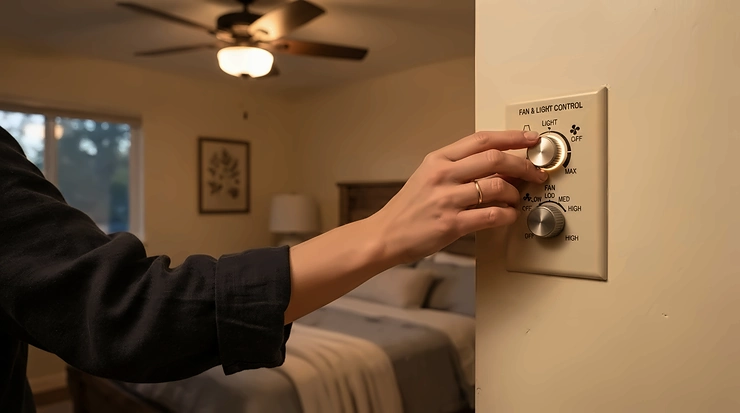
- Decide on controls. A handheld remote or app beats pull chains in a dark bedroom.
- Evaluate the light. Look for dimmable LED, warm color temperature, and a low minimum brightness.
- Verify efficiency and warranty. ENERGY STAR labeling and a decent motor warranty are good tie-breakers.
Airflow (CFM) Explained: How Much Do You Really Need?
Airflow (CFM) stands for cubic feet per minute, and it’s the closest thing to a horsepower rating for fans. But it’s slippery. Some listings cite maximum CFM at the highest speed. One DREO variant is described as reaching up to 6,040 CFM with an average near 4,231, which is a healthy reminder that “peak” isn’t “typical.”
ENERGY STAR’s key product criteria define efficiency as airflow per watt, a weighted metric across speeds and standby mode. That’s a better yardstick than a single flashy peak. Efficiency is where a fan like the Barn 65 shines, with roughly 183 CFM per watt in one retailer’s data.
Practical guidance: a master bedroom around 250 square feet is well served by 4,000 to 6,000 CFM. Larger suites benefit from the 6,500-plus territory. One 2026 review reports about 6,500 CFM on high being enough for rooms up to 400 square feet. Beware outliers, too. One retailer boasts more than 10,000 CFM from a 60-inch fan, and claims like that deserve scrutiny.
Energy-Efficient Ceiling Fan Light Combo: What the Numbers Really Save
An energy-efficient ceiling fan light combo saves money in two places, and the lighting half is the bigger one. According to the Building America Solution Center, about 80% of possible savings from a more efficient fan come from more efficient lighting. It also reports that ENERGY STAR-labeled LED lighting typically cuts a fan’s lighting energy use by 60% to 80% versus incandescent, and that certified fan-light combos are about 60% more efficient than standard units.
| Feature | Modern LED Fan-Light Combo | Traditional Fan + Incandescent Kit |
|---|---|---|
| Light energy | 60–80% less (ENERGY STAR LED) | Baseline |
| Bulb life | Listed 30,000–60,000 hours | Frequent replacement |
| Motor | DC options: quieter, cooler | Usually AC |
| Best For | Bedrooms used nightly | Rarely used rooms |
The table shows the lighting upgrade delivers the lion’s share of the benefit, so don’t chase motor specs alone. A fan like the Warrant 60, listed at 60,000 hours of light life, hits both halves of the savings. The trade-off is repairability, since integrated LEDs are harder to swap than the standard sockets on the Builder Deluxe.
Large Bedroom Ceiling Fan with Light: Sizing for Big Rooms
A large bedroom ceiling fan with light needs the right blade span first, and everything else second. One 2026 bedroom guide recommends 52 to 60 inches for larger bedrooms and 60 for master suites needing stronger coverage. Manufacturers vary: Honeywell lists a 52-inch fan for 150–320 square feet, while Harbor Breeze rates its 52-inch Sailor Bay for up to 400.
For ceiling fan with light for big rooms, work with your real dimensions. A 20-by-20 suite is 400 square feet, which is where I’d move to a 60-inch fan like the Warrant 60 or a 65-inch fan like the Barn 65. Around 14 by 16 (about 224 square feet), a 52-inch fan such as the DREO 52 is comfortable.
Clearance matters too. One buyer guide suggests blades sit roughly 10 to 12 inches below the ceiling and 7 to 9 feet above the floor. Use it as a sanity check, and follow the manufacturer’s installation manual for your model.
Dual-Mount Fan: Flush, Downrod, or Both?
A dual-mount fan installs either flush against the ceiling or on a downrod, so one purchase adapts to more rooms. That’s why it deserves attention in a master bedroom, where ceiling height is often the deciding factor.
| Mount Type | Drop From Ceiling | Airflow Effect | Best For |
|---|---|---|---|
| Flush / low-profile | Smallest | Slightly restricted | Ceilings under about 9 feet |
| Downrod | Larger | Best air movement | Higher or vaulted ceilings |
| Dual-mount | Flexible | Depends on setup | Uncertain ceiling height |
The table shows why the Sailor Bay and Hunter’s three-position mounts are appealing. You can lower or raise the fan without switching products. One category example, Luminance’s 50-inch Pro Series fan, is also listed as dual-mount for flush or downrod use. The trade-off is that flush placement lets air move less freely around the blades, so it suits low ceilings, not lofty ones.

LED Light Kit: Brightness, Color Temperature, and Sleep
The LED light kit is half your purchase, so judge it like a lamp. Warm white, around 3000K, is widely recommended for bedrooms because it reduces glare and feels relaxing. Cool white belongs in the home office.
Numbers matter here. The Barn 65 delivers about 1,984 lumens from a 40W module, while the Amico 52 is listed at 2,500 lumens. The Warrant 60 and Sailor Bay each land around 16W of total LED power. Bigger isn’t automatically better. A powerful kit with a poor dimming floor will glare at midnight, which is why the DREO 52‘s 1% minimum is a genuine bedroom advantage.
For repairs, remember the forum wisdom: standard sockets often outlast integrated modules. If you’d rather not replace the whole light kit someday, favor fans like the Builder Deluxe. Otherwise, integrated LEDs on the Barn 65 are rated for tens of thousands of hours.
Install and Set Up Your Fan Like a Pro: The Master Bedroom Playbook
Installing a fan isn’t rocket science, but it does reward patience. Start by confirming the ceiling box is fan-rated, since a plain light box may not support a moving fan. If you’re unsure, hire a licensed electrician. Shut off the breaker, not just the wall switch.
Measure clearance next. On a 9-foot ceiling, a 10-inch downrod like the Barn 65‘s puts the lowest point near 7.2 feet, so check that math against your ceiling. For sloped ceilings, Bob Vila’s testers used a longer drop bar so wide blades wouldn’t clip the slope.
Then tackle the first 30 days:
- Week one: Retighten blade screws once the fan has run for a few days.
- Week two: Listen for wobble; a balancing kit usually fixes it.
- Ongoing: Wipe blades quarterly, and reverse direction each season (warm-weather downdraft, cold-weather updraft).
Finally, pair the remote or app. If you own a smart model like the DREO 52, create a “bedtime” scene with warm, dim light and Sleep mode.
Real-World Scenarios: Which Fan Fits Which Master Bedroom?
Specs get real when you plug in a room. Here are three profiles, matched to a fan with the reasoning laid out.
The light sleeper, 14 by 16, 9-foot ceiling. Noise is the enemy. The DREO 52 with its low-dB DC motor and Sleep mode is the logical match. Use 3000K light at low brightness and a nightlight preset.
The big-suite owner, 20 by 20, vaulted or 10-foot ceiling. You have space to fill. The Barn 65, with its 10-inch downrod, suits the height and floor area. If your budget is tighter, the Warrant 60 covers similar ground with wall-mounted simplicity.
The older-home budget buyer, 8-foot ceiling, modest room. Headroom is scarce. The Dempsey 52 stays close to the ceiling, and the Sailor Bay flushed against it is a cheaper alternative. If you want smart features under $100, the Amico 52 is the value play.
Notice how budget, environment, and frequency of use drive the choice more than the brand name does.
Problem → Solution Guide: Fixing Common Master Bedroom Fan Frustrations
Problem: the light is too bright at night. Solution: choose a fan with a low dimming floor, like the DREO 52, and set 2700K to 3000K. If you own a fan with a 10% floor, like the Amico 52, keep the light on the warmest setting.
Problem: the fan feels weak in a big room. Solution: step up the span. Move from 52 to 60 inches with the Warrant 60, or pick the Barn 65 for extra-large suites.
Problem: I can’t reach the pull chains in the dark. Solution: choose a fan with a remote or app. Pull-chain fans like the Builder Deluxe and Sailor Bay are simple, but they’re the fans most likely to annoy you at bedtime.
Problem: the light flickers or whines. Solution: one DREO reviewer reported this after extended use. Try a different dimmer setting, confirm wiring, and contact support if it persists.
FAQ
❓ How much should I budget for a ceiling fan with light for master bedroom?
❓ Is a DC motor worth it for a large bedroom ceiling fan with light?
❓ Can I hang a new fan on my old light fixture box?
❓ Do ceiling fans with lights use a lot of electricity?
❓ What's the difference between a dual-mount fan and a flush-mount fan?
Conclusion
The right ceiling fan with light for master bedroom isn’t the fanciest one. It’s the one that matches your room size, ceiling height, and tolerance for noise at 2 a.m. For most mid-size suites, the DREO 52 Inch Smart Ceiling Fan is the best all-rounder. For larger rooms, the Hunter Warrant 60-Inch offers efficiency and reach, and the Minka-Aire Barn 65 goes big on airflow and drama.
If ceilings are low, the Hunter Dempsey 52-Inch or the flexible Harbor Breeze Sailor Bay 52-Inch keep clearance. Want smart features on a shoestring? Consider the Amico 52 Inch Smart Ceiling Fan. If you’d rather keep things classic and serviceable, the Hunter Builder Deluxe 52-Inch is the dependable workhorse.
Whatever you pick, size it to the room, prioritize a quiet motor and a dimmable LED light kit, and confirm your ceiling box is fan-rated. Do that, and your bedroom will be cooler, calmer, and much easier on the ears.
Recommended for You
- Flush Mount Ceiling Light For Low-Ceiling Bedroom: 7 Top Picks 2026
- 7 Bedroom Chandeliers Under $200 That Actually Look Expensive (2026)
- Smart Bulbs For Living Room: 7 Best Picks To Upgrade In 2026
Disclaimer: This article contains affiliate links. As an Amazon Associate, I earn from qualifying purchases. If you purchase products through these links, we may earn a small commission at no additional cost to you.
✨ Found this helpful? Share it with your friends! 💬🤗
