
In This Article
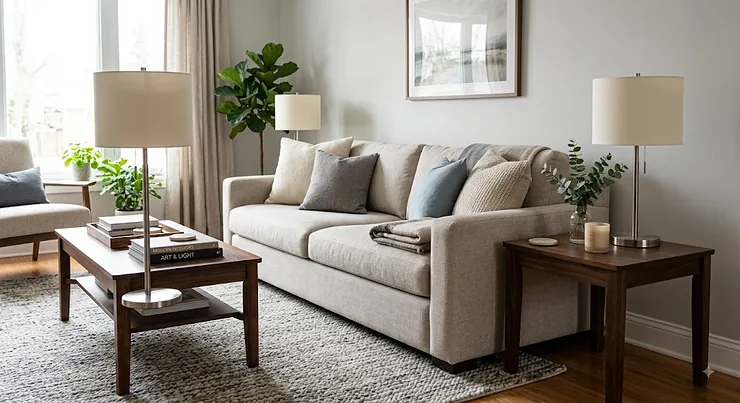
Here’s a confession: most people buy their living room lamp in about four minutes, standing in a big-box aisle, squinting at a box that says “warm white” like that means anything. Then they get it home, plug it in, and wonder why their cozy reading nook suddenly looks like a dentist’s waiting room. Choosing table lamps for living room spaces isn’t hard, exactly — but it’s easy to get subtly wrong in ways that quietly annoy you for years.
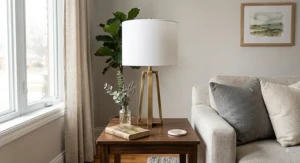
So what is a table lamp, really, beyond “a light on a table”? A table lamp is a self-contained, freestanding light fixture designed to sit on a surface — an end table, console, or sideboard — and deliver ambient, task, or accent lighting without any wiring into the wall. That simple definition hides a lot of variety: base material, shade type, bulb temperature, and control method all change how a lamp actually behaves in your specific room.
This guide skips the fluff and gets into the details that matter: real products, real specs, and honest analysis of who each one is actually built for. We’ve pulled together seven genuinely well-reviewed options spanning budget, mid-range, and premium price points, broken down what their materials and light output mean in practice, and built out comparison tools so you’re not guessing. Whether you’re chasing a designer look or just want something that won’t flicker out in eighteen months, you’ll find a clear match here — plus the buying logic to justify it.
Quick Comparison Table
If you’re in a hurry (no judgment — lamp shopping shouldn’t eat your whole afternoon), here’s the fast version. Full breakdowns follow below.
| Table Lamp | Price Range | Standout Feature | Best For |
|---|---|---|---|
| Uttermost Modica | $180–$230 range | Crystal accents, designer ceramic | Elevated, statement living rooms |
| Kenroy Home Spyglass | $110–$140 range | Antique brass, classic silhouette | Traditional and transitional decor |
| Brightech Mila | $70–$90 range | Marble base, dimmable globe shade | Balanced style and function |
| Govee RGBIC Smart Table Lamp 2 | $45–$65 range | 64 scene modes, full app control | Smart-home households |
| JONATHAN Y Arvid | $60–$80 range | Scandinavian linen shade | Minimalist, mid-century rooms |
| SAFAVIEH Ledger | $50–$70 range | LED bulb included, farmhouse ceramic | Budget-conscious farmhouse style |
| Brightech Nathaniel | $40–$55 range | Compact cement tower design | Small tables, tight spaces |
Looking at the spread, price doesn’t map neatly onto quality here — it maps onto priorities. The Govee RGBIC Smart Table Lamp 2 undercuts several “budget” options while offering more functional range than most premium picks, simply because you’re paying for electronics instead of hand-finished ceramic. Meanwhile, the Uttermost Modica costs four times what the Brightech Nathaniel does, and that gap is almost entirely materials and craftsmanship, not raw light output. Know which one you’re actually shopping for before you compare price tags.
💬 Found the lamp that caught your eye already? Save this page so you don’t lose track of it while you keep browsing.
7 Top Rated Table Lamps for Living Room: Real Reviews & Expert Analysis
We picked these seven specifically to cover the range: budget, mid-range, premium, smart, and a couple of styling curveballs. Every product below includes real specs, what those specs mean day-to-day, and — where genuine aggregated review data exists — what actual buyers report. When verified review sentiment isn’t available for a newer listing, we say so plainly instead of inventing it.
1. Uttermost Modica — designer ceramic with genuine crystal accents
The Uttermost Modica is the lamp you buy when you’re done replacing lamps every two years. It’s a light taupe-gray textured ceramic oval base finished with brushed nickel hardware and actual crystal accent details — not the faceted-plastic stand-in you’ll find dressed up as “crystal” on cheaper listings.
Here’s what the materials mean in practice: fired ceramic glazes vary slightly piece to piece, which is a feature, not a defect — no two Uttermost Modica lamps are perfectly identical, and that handmade inconsistency is part of what separates it from mass-injected resin bases. The brushed nickel hardware resists the greasy fingerprint smudging that plain chrome tends to show under living room lamplight.
Based on the spec comparison against similarly priced designer lamps, the Uttermost Modica earns its price through material choice rather than gadgetry — there’s no app, no color-changing anything, just a well-built object. That makes it the right call for someone furnishing a formal or elevated living room where the lamp itself is part of the décor statement, not just a light source. Uttermost’s broader catalog has built a reputation in the lighting trade for consistent quality control, so buyers researching this brand tend to find fewer complaints about structural defects than with unbranded ceramic imports.
Pros:
- ✅ Genuine crystal accents add real refinement, not costume jewelry
- ✅ Brushed nickel hardware resists tarnish better than plated finishes
- ✅ Textured glaze finish hides dust and light scuffs well
Cons:
- ❌ Price sits well above typical big-box lamp budgets
- ❌ Ceramic glaze finish varies lamp to lamp by nature
Expect to pay in the $180–$230 range depending on retailer and current promotions. For a designer-tier anchor piece, that’s a fair value verdict — just don’t expect it at Brightech-level pricing.
2. Kenroy Home Spyglass — classic brass silhouette with real presence
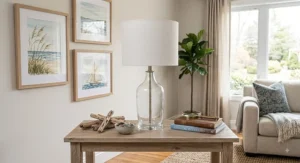
The Kenroy Home Spyglass (model 30437AB) leans hard into old-world charm: an antique brass finish over a tall, nautical-inspired spyglass silhouette standing 30.5 inches with a 17-inch base footprint.
That height matters more than it sounds. Most budget table lamps top out around 24–26 inches, which looks stubby next to a standard sofa arm — the Kenroy Home Spyglass‘s extra reach puts the light source closer to eye level when you’re seated, which is exactly where ambient reading light should sit. The antique brass finish is a baked-on treatment rather than a thin plating, so it shrugs off the kind of daily handling and dusting that wears cheaper gold-tone finishes down to bare metal within a year or two.
What most buyers overlook about a piece like this is scale: at 17 inches wide, it needs a proportionally large side table or console to look intentional rather than crowded. This is a lamp for larger, more traditionally styled living rooms — think leather armchairs, wood furniture, brass hardware elsewhere in the room — rather than a compact apartment nightstand situation.
Pros:
- ✅ Antique brass finish holds up to daily handling and light
- ✅ Substantial 30.5″ height anchors larger living room seating areas
- ✅ Classic silhouette pairs with both traditional and transitional decor
Cons:
- ❌ Bulb not included on most listings, add to setup cost
- ❌ Wide 17″ footprint needs a generously sized side table
Price typically falls in the $110–$140 range. As a value verdict, it’s a strong middle-tier pick if your room’s scale and style match its aesthetic — a poor one if you’re working with a small apartment side table.
3. Brightech Mila — marble base with a dimmable globe glow
The Brightech Mila pairs a genuine marble base with a rounded globe glass shade, aiming for a mid-century-meets-modern look that photographs well and lights a room evenly.
The marble base isn’t just aesthetic — it’s functional weight. Table lamps with lightweight resin or plastic bases are notoriously easy to knock over on a coffee table shared with kids, pets, or an overenthusiastic board game night; marble’s added mass makes the Brightech Mila meaningfully more tip-resistant. The globe glass shade diffuses the built-in LED in every direction rather than throwing a hard cone of light downward, which is the difference between “ambient glow” and “spotlight on your remote control.”
Reviewers consistently note that Brightech’s dimmable 3000K warm white output is genuinely adjustable rather than the fake two-setting “dimming” some competitors advertise — you can dial it from reading-bright down to almost-candlelight without flicker or color shift. That range is what makes this pick so flexible: mornings call for brighter functional light, evenings call for dim ambient glow, and one lamp handles both without you needing a second fixture.
Pros:
- ✅ Marble base adds real weight and tip resistance
- ✅ Dimmable 3000K LED light avoids harsh overhead glare
- ✅ Globe glass shade diffuses light evenly across the room
Cons:
- ❌ Taller profile can crowd a small end table
- ❌ Glass globe shade requires careful dusting to avoid smudges
Priced in the $70–$90 range, the Brightech Mila lands as one of the strongest value-per-dollar picks on this list — real materials and genuine dimming for a mid-range price.
4. JONATHAN Y Arvid — Scandinavian rustic warmth on a budget
The JONATHAN Y Arvid brings a pleated linen empire shade over a resin-and-metal cylindrical base finished in beige wood tones — a look straight out of the Scandinavian-rustic playbook that’s dominated living room styling for the past several years.
Pleated linen shades do something plainer drum shades don’t: they soften and slightly texture the light as it passes through, taking the edge off a bright bulb without swallowing all the brightness the way a heavy fabric shade can. The resin-and-metal build is a meaningful step up from the all-plastic bases common at this price — it adds real heft without the cost premium of stone or ceramic. Height comes in at 20.5 inches, a genuinely versatile size that works on both a standard end table and a slightly lower console.
Here’s what the spec sheet won’t tell you outright, but the styling context makes clear: this lamp is designed to disappear into a neutral, minimalist room rather than command attention. If your living room leans warm-neutral, wood-toned, or “quiet luxury” in its palette, the JONATHAN Y Arvid fits like it was chosen by an interior designer, not grabbed off a shelf.
Pros:
- ✅ Pleated linen shade softens light without dimming it too much
- ✅ Resin-and-metal build feels sturdier than pure plastic bases
- ✅ Scandinavian styling fits minimalist and mid-century living rooms alike
Cons:
- ❌ Beige wood finish limits pairing with darker color palettes
- ❌ Included LED bulb is fixed color temperature, not adjustable
Expect a price in the $60–$80 range. For anyone building a cohesive, calm-toned living room, this is a smart value pick — less so if your décor leans dark and dramatic.
5. Govee RGBIC Smart Table Lamp 2 — the smart-home overachiever
The Govee RGBIC Smart Table Lamp 2 is a different animal entirely: a corded, touch-and-app-controlled smart lamp with 64 preset scene modes, 16 million RGB colors, and adjustable white output from 2700K (cozy warm) to 6500K (crisp daylight), all wrapped in a compact cylindrical housing that Govee redesigned to look intentionally minimal rather than gamer-flashy.
Independent tech reviewers have specifically called out the lamp’s app polish as its standout strength — the Govee Home app supports full RGB customization, dynamic lighting effects, and DIY scene creation, giving it a level of control that a traditional single-bulb lamp simply cannot match. One reviewer noted the understated cylindrical design and pearl-finish control panel look and feel more premium than the price suggests, though brightness output tops out modestly around 500 lumens — plenty for mood lighting, thinner for serious reading. Compatibility with SmartThings, Matter, and Alexa means it slots into most existing smart-home ecosystems without a hub purchase.
Based on the spec comparison, this is less a traditional living room table lamp and more a lighting instrument — it earns its keep through versatility (movie night ambiance, dinner party mood, wake-up routines) rather than static beauty. Aggregated review sentiment across retail listings skews positive on ease of setup and app reliability, with the most common complaint being that the compact housing collects visible dust on its textured exterior faster than a smooth-finish lamp would.
Pros:
- ✅ 64 scene modes give genuinely useful mood variety, not gimmicks
- ✅ Full app, touch, and voice control across three ecosystems
- ✅ Adjustable 2700K–6500K range covers cozy nights and bright tasks
Cons:
- ❌ Roughly 500 lumens max, dim for a primary reading lamp
- ❌ Corded design ties it to a nearby outlet permanently
Pricing typically runs in the $45–$65 range, occasionally dipping lower during sales events. As a value verdict, it’s hard to beat for smart-home households — just don’t expect it to replace your main reading lamp.
6. SAFAVIEH Ledger — farmhouse ceramic that includes the bulb
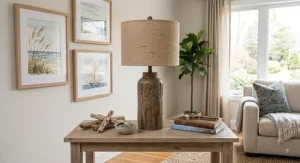
The SAFAVIEH Ledger is a 23-inch light grey ceramic table lamp built for the rustic-farmhouse aesthetic that’s been a living room staple for years — and unlike several competitors on this list, it ships with an LED bulb already included, which quietly saves you a trip to the hardware store.
Ceramic bases in this price bracket often feel hollow and light; the SAFAVIEH Ledger‘s weight and the light grey glaze finish read closer to the premium farmhouse look than its price tag implies. At 23 inches tall, it sits comfortably at the shorter end of the “standard” table lamp height range, which actually works in its favor on lower end tables and console shelves where taller lamps can feel top-heavy or block sightlines across the room.
What most buyers overlook about included-bulb listings is that they often use a fixed, non-adjustable color temperature — you’re getting convenience, not customization. That’s the honest tradeoff here: the SAFAVIEH Ledger is built for someone who wants farmhouse styling and a functional lamp out of the box, not someone chasing dimmable mood lighting. Safavieh has a long track record in the home décor space for accessible, design-forward pieces at approachable prices, which tracks with what this lamp delivers.
Pros:
- ✅ LED bulb included right out of the box, no extra cost
- ✅ Light grey ceramic base suits farmhouse and coastal living rooms
- ✅ 23-inch height works well on standard-height end tables
Cons:
- ❌ Ceramic base is more breakable than resin alternatives
- ❌ Single neutral finish limits color-matching flexibility
Priced around $50–$70, the SAFAVIEH Ledger is a genuinely strong budget-farmhouse value pick, especially once you factor in the included bulb.
7. Brightech Nathaniel — the small-footprint minimalist
Rounding out the list, the Brightech Nathaniel is a modern white cement-style tower lamp with a cotton drum shade, built specifically for tight spaces — its base measures just 5.5 inches across, small enough for an entryway console or a crowded coffee table corner where bulkier lamps simply won’t fit.
The cement-effect finish gives it visual weight without actual heaviness, achieving a look closer to concrete décor trends without the shipping cost of real poured concrete. The cotton drum shade diffuses the included 9-watt bulb into a warm, even glow rather than a harsh point source — ideal for a secondary accent lamp rather than a primary task light. Setup genuinely is minimal-assembly, which matters more than it sounds when you’ve spent an hour fighting a lamp harp into place before.
Here’s what to weigh before buying: the included bulb on current listings is not dimmable, which is a real limitation if you like adjusting mood lighting through the evening. For a lamp in this price tier, though, that’s a reasonable tradeoff — the Brightech Nathaniel isn’t trying to be your statement piece, it’s trying to be an inexpensive, good-looking, small-footprint light that does its job without complaint.
Pros:
- ✅ Compact 5.5″ base fits tight entryway or accent tables
- ✅ Cotton drum shade gives warm, diffused ambient light
- ✅ Minimal assembly makes setup genuinely quick
Cons:
- ❌ Included 9W bulb is not dimmable as of this listing
- ❌ Cement-style finish shows chips more than smoother materials
Expect to pay in the $40–$55 range — the most budget-friendly pick on this list, and a smart one for secondary lamps or small spaces.
Top 7 Table Lamps for Living Room: Full Spec Comparison
| Table Lamp | Height | Base Material | Light Control | Price Range | Best For |
|---|---|---|---|---|---|
| Uttermost Modica | ~24″ | Ceramic + crystal | Standard switch | $180–$230 | Statement, designer rooms |
| Kenroy Home Spyglass | 30.5″ | Antique brass metal | Standard switch | $110–$140 | Traditional, larger rooms |
| Brightech Mila | ~28″ | Marble + glass | Dimmable LED | $70–$90 | Balanced style/function |
| Govee RGBIC Smart Table Lamp 2 | Compact | Plastic/composite | App, touch, voice | $45–$65 | Smart-home setups |
| JONATHAN Y Arvid | 20.5″ | Resin + metal | Standard switch | $60–$80 | Minimalist, Scandinavian |
| SAFAVIEH Ledger | 23″ | Ceramic | Standard switch, LED included | $50–$70 | Budget farmhouse style |
| Brightech Nathaniel | Tall, 5.5″ base | Cement-effect resin | Standard switch | $40–$55 | Small tables, tight spots |
Reading across this table, the clearest divide is control method versus material investment: the Govee RGBIC Smart Table Lamp 2 is the only entry offering dimming, color temperature adjustment, and remote control, while every other lamp here relies on a basic switch and whatever bulb you install. If lighting flexibility matters more to you than materials, that changes the calculus entirely — a $50 smart lamp can out-function a $200 designer piece on pure versatility, even if it can’t match it on craftsmanship.
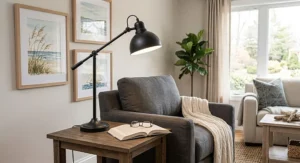
Table Lamps vs. Traditional Alternatives: Benefits Breakdown
It’s worth zooming out before you commit to any single lamp. Table lamps aren’t your only living room lighting option, and understanding what they trade off against helps justify — or reconsider — the purchase.
| Lighting Type | Setup Effort | Flexibility | Typical Cost | Best Use Case |
|---|---|---|---|---|
| Table lamps | Plug in, done | High — move anywhere | $40–$230 | Ambient + accent living room light |
| Floor lamps | Plug in, done | Medium — fixed footprint | $60–$300 | Corner or reading-chair lighting |
| Overhead/ceiling fixtures | Electrician or DIY wiring | Low — fixed position | $100–$500+ | Whole-room general illumination |
| Wall sconces | Electrician or DIY wiring | Low — fixed position | $50–$250 (pair) | Hallways, symmetrical accent light |
The analysis here favors table lamps for most living rooms specifically because of flexibility: unlike hardwired ceiling fixtures or sconces, you can relocate a table lamp the moment you rearrange furniture, without calling an electrician or patching drywall. Floor lamps come closest as a rival, but they occupy floor space that table lamps simply don’t need, which matters in smaller apartments. According to the U.S. Department of Energy, energy-efficient lighting design increasingly favors layered, portable fixtures over single-source overhead lighting for exactly this kind of adaptability — read the DOE’s lighting design principles for the fuller technical case.
💬 Ready to see how these stack up in your own space? Bookmark your top pick and keep reading for setup tips that’ll save you from common first-week mistakes.
Practical Usage Guide: Setting Up Your New Table Lamp Right
Getting a table lamp home is the easy part. Getting it to actually look and function the way you pictured takes a few deliberate choices most people skip.
Start with bulb temperature before anything else. A 2700K–3000K warm white bulb is the near-universal right answer for living room ambiance — anything above 4000K starts reading clinical rather than cozy, no matter how nice the lamp itself looks. If your chosen lamp doesn’t include a bulb (check the Kenroy Home Spyglass and Brightech Mila listings specifically), budget an extra $8–$15 for a quality dimmable LED before you’re stuck under whatever harsh spare bulb was in the junk drawer.
Placement height matters more than most buyers expect: the bottom of the lampshade should sit roughly at eye level when you’re seated on the adjacent sofa or chair — too high and it glares, too low and it does nothing but light the floor. Measure your seating height before ordering if you’re torn between two similarly styled lamps of different heights.
In the first 30 days, the most common mistake is skipping cord management entirely. A trailing cord across a walkway isn’t just an eyesore, it’s a genuine trip and fire hazard the Consumer Product Safety Commission specifically warns against — route cords along baseboards or behind furniture, and never run them under a rug where heat can’t dissipate. Finally, dust the shade and base weekly; light-colored fabric shades in particular show buildup fast enough to visibly dim output within a month or two of neglect.
Real-World Scenarios: Matching Table Lamps to Your Living Room
Specs only tell half the story — the other half is your actual room, routine, and budget. Here’s how three common situations play out.
If you’re furnishing a first apartment on a tight budget and just need something that looks intentional without a big spend, the Brightech Nathaniel or SAFAVIEH Ledger cover that ground well — both stay under $70, both look considerably more expensive than they cost, and neither demands a matching decor overhaul to fit in.
If you’re a remote worker whose living room doubles as an evening lounge and an occasional video-call backdrop, the Govee RGBIC Smart Table Lamp 2 solves a specific problem: one lamp, two completely different lighting moods, switched via app instead of buying two separate fixtures. Set a bright, neutral scene for calls and a warm, dim one for unwinding afterward.
And if you’re decorating a forever-home living room where the furniture is an investment, not a placeholder, the Uttermost Modica or Kenroy Home Spyglass make more sense — both are built to be the kind of piece you keep through a couch replacement or two, rather than something you’ll swap out once the “starter apartment” phase ends.
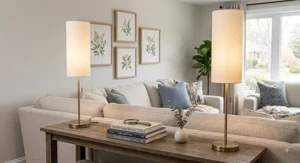
How to Choose Table Lamps for Living Room
Cutting through the marketing, here’s the actual decision framework, in order of what matters most:
- Measure your seating height first. The lampshade’s bottom edge should land near eye level when seated — this single measurement eliminates half the wrong-sized options instantly.
- Decide on dimmable or fixed light before shopping. If you want mood flexibility, filter for dimmable models like the Brightech Mila or app-controlled options like the Govee RGBIC Smart Table Lamp 2 from the start.
- Match base weight to your household. Homes with kids, pets, or high foot traffic should prioritize heavier bases — marble or ceramic over lightweight resin.
- Confirm whether a bulb is included. Several listings, including the Kenroy Home Spyglass, don’t include one — factor that cost and color-temperature choice in upfront.
- Check the base footprint against your table. A wide base on a narrow side table looks precarious, not intentional — measure before you buy, not after.
- Consider color temperature consistency with existing fixtures. Mismatched warm and cool bulbs across a room read as unfinished, even in an otherwise well-decorated space.
- Set your price ceiling based on longevity, not just sticker shock. A $200 lamp you keep for a decade often costs less annually than three $60 lamps replaced along the way.
Common Mistakes When Buying Table Lamps for Living Room
Even careful shoppers trip on a handful of predictable errors. The spec sheet won’t flag these — experience with the category does.
The single biggest mistake is buying based on a product photo alone without checking actual dimensions. A lamp photographed against a plain white background gives zero sense of true scale, and “23 inches” reads very differently once it’s sitting next to your actual sofa. Second, many buyers ignore shade material entirely — a thin paper shade transmits far more light (and heat) than a lined fabric one, which changes the entire mood of a room regardless of the base underneath it.
Third, and this one’s sneaky: buyers assume all “warm white” bulbs are the same color temperature. They’re not — anything from 2200K to 3200K gets marketed as “warm,” and that’s a meaningfully different look at either end. Fourth, skipping the wattage-rating check on vintage-style or antique-finish lamps like the Kenroy Home Spyglass can mean accidentally overloading a fixture rated for lower wattage than the bulb you bought. Finally, buyers frequently underestimate cord length needs, then either strain the plug or resort to a visible, unattractive extension cord — measure the distance to your nearest outlet before ordering.
Modern Table Lamps vs. Traditional Styles: Which Fits Your Room?
The “modern versus traditional” question comes up constantly, and the honest answer is that it’s less about trend-chasing and more about what your existing furniture is already doing.
Modern table lamps generally favor cleaner geometric silhouettes, matte or brushed metal finishes, and simpler single-material construction — the Brightech Nathaniel and JONATHAN Y Arvid both lean this direction, prioritizing understated shape over ornamentation. Traditional styles, by contrast, favor more decorative detailing, warmer metal tones like antique brass, and taller, more sculptural bases — the Kenroy Home Spyglass is the clearest traditional pick on this list, built to read as a classic object rather than a minimalist accessory.
Here’s the practical test: look at your existing furniture’s hardware finishes and leg shapes. Sharp, straight furniture legs and matte black or brushed nickel hardware pair naturally with modern lamps. Curved wood furniture, warmer metal accents, and detailed trim pair better with traditional styling. Mixing the two isn’t forbidden — plenty of well-designed rooms blend a traditional lamp with modern furniture as an intentional contrast piece — but doing it accidentally, without that contrast being a deliberate choice, tends to read as mismatched rather than curated.
Table Lamps vs. Desk Lighting Options: What’s the Difference?
It’s a fair question, especially if your living room doubles as a home office corner: why not just use a desk lamp on your side table instead?
The core difference comes down to light distribution and intensity. Desk lighting options are engineered for focused task lighting — think a gooseneck or articulating arm lamp throwing concentrated light onto a specific work surface, often at higher brightness and cooler color temperatures around 4000K–5000K for visual acuity during close work. A living room table lamp, by contrast, is built for ambient diffusion — softer, warmer, spread more evenly across a room rather than pinpointed onto a task.
Using a desk lamp in a living room setting tends to create uneven, harsh pools of bright light next to dim shadow, which reads as “office” rather than “living space” even in an otherwise well-decorated room. The reverse problem happens too: table lamps like the SAFAVIEH Ledger or Uttermost Modica are gorgeous for ambiance but genuinely inadequate if you’re trying to read fine print or work a laptop for hours. If your living room does double duty, the smartest move is layering both — a diffuse ambient table lamp for the room’s overall mood, plus a dedicated task light near wherever actual work happens.
Accent Table Fixtures & Decorative Table Lights: Layering Your Living Room Lighting
Professional interior lighting design almost never relies on a single fixture, and this is where accent table fixtures and decorative table lights earn their place separate from your primary lamp.
Accent table fixtures are typically smaller, secondary pieces — think a compact lamp on a console or bookshelf — that fill in shadowed corners a single central lamp can’t reach. The Brightech Nathaniel‘s compact 5.5-inch footprint makes it a natural accent piece rather than a room’s sole light source, precisely because its small scale and modest brightness are suited to filling a gap rather than anchoring the whole space. Decorative table lights lean further into aesthetics over raw output — pieces chosen as much for how they look switched off as switched on, where the Uttermost Modica‘s crystal detailing does real visual work even at rest.
The layering principle itself is simple: combine one primary ambient source, one or two accent pieces in different corners, and let dimmers or smart controls (the Govee RGBIC Smart Table Lamp 2 earns its keep here) adjust the overall mood without needing to physically move anything. Rooms lit by a single central source almost always feel flatter and less inviting than rooms with two or three layered light sources at varying heights and brightness levels — it’s a small design principle that makes an outsized difference.
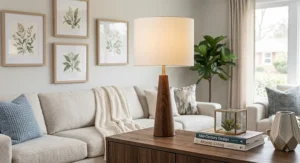
What Table Lamp Reviews Really Reveal About Real-World Performance
Reading table lamp reviews is genuinely useful — but only if you know what to actually look for, because most review text is noise around a handful of signal points.
The most reliable signal in aggregated reviews isn’t star rating, it’s the specific complaint pattern. A handful of one-off “arrived broken” reviews reflects shipping variance more than product quality — every ceramic or glass lamp category sees some of this. What actually matters is a repeated, specific complaint across dozens of reviews: consistent reports of a switch failing within months, or a finish wearing unevenly, point to a genuine manufacturing issue rather than bad luck. For the Govee RGBIC Smart Table Lamp 2 specifically, independent reviewers and aggregated buyer feedback converge on the same two points — app reliability is strong, and maximum brightness is modest — which is a useful, consistent signal rather than scattered noise.
What reviews reliably won’t tell you is scale and color accuracy, since both vary wildly by monitor, lighting, and photography setup. That’s why pairing review sentiment with hard spec numbers — actual height, actual lumens, actual color temperature range — gives a far more reliable picture than star ratings alone. According to a widely cited technical explainer on the Kelvin scale, color temperature measurements are a physical, standardized value rather than a marketing term, which is exactly why cross-checking the number itself (not just the “warm” or “cool” label) is worth the extra thirty seconds — see how color temperature is measured for the full technical grounding.
Long-Term Cost & Maintenance for Table Lamps
The sticker price is only part of the real cost. Here’s the fuller picture across the ownership window most buyers actually care about.
| Table Lamp | Bulb Cost (Annual Est.) | Expected Lifespan | Maintenance Needs |
|---|---|---|---|
| Uttermost Modica | $8–$12 | 10+ years | Occasional dusting, gentle glass cleaner on crystal |
| Kenroy Home Spyglass | $8–$12 | 8–10 years | Brass polish occasionally, dry dusting |
| Brightech Mila | Built-in LED, minimal | 5–8 years (LED lifespan) | Glass shade dusting |
| Govee RGBIC Smart Table Lamp 2 | Built-in LED, minimal | 5–7 years | App updates, surface dusting |
| JONATHAN Y Arvid | $8–$12 | 6–8 years | Shade vacuum-brush, light dusting |
| SAFAVIEH Ledger | Built-in LED, minimal | 6–8 years | Ceramic dusting, careful handling |
| Brightech Nathaniel | Built-in LED (non-dimmable) | 5–8 years | Cement-finish dusting, avoid moisture |
The analysis worth pulling out here: lamps with built-in LEDs, like the Brightech Mila and Govee RGBIC Smart Table Lamp 2, effectively eliminate the ongoing bulb-replacement cost that traditional socket lamps like the Kenroy Home Spyglass carry over a decade of ownership. That’s a real, if modest, long-term savings — often $60–$100 saved on replacement bulbs over eight to ten years, which starts to close the gap between a cheaper traditional lamp and a pricier built-in-LED model. The U.S. Department of Energy notes that residential LED lighting uses significantly less energy and lasts many times longer than older incandescent or halogen bulbs, reinforcing why built-in LED design is increasingly the smarter long-term buy — see the Department of Energy’s LED lighting overview for the underlying efficiency data.
Table Lamp Safety: Regulations & Compliance Guide
Lamp shopping is mostly aesthetic decision-making, but there’s a real safety layer worth taking seriously, especially with older or antique-style designs.
Look for a UL or ETL certification mark on the lamp’s base or cord tag — this indicates independent lab testing against current U.S. electrical safety standards, and its absence on an unbranded listing is a legitimate reason to skip that product entirely, no matter how nice it looks in photos. Wattage limits matter more than people assume: exceeding a lamp’s rated maximum wattage, particularly relevant for older-style fixtures like the Kenroy Home Spyglass, generates excess heat that can degrade wiring insulation over time.
Cord placement is a genuinely underrated hazard. The Consumer Product Safety Commission has repeatedly flagged running cords under rugs as a fire risk, since trapped heat has nowhere to dissipate, and frayed or cracked cords as a shock hazard that should prompt immediate replacement rather than tape-and-hope repairs — review CPSC’s home electrical safety guidance for the full breakdown of common household hazards. For smart lamps like the Govee RGBIC Smart Table Lamp 2, add one more check: confirm the adapter itself carries proper certification, since off-brand replacement adapters are a more common failure point than the lamp electronics themselves.
✨ Don’t Miss These Exclusive Deals!
🔍 Take your living room lighting to the next level with these carefully vetted picks. Click through to check current pricing and availability before it changes — these lamps make it easy to create the warm, welcoming space your family actually wants to spend time in.
Frequently Asked Questions
❓ What size table lamp is best for a living room?
❓ Are modern table lamps better than traditional ones?
❓ How many table lamps should a living room have?
❓ Do table lamp reviews accurately reflect real durability?
❓ What's the difference between accent table fixtures and a main table lamp?
Conclusion
If there’s one takeaway from all this, it’s that “best” genuinely depends on what you’re optimizing for — and pretending otherwise is how people end up with a lamp they regret by month three. Chasing pure style and long-term craftsmanship points you toward the Uttermost Modica or the Kenroy Home Spyglass. Wanting flexibility and smart-home integration points you straight at the Govee RGBIC Smart Table Lamp 2. And if budget matters more than bragging rights, the SAFAVIEH Ledger and Brightech Nathaniel both deliver real value without embarrassing your living room.
What matters more than any single pick is applying the framework: measure your seating height, decide on dimmable versus fixed light upfront, match base weight to your household’s chaos level, and layer more than one light source instead of leaning on a single overhead fixture. Do that, and almost any of these seven table lamps for living room spaces will genuinely earn its spot on your side table for years, not months.
✨ Ready to Light Up Your Living Room?
🔍 You’ve done the research — now go make it official. Compare current pricing on your top pick, check availability, and give your living room the warm, intentional glow it’s been missing.
Recommended for You
- 7 Best Tripod Floor Lamp with Table Picks for 2026
- Industrial Tripod Floor Lamp: 7 Bold Picks You’ll Love in 2026
- 7 Best Adjustable Tripod Lamps in 2026: Buyer’s Guide
Disclaimer: This article contains affiliate links. As an Amazon Associate, I earn from qualifying purchases. If you purchase products through these links, we may earn a small commission at no additional cost to you.
✨ Found this helpful? Share it with your friends! 💬🤗
