
In This Article
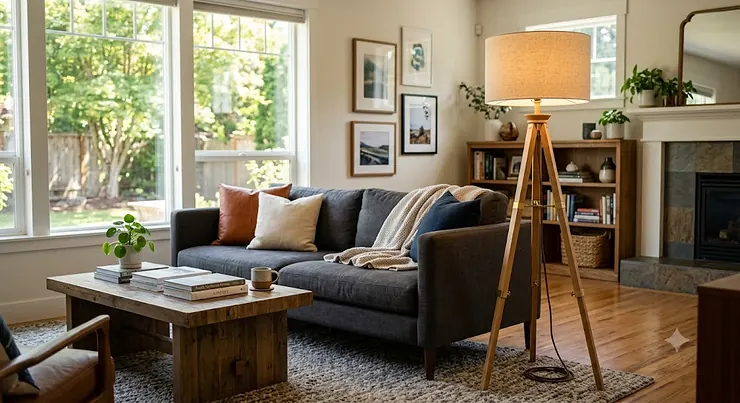
Somewhere between “I need more light in this corner” and “why does every lamp in my house look like it belongs in a dentist’s waiting room” sits the humble adjustable tripod lamp. It’s one of the few lighting fixtures that actually earns its keep — you can raise it, lower it, tilt it, swivel it, and generally bully it into pointing exactly where you need light instead of rearranging your whole room around a fixed fixture. That flexibility is the entire pitch, and it’s also why the category has exploded with options that range from $20 bedroom accents to serious work-site equipment.
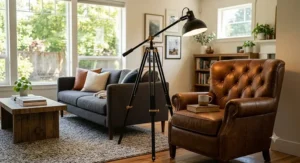
An adjustable tripod lamp is a light fixture mounted on a three-legged stand with a height- and often angle-adjustable pole or arm, allowing the light source to be repositioned for reading, photography, task work, or ambient decor. The three-legged base is what separates it from a standard floor lamp: it’s inherently more stable on uneven surfaces, and in most designs, it folds down for storage or transport far more compactly than a pole lamp ever could.
That versatility is exactly why the category gets murky fast. A “tripod lamp” search turns up mid-century wood-legged reading lamps sitting next to telescoping work lights that look like they escaped a construction site. Both are legitimately “adjustable tripod lamps” — they just solve different problems. Below, I’ve pulled together real products across decor, task, and telescoping categories, broken down what actually matters in the specs, and built out comparison tools so you’re not guessing which one fits your space. According to the U.S. Department of Energy, LED fixtures — which now dominate this category — use at least 75% less energy than incandescent lighting, which matters more than you’d think once you’re running a lamp for hours at a stretch.
Quick Comparison Table
Before diving into the deep-dive reviews, here’s the fast version — the one you’d want if you’re standing in your living room right now trying to decide.
| Product | Height Range | Best For | Price Range |
|---|---|---|---|
| Edishine Tripod Table Lamp | ~14″ (fixed tabletop) | Nightstands, small spaces | Under $30 |
| Brightech Eden Tripod Floor Lamp | ~62″ | Everyday living room reading | $80-110 |
| Decoluce Vintage Tripod Floor Lamp | Adjustable, ~50-65″ | Studio/cinema decor accent | $90-130 |
| Kira Home Sulis Tripod Spotlight Lamp | ~58″ | Statement piece, premium decor | $140-190 |
| Floor Photography Tripod LED Light | Telescoping, ~20-60″ | Live streaming, content creation | $30-55 |
| SANSI LED Work Light w/ Telescoping Tripod | 30-55″ | Garage, workshop task lighting | $45-70 |
| LUTEC 6290Pro Dual-Head Work Light | Telescoping | Job sites, heavy-duty use | $90-130 |
A quick read of this table tells you most of what you need: if you want something that just looks nice in a living room, you’re choosing between the Brightech Eden Tripod Floor Lamp, the Decoluce Vintage Tripod Floor Lamp, and the Kira Home Sulis Tripod Spotlight Lamp — the difference comes down to style and budget, not function. If you’re lighting a workspace, a garage, or a video call setup, the SANSI LED Work Light, the LUTEC 6290Pro, and the Floor Photography Tripod LED Light are the ones worth your attention, since they prioritize raw output and telescoping range over aesthetics. The Edishine Tripod Table Lamp is the outlier here — it’s not a floor lamp at all, but it’s cheap enough and charming enough that it deserves a spot for anyone furnishing a small space on a budget.
💬 Already have a favorite from this table? Click through to check its current price and availability before it changes.
Top 7 Adjustable Tripod Lamps: Expert Analysis
I picked these seven to cover the real spread of what “adjustable tripod lamp” actually means to shoppers — decor pieces, task lighting, and telescoping photography rigs — at budget, mid-range, and premium price points.
1. Edishine Tripod Table Lamp — cheapest way to test the tripod look
The Edishine Tripod Table Lamp is the entry point for anyone who wants the tripod aesthetic without committing floor-lamp money or floor-lamp space to it.
At around 14 inches tall with a wooden tripod base and a linen shade, it’s built for nightstands and small side tables rather than room-scale lighting — this is ambient and accent lighting, not a reading workhorse. It runs on a standard E26 bulb socket, so swapping in a warmer or cooler bulb later is trivial and cheap. Based on the spec sheet, the compact footprint and low center of gravity make it noticeably harder to knock over than taller lamps, which matters if you’ve got a cat, a toddler, or both prowling the nightstand.
Who it’s for: renters, dorm rooms, or anyone furnishing a guest room on a shoestring budget who still wants something that looks intentional rather than thrown together. Shoppers who’ve picked it up in its various style options consistently describe it as a small, charming accent piece rather than a primary light source — which tracks with its size and single-bulb output. Reviewers frequently mention the range of shade styles (bohemian, cottage, vintage, art deco) as a reason they bought more than one for matching rooms.
Pros:
- ✅ Extremely low price of entry for the tripod aesthetic
- ✅ Compact wooden base resists tipping on small surfaces
- ✅ Available in multiple style variants for different decor
Cons:
- ❌ Fixed height — no telescoping or adjustment range
- ❌ Too small and dim for task or reading light
Priced under $30 in most style variants at the time of research, the Edishine Tripod Table Lamp is hard to argue with as a low-stakes accent buy — just don’t expect it to replace a real reading lamp.
2. Brightech Eden Tripod Floor Lamp — best all-rounder for everyday rooms
The Brightech Eden Tripod Floor Lamp is the one I’d point a first-time floor-lamp buyer toward, because it does the “adjustable tripod lamp” job without asking you to think too hard about it.
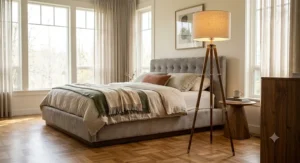
It’s built with solid wood tripod legs and a dimmable LED head, standing roughly five feet tall — tall enough to clear the arm of a couch or reading chair without you having to crane your neck. The dimmer is a real functional upgrade over fixed-brightness competitors: dropping the output for late-night reading versus cranking it for daytime task work is a one-touch adjustment rather than a bulb swap. What most buyers overlook about dimmable floor lamps in this price tier is that the dimming range often bottoms out higher than expected; Brightech’s stepped or continuous dimmer (depending on model year) tends to get real marks for actually reaching a low, warm setting instead of stopping at “medium.”
Who it’s for: living rooms and bedrooms where the lamp needs to do double duty as both ambient and reading light, and where the wood-leg aesthetic needs to blend into an existing mid-century or transitional decor scheme. Aggregated customer sentiment for the Brightech line skews toward praise for build sturdiness and the tripod base’s resistance to wobble on hardwood or rugs, with occasional complaints about assembly instructions being sparse.
Pros:
- ✅ Genuine dimmable range from bright task light to low glow
- ✅ Solid wood legs feel sturdier than metal competitors
- ✅ Easy-clean drum shade suits multiple room styles
Cons:
- ❌ Assembly instructions reported as minimal by some buyers
- ❌ No height telescoping — fixed at roughly 60-65 inches
In the $80-110 range depending on finish, the Brightech Eden Tripod Floor Lamp delivers the best cost-per-use of any lamp on this list for someone who just wants a great everyday floor lamp.
3. Decoluce Vintage Tripod Floor Lamp — most distinctive design for studio-style rooms
If you want your lighting to look like a prop from a 1940s film set, the Decoluce Vintage Tripod Floor Lamp is built specifically for that job.
It pairs a solid beechwood tripod easel with a metal cinema-camera-shaped spotlight shade, and the pole height adjusts to change both the light’s position and its dramatic angle — the design leans hard into the “vintage camera on a stand” look rather than trying to blend in. Reviewers and product listings consistently flag the foot-switch operation and roughly 2.8-meter cord as genuinely convenient details, not filler spec-sheet items — you don’t have to bend down to a tiny inline switch every time you want the light on. Based on the spec comparison with more conventional tripod lamps, this one trades subtlety for personality; it’s a statement piece first and a practical reading lamp second.
Who it’s for: home offices, studios, or living rooms that lean into an industrial-vintage or Hollywood-glam aesthetic, and buyers who specifically want the lamp itself to function as a decor focal point rather than disappearing into the room. The E27-style socket compatibility means bulb replacement is straightforward and inexpensive, which offsets the higher upfront cost of the fixture itself over the long run.
Pros:
- ✅ Genuinely height- and angle-adjustable spotlight head
- ✅ Foot-switch operation avoids fumbling for a tiny switch
- ✅ Standout design doubles as a room’s focal point
Cons:
- ❌ Style is polarizing — not a fit for minimalist decor
- ❌ Heavier and bulkier than simpler tripod designs
Expect to pay in the $90-130 range at the time of research; given how much design work is baked into this fixture, that’s a reasonable value verdict for anyone who actually wants the look.
4. Kira Home Sulis Tripod Spotlight Floor Lamp — best premium statement piece
The Kira Home Sulis Tripod Spotlight Floor Lamp sits at the top of the decor tier here, and the price difference versus the Brightech and Decoluce options is visible the moment you look at the materials.
Standing about 58 inches tall, it pairs a gold-foil satellite-style shade with leather-wrapped leg accents and a matte black finish — the kind of detailing that reads as “designer” rather than “big-box” even at a glance. It ships with a 9-watt LED bulb, which keeps running costs low despite the premium build. What the spec sheet won’t tell you, but the design intent makes clear, is that this lamp is engineered to be looked at as much as it’s meant to light a room — the satellite-dish shade throws a distinctive directional pool of light rather than broad ambient glow, so it pairs better with other ambient sources than as a room’s sole light.
Who it’s for: buyers furnishing a living room, office, or entryway where the lamp is meant to function as a piece of decor first, with the mid-century industrial detailing (leather leg wraps, gold foil shade) doing real visual work. It’s a poor fit if you need one lamp to handle all your lighting needs, since its directional throw is narrower than a standard drum-shade floor lamp.
Pros:
- ✅ Premium materials — leather accents and gold-foil shade
- ✅ Efficient 9W LED keeps operating costs low
- ✅ Distinctive silhouette works as a standalone decor piece
Cons:
- ❌ Highest price point among the decor-focused options
- ❌ Directional spotlight throw, not broad room lighting
At roughly $140-190 depending on retailer promotions, the Kira Home Sulis Tripod Spotlight Floor Lamp is a premium buy — justified if design is doing real work in your space, less so if you just need reliable light.
5. Floor Photography Tripod LED Light — best telescoping tripod lamp for content creators
For anyone whose search for an adjustable tripod lamp is really a search for better lighting on video calls or short-form video, the Floor Photography Tripod LED Light is the practical, budget-friendly answer.
This is a telescoping tripod lamp in the truest sense — the pole extends across a wide height range, and the head rotates a full 360 degrees to support both horizontal and vertical framing, with a phone clamp built in for anyone shooting content directly off the same stand. Based on the spec comparison with dedicated ring lights, the tradeoff here is brightness uniformity: a single LED panel head doesn’t diffuse light as evenly across a face as a true ring light does, but it’s far more portable and doubles as general-purpose task lighting when you’re not filming. Reviewers commonly describe it as their go-to for live selling, remote work backgrounds, and quick TikTok or Instagram setups where a dedicated studio rig would be overkill.
Who it’s for: streamers, remote workers who want better video-call lighting, and small-business owners doing live product demos — anyone who needs the lamp to double as both a phone mount and a fill light without a huge cash outlay. It’s a poor fit for professional photography, where dedicated soft-box lighting will outperform it in every way.
Pros:
- ✅ True telescoping height range for multiple shooting setups
- ✅ Built-in phone clamp doubles as a content-creation rig
- ✅ Genuinely affordable relative to dedicated ring lights
Cons:
- ❌ Light diffusion is uneven compared to true ring lights
- ❌ Plastic mounting hardware feels less durable long-term
At around $30-55 at the time of research, this is the best-value telescoping tripod lamp on this list for anyone getting started with content creation or hybrid work setups.
6. SANSI LED Work Light with Telescoping Tripod — most practical customizable height lamp for task work
The SANSI LED Work Light with Telescoping Tripod is where the category shifts from decor into genuinely functional task lighting, and the spec sheet backs that up.
It’s rated as a 300-watt-equivalent LED fixture pushing roughly 3,300 lumens, with a carbon-steel telescoping tripod that adjusts across a 30- to 55-inch range — enough to go from a low bench-height position to eye level on a shelf or workbench. That lumen output matters in practice: at 3,300 lumens, this is bright enough to fully illuminate a garage bay or workshop corner, which is well beyond what any decor floor lamp on this list can manage. Here’s what to weigh — this level of brightness is genuinely uncomfortable to look at directly, so positioning and angling the head (rather than staring straight down the beam) is part of using it correctly, not an afterthought.
Who it’s for: garage tinkerers, DIY renovators, and anyone who needs a genuinely customizable height lamp for a workbench, detail-oriented repair job, or temporary jobsite setup, rather than ambient room lighting. The carbon-steel build is a meaningful upgrade over the flimsier aluminum tripods bundled with cheaper work lights, and it shows in how little wobble there is at full extension.
Pros:
- ✅ High 3,300-lumen output actually lights a full workspace
- ✅ Durable carbon-steel tripod resists wobble at full height
- ✅ Wide 30-55 inch adjustable height range
Cons:
- ❌ Far too bright and utilitarian-looking for living spaces
- ❌ No dimming — it’s essentially on/off at full output
Typically priced in the $45-70 range, the SANSI LED Work Light delivers strong value-per-lumen for anyone whose “adjustable tripod lamp” search is actually a search for workshop lighting.
7. LUTEC 6290Pro Dual-Head LED Work Light — most powerful variable tripod fixture for heavy use
At the top of the functional tier sits the LUTEC 6290Pro Dual-Head LED Work Light, a genuinely industrial-grade variable tripod fixture built for people who use work lighting daily rather than occasionally.
It’s rated around 15,000 lumens across two independently adjustable LED heads, mounted on a telescoping tripod with a rotating, waterproof housing and an 8-foot 3-prong power cord. The dual-head design is the real differentiator here: you can angle one head toward a work surface and the other toward ambient fill, something none of the single-head lights on this list can replicate. Based on the spec comparison against single-head competitors like the SANSI unit above, the LUTEC trades portability and price for genuinely professional-grade coverage — it’s overkill for a single bench but well-matched to job sites, garages, or outdoor project areas that need real area lighting.
Who it’s for: contractors, serious home-workshop owners, and anyone doing after-dark outdoor work (landscaping, auto repair, construction) who needs weatherproof, high-output lighting that won’t quit after a season of use. The waterproof rating is a genuine functional necessity here, not a marketing checkbox, given the outdoor and jobsite use case this fixture is built for.
Pros:
- ✅ Dual independently adjustable heads for task and fill light
- ✅ Waterproof housing built for outdoor or jobsite use
- ✅ Exceptionally high 15,000-lumen combined output
Cons:
- ❌ Premium price relative to single-head work lights
- ❌ Bulkier and heavier — not built for indoor decor use
At roughly $90-130 at the time of research, the LUTEC 6290Pro Dual-Head LED Work Light is the clear pick for anyone who needs professional-grade, weatherproof output rather than a decorative accent.
Practical Usage Guide: Getting the Most From a Customizable Height Lamp
Buying the right adjustable tripod lamp is half the job — setting it up correctly is the other half, and it’s the part most product listings skip entirely.
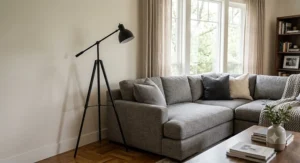
Start with leg placement before you touch the height adjustment. Tripod lamps are stable specifically because their three legs spread the load, so splay them to their full recommended width rather than keeping them narrow to save floor space — a narrow stance is the single most common cause of tip-overs, especially on carpet where the feet can sink unevenly. Once the base is set, adjust height for the task first and angle second: for reading, the light source should sit slightly behind and above your shoulder rather than directly overhead, which cuts glare on the page or screen. For task lighting over a workbench, aim for roughly 18-24 inches above the work surface as a starting point, then fine-tune from there.
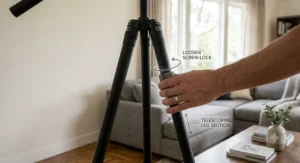
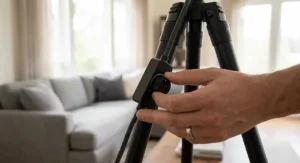
Maintenance on these fixtures is minimal but not zero. Check the tightening collars or locking knobs on telescoping poles every few months — repeated extension and collapse gradually loosens them, and a wobbly telescoping joint is usually a five-minute fix, not a warranty claim. Dust the shade and clean any exposed LED lenses with a dry microfiber cloth; buildup on a work light’s lens can measurably dim its output over time. The most common first-30-days mistake buyers make is overtightening plastic locking collars on budget telescoping models, which strips the threads — hand-tight plus a quarter turn is almost always enough.
Real-World Scenarios: Matching the Lamp to the Situation
Specs only tell you so much — here’s how these products actually map onto real living situations.
Take a graduate student living in a 400-square-foot studio apartment who needs a reading lamp beside a daybed and a better-lit video call setup for online seminars. The Edishine Tripod Table Lamp handles the nightstand accent role cheaply, while the Floor Photography Tripod LED Light solves the video-call lighting problem for under $50 combined — both fit the tight budget and tight footprint that studio living demands.
Now picture a small-business owner who does weekly live product demos on Instagram from a home office that doubles as a garage workbench during the day. That’s a case for owning two purpose-built lights rather than one compromise fixture: the SANSI LED Work Light for actual workbench repairs, and the Floor Photography Tripod LED Light swapped in for streaming sessions — different jobs, different tools, and neither one is a great substitute for the other despite both technically being adjustable tripod lamps.
Finally, consider a homeowner renovating a garage into a weekend workshop who also wants landscape and driveway lighting for evening projects. The LUTEC 6290Pro Dual-Head LED Work Light is the obvious fit here — its weatherproof housing and dual-head coverage are built exactly for that dual indoor/outdoor jobsite use case, and stepping down to a lighter-duty option would mean re-buying within a year of heavier use.
How to Choose a Height Adjustable Tripod Lamp
Cutting through the marketing copy, here’s the actual decision framework, in order of what matters most.
- Define the primary job first. Decide whether the lamp is decor, task lighting, or content-creation gear before comparing specs — a beautiful decor lamp makes a poor workshop light, and vice versa.
- Check the real height range, not just the “adjustable” claim. A height adjustable tripod with a 5-inch range isn’t solving the same problem as one that telescopes from 20 to 60 inches — read the actual numbers.
- Match lumen output to the room’s purpose. Ambient/decor lighting is typically fine in the 400-800 lumen range; task and workshop use benefits from 2,000+ lumens.
- Weigh build material against use frequency. Wood and lightweight metal tripods suit occasional indoor use; carbon steel or aluminum telescoping tripods hold up better under daily repositioning.
- Confirm the bulb or LED module is replaceable. A fixture with a standard E26/E27 socket outlives one with a sealed, non-replaceable LED module.
- Look for a genuine dimmer if the lamp will double as ambient lighting. Stepped dimmers are common; continuous dimmers give finer control for reading versus relaxing.
- Factor in portability if the lamp will move rooms often. Foldable telescoping tripods pack down far smaller than fixed wood-leg designs.
Adjustable Tripod Lamp vs Fixed Floor Lamp: The Case for Adaptable Floor Lighting
The core argument for adaptable floor lighting over a traditional fixed floor lamp comes down to one word: repositioning. A fixed floor lamp is chosen once, placed once, and largely stays put for the life of the fixture — moving it means unplugging, relocating, and hoping the new spot works as well as the old one. A tripod design with height and angle adjustment lets you change the light’s job without changing its address: raise it for reading, lower and angle it for a coffee-table game night, or swivel the head toward a wall for indirect ambient glow.
That flexibility isn’t free, though. Fixed floor lamps generally offer more consistent, symmetrical light distribution because their shade geometry is engineered around one fixed position, while tripod heads — especially spotlight-style designs like the Decoluce Vintage Tripod Floor Lamp or Kira Home Sulis Tripod Spotlight Floor Lamp — throw more directional light that can leave the rest of a room comparatively dim. The practical takeaway: if your room genuinely needs multi-purpose lighting (reading corner today, workspace tomorrow), the adjustability pays for itself. If you just need one, unchanging pool of even light in one spot, a well-chosen fixed floor lamp may actually serve you better and cost less.
Common Mistakes When Buying a Height Adjustable Tripod
Most buyer’s remorse in this category comes down to a handful of repeatable mistakes, not bad products.
The biggest one is buying based on photos alone and skipping the height-range numbers entirely — a lamp that looks tall in a staged photo can end up shorter than expected next to your actual couch or desk. Second is underestimating brightness needs for task use; a lamp rated for ambient decor lighting (400-800 lumens) will frustrate anyone trying to use it for detailed reading or workshop tasks, where 1,500+ lumens is closer to the mark. Third, buyers frequently ignore the tripod footprint diameter, then discover the splayed legs don’t actually fit the corner they had planned — measure the fully extended leg spread, not just the lamp’s height, before ordering. Finally, skipping the bulb-socket type is a quiet but recurring problem: a fixture locked to a proprietary or sealed LED module can’t be upgraded or repaired down the line the way a standard E26/E27 socket can.
✨ Don’t Miss These Exclusive Deals!
🔍 Take your lighting setup to the next level with these carefully selected adjustable tripod lamps. Click on any highlighted item to check current pricing and availability before it changes. The right pick here means better light for years, not months.
Telescoping Tripod Lamp Picks for Content Creators and Remote Workers
If you landed here specifically searching for a telescoping tripod lamp, your use case is almost certainly one of three things: video calls, short-form content, or live selling — and the buying criteria shift accordingly.
For video calls, prioritize a wide, even light source over raw brightness; a harsh, narrow beam from a small LED panel can actually look worse on camera than a dimmer, broader source. The Floor Photography Tripod LED Light covers this reasonably well thanks to its rotating panel head, though pairing it with a cheap diffusion clip or a sheet of translucent fabric over the lens will noticeably soften harsh shadows for a few dollars more. For live selling or product demos where you need the light to travel with you from a desk to a kitchen counter, the folding telescoping design matters more than raw lumens — collapsibility beats brightness when the setup changes daily.
One detail the Illuminating Engineering Society emphasizes in its guidance on task lighting is color temperature consistency — mismatched color temperatures between your room lighting and your tripod light show up clearly on camera as color-shifted skin tones. Sticking to a single 5000-5600K “daylight” bulb across your whole setup avoids that problem entirely, and it’s a five-dollar fix that outperforms most software color correction.
Long-Term Cost & Maintenance of a Variable Tripod Fixture
The sticker price on an adjustable tripod lamp is only part of the real cost of ownership, and the gap between options is bigger than it looks at checkout.
LED-based fixtures — which cover every product on this list — sip power compared to older incandescent or halogen work lights; a 300-watt-equivalent LED head like the one on the SANSI LED Work Light typically draws well under 40 actual watts, meaning years of regular use add up to a genuinely small line item on an electric bill. The bigger long-term cost variable is mechanical wear on the telescoping and locking hardware: cheaper plastic locking collars on lower-cost telescoping tripods are the first thing to fail, usually within a year or two of frequent extension and collapse, while carbon-steel or aluminum tripods like those on the LUTEC 6290Pro and SANSI LED Work Light hold up considerably longer under the same use pattern.
Bulb or LED-module replacement cost is the other factor worth budgeting for. Fixtures with a standard E26/E27 socket, like the Brightech Eden Tripod Floor Lamp and Decoluce Vintage Tripod Floor Lamp, let you replace a failed bulb for a few dollars; fixtures with sealed, non-replaceable LED modules eventually require replacing the entire head or fixture once the diodes degrade, which is a real total-cost-of-ownership difference worth factoring into the initial price comparison.
Safety, Certifications & Wiring: What to Check on Any Flexible Tripod Floor Light
Because these fixtures combine electrical components with a mechanically adjustable, sometimes top-heavy frame, safety compliance is worth a specific look before checkout, not an afterthought.
Confirm UL listing (or an equivalent recognized safety certification) on any flexible tripod floor light before buying — this covers wiring insulation, thermal safety, and build quality standards that unlisted off-brand fixtures may skip entirely. According to the Consumer Product Safety Commission, lamps and lighting products are among the electrical products most frequently associated with home fire risks when wiring or certification standards are bypassed, which makes this one checkbox worth actually verifying rather than assuming. For outdoor or garage use, like the LUTEC 6290Pro, confirm the IP (ingress protection) rating explicitly — a work light rated IP65 is built for rain and dust exposure, while an indoor-only fixture used outdoors voids both the warranty and the safety assumptions baked into its design.
Stability matters just as much as wiring. Fully extend the tripod legs before use, avoid running the fixture at maximum height on soft or uneven flooring, and route power cords away from walkways where a loose swivel head could get caught and yanked over. None of this is complicated, but skipping it is exactly how an otherwise well-built lamp ends up as a returned or damaged item within its first month.
What to Expect: Real-World Performance
Spec sheets rarely tell you what a lamp actually feels like to live with day to day, so here’s the translation.
Decor-focused tripod lamps like the Brightech Eden Tripod Floor Lamp genuinely do disappear into a room’s aesthetic the way their marketing promises — the wood-leg, drum-shade combination reads as intentional furniture rather than “a lamp,” which is exactly the point. Spotlight-style designs like the Decoluce Vintage Tripod Floor Lamp and Kira Home Sulis Tripod Spotlight Floor Lamp deliver more visual drama but noticeably less usable, even room light — expect to supplement them with another light source if they’re your only fixture in a room. On the functional side, work lights like the SANSI LED Work Light and LUTEC 6290Pro genuinely do output as much light as advertised, to the point that positioning and angling become the actual skill involved in using them well, rather than wishing for more brightness.
Frequently Asked Questions
❓ What is the difference between a tripod lamp and a regular floor lamp?
❓ Are adjustable tripod lamps safe to use with children or pets around?
❓ Can a telescoping tripod lamp be used outdoors?
❓ How tall should an adjustable tripod lamp be for reading?
❓ Do adjustable tripod lamps use a lot of electricity?
Conclusion
The right adjustable tripod lamp really comes down to matching the fixture to the job, not chasing the single “best” option on paper. For everyday living-room reading, the Brightech Eden Tripod Floor Lamp is the safest, most versatile pick. For anyone leaning into a design statement, the Decoluce Vintage Tripod Floor Lamp and Kira Home Sulis Tripod Spotlight Floor Lamp deliver personality that plain drum-shade lamps can’t match. If your search was really about video calls or content creation, the Floor Photography Tripod LED Light solves that specific problem without overspending. And for genuine task and workshop use, the SANSI LED Work Light and LUTEC 6290Pro Dual-Head LED Work Light are built for output and durability over aesthetics.
Whichever direction you go, the buying framework stays the same: define the job first, check the real height and lumen numbers rather than trusting the product photo, and confirm the safety certification before checkout. Do that, and any of the seven picks above will genuinely earn its spot in your space rather than becoming another lamp shoved in a closet after a month.
✨ Ready to brighten up your space?
Revisit the comparison table above, pick the lamp that matches your actual use case, and check its current price before you decide. 💡
Recommended for You
- 7 Best Mid Century Tripod Lamp Picks You’ll Actually Love (2026)
- 7 Best wood tripod floor lamp Picks That Actually Warm Up a Room (2026)
- Best Tripod Floor Lamps 2026: 7 Top Picks That Won’t Wobble
Disclaimer: This article contains affiliate links. As an Amazon Associate, I earn from qualifying purchases. If you purchase products through these links, we may earn a small commission at no additional cost to you.
✨ Found this helpful? Share it with your friends! 💬🤗
