
In This Article
What is best crystal chandeliers? Crystal chandeliers are ornamental lighting fixtures featuring multiple lights suspended from the ceiling with cascading crystal prisms that refract light into dazzling displays, serving as both functional illumination and statement decor pieces. These timeless fixtures have evolved from their 16th-century origins using natural rock crystals to today’s sophisticated designs incorporating K9 crystal, Swarovski elements, and innovative LED technology.
In 2026, crystal chandeliers aren’t just relics of European palaces—they’ve become the centerpiece of modern luxury interiors, transforming everything from minimalist living rooms to grand two-story foyers. Walking into a room illuminated by a well-chosen crystal chandelier feels like stepping into a different world. The way light dances through hundreds of precision-cut facets, throwing rainbow patterns across walls and ceilings, creates an atmosphere no other lighting fixture can match. I’ve watched homeowners struggle between choosing safe, boring ceiling lights and taking the leap into statement lighting—and every single person who chose the chandelier never looked back.
The market has exploded with options ranging from the $150-$300 budget tier featuring quality K9 crystal to the $2,000+ premium segment showcasing authentic Swarovski crystals. What most buyers overlook is that the “best” chandelier isn’t always the most expensive one—it’s the fixture that matches your ceiling height, room dimensions, and design vision while delivering that prismatic light effect that makes crystal lighting so captivating. Whether you’re renovating a dining room, upgrading a master bedroom, or making a grand entrance statement, this guide reveals seven crystal chandeliers that actually deliver on their promises.
Quick Comparison Table: Top 7 Crystal Chandeliers at a Glance
| Chandelier Model | Dimensions | Crystal Type | Lights | Price Range | Best For |
|---|---|---|---|---|---|
| Witkey Modern Tree Branch (72″) | 72.1″ L × 23.6″ H | K9 Crystal | 20 lights | $400-$550 | Large dining rooms, kitchen islands |
| Lt-vt 7-Tier Round Chandelier | 39″ D × 24″ H | K9 Crystal | 28 lights | $300-$450 | Grand foyers, living rooms |
| IDEQUY 5-Ring Gold Chandelier | 8″-40″ rings | Hexagonal Crystal | LED integrated | $800-$1,200 | High ceilings, staircases |
| Saint Mossi 6-Light Chrome | 24″ D × 23″ H | K9 Crystal | 6 lights (E12) | $180-$280 | Bedrooms, smaller dining areas |
| Maxax 6-Light Raindrop | Adjustable height | K9 Crystal | 6 lights (G9) | $150-$250 | Budget-conscious buyers |
| Schonbek Swarovski Collection | Varies by model | Swarovski Crystal | Varies | $2,000-$5,000+ | Luxury installations, heirloom pieces |
| Saint Mossi 3-Light Rectangular | 33″ H × 25″ L × 10″ W | K9 Crystal | 3 lights (GU10) | $200-$320 | Modern spaces, kitchen islands |
Analysis: Looking at this comparison, the sweet spot for most homeowners sits in the $250-$500 range where you get substantial K9 crystal coverage without entering luxury pricing territory. The Witkey Tree Branch delivers the most dramatic visual impact per dollar spent, while the IDEQUY ring design solves the perennial problem of lighting two-story spaces where traditional chandeliers get lost in vertical space. Budget buyers shouldn’t dismiss the Maxax—its $150-$250 price point sacrifices quantity of crystals but maintains the essential light refraction quality that makes crystal chandeliers special. For those who can stretch to premium pricing, Schonbek’s Swarovski pieces represent genuine investment lighting that appreciates in value rather than depreciates like cheaper alternatives.
💬 Just one click — help others make better buying decisions too!😊
✨ Don’t Miss These Exclusive Deals!
Top 7 Crystal Chandeliers: Expert Analysis & Real-World Performance
1. Witkey Modern Tree Branch Crystal Chandelier (72″ Gold, 20-Light)
The tree branch design trend has exploded in 2026, and this 72-inch linear chandelier represents why—it transforms the ceiling into living sculpture while delivering functional illumination across long spaces. Built with premium K9 crystals hand-finished on gold decorative branches, this fixture weighs a substantial 42.3 pounds, which tells you immediately this isn’t hollow costume jewelry for your ceiling.
The 72.1″ length makes it purpose-built for rectangular dining tables seating 8-10 people or kitchen islands longer than 6 feet. What the spec sheet won’t tell you is that the 23.6″ height means you need at least 8-foot ceilings to maintain the recommended 30-36 inch clearance above your table surface—hang it lower and you’ll be dodging branches during dinner conversation. The adjustable 78.75″ cable lets you customize drop height, which matters enormously in homes with 10-12 foot ceilings where standard-length chandeliers disappear into vertical space.
From an expert perspective, this chandelier excels at solving the “dark center” problem plaguing many dining rooms where a single-point light source leaves table edges in shadow. The distributed 20-light configuration spreads illumination evenly, and when paired with dimmable bulbs (not included), you can dial the mood from bright task lighting for family dinners to soft ambiance for entertaining. Customer feedback consistently mentions the “starlight effect”—that mesmerizing play of refracted light across walls and ceilings that only crystal can produce. The five-year warranty coverage is exceptional in this price category and signals manufacturer confidence in build quality.
Pros:
✅ Even light distribution across 6+ foot spaces eliminates dark zones
✅ Adjustable cable accommodates ceiling heights from 8 to 12 feet
✅ Substantial 42-pound weight indicates quality construction (not hollow frames)
Cons:
❌ 72″ length overwhelms rooms smaller than 12′ × 14′
❌ Assembly requires 2-3 hours due to individual crystal attachment
Best For: Homeowners with large rectangular dining areas or extended kitchen islands who need statement lighting that performs as well as it looks
Price Range & Value Verdict: At around $450-$550, this delivers premium visual impact without crossing into luxury pricing territory—expect similar aesthetics from fixtures costing $800+ with lesser brand names.
2. Lt-vt 7-Tier Crystal Chandelier (39″ Round, 28-Light, Gold)
If you want heads turning upward the moment guests enter your home, this seven-tier cascade of 490 high-grade K9 crystals delivers exactly that “whoa” factor. The 39-inch diameter and 24-inch height create substantial vertical presence, making this ideal for two-story foyers, living rooms with vaulted ceilings, or dining spaces where the chandelier needs to anchor the entire room’s aesthetic.
The seven-tier construction isn’t just about looks—each layer creates a distinct zone of light refraction, so you get depth and dimension rather than a flat blob of brightness. This matters enormously in larger rooms where single-tier chandeliers can feel like they’re floating disconnected from the space. The 79-inch adjustable chain gives you room to work with ceiling heights ranging from standard 8-footers (where it becomes a semi-flush statement) to grand 14-16 foot cathedral ceilings where it can truly breathe and show off its cascading crystal design.
What buyers need to understand before clicking “add to cart”: this chandelier requires a 30-80 square meter room (roughly 320-860 square feet) to look proportionate. Hang it in a 12′ × 12′ dining room and it’ll visually consume the space like a disco ball at a dinner party. The 28-light configuration means substantial electricity draw if you’re using traditional incandescent bulbs—switching to LED equivalents cuts energy consumption by 80% while maintaining that warm crystal glow. Customer reviews reveal the assembly time runs 3-4 hours for two people, primarily spent attaching individual crystals to the frame. This is where patience pays dividends—sloppy assembly shows in uneven crystal distribution that ruins the symmetrical cascade effect.
Pros:
✅ 490 crystals create unmatched light refraction in this price category
✅ Seven-tier design delivers vertical drama suitable for high ceilings
✅ Compatible with LED, incandescent, halogen—flexibility for energy preferences
Cons:
❌ Requires large rooms (320+ sq ft) to avoid overwhelming the space
❌ 28 bulbs increase ongoing electricity and replacement bulb costs
Best For: Grand foyers, living rooms with vaulting ceilings, or dining spaces where the chandelier serves as the room’s architectural focal point
Price Range & Value Verdict: In the $300-$450 range, this represents exceptional crystal-per-dollar value—comparable Swarovski-trimmed fixtures run $1,200+ for similar visual presence.
3. IDEQUY Modern Large Gold 5-Ring Chandelier (Hexagonal Crystal, LED Integrated)
Here’s where crystal chandelier design gets genuinely innovative. The five-ring concentric design with hexagonal crystals solves a problem traditional chandeliers can’t touch—properly illuminating vertical spaces like staircases and two-story foyers without looking like a tiny decoration floating in vast emptiness. The rings graduate from 8″ to 40″ diameter, creating a sculptural presence that fills height rather than just width.
The integrated LED technology represents the future of crystal lighting—no more hunting for replacement bulbs or dealing with E12 bases that limit your options. The dimmable LED panels hidden within each ring provide 3,000K-6,000K adjustable color temperature (warm to cool white), letting you shift from cozy dinner ambiance to crisp task lighting with a remote control. This matters more than most buyers realize—K9 crystals refract warm light into golden tones and cool light into icy blue shimmer, so adjustable temperature effectively gives you two different chandeliers in one.
From an installation perspective, the height-adjustable design accommodates ceilings from 10 to 20 feet, though it really shines in 12-16 foot applications where traditional chandeliers leave awkward vertical gaps. The hexagonal crystal cut represents a departure from traditional teardrop shapes—it creates sharper, more geometric light patterns that complement modern and transitional interiors better than Victorian-style prisms. Customer feedback points to the “floating rings” optical illusion when properly installed—the thin suspension cables become nearly invisible against light-colored ceilings, making the illuminated rings appear to hover.
Pros:
✅ Ring design fills vertical space where traditional styles fail
✅ Integrated LED eliminates bulb replacement headaches for 10+ years
✅ Dimmable with adjustable color temperature (3,000K-6,000K range)
Cons:
❌ Higher upfront cost ($800-$1,200) compared to bulb-socket chandeliers
❌ LED failure requires professional repair rather than simple bulb swap
Best For: Two-story foyers, staircases, or high-ceiling living rooms where vertical presence matters as much as horizontal spread
Price Range & Value Verdict: Around $800-$1,200 feels steep until you calculate eliminating 10 years of bulb replacements and electricity savings—total cost of ownership often beats cheaper alternatives.
4. Saint Mossi 6-Light Modern K9 Crystal Chandelier (Chrome Finish)
This is the chandelier I recommend to first-time crystal buyers who aren’t ready to commit four figures but still want authentic prismatic lighting. The 24-inch diameter and 23-inch height hit the sweet spot for 10′ × 12′ dining rooms, master bedrooms, or smaller living spaces where larger fixtures would overpower the architecture. Saint Mossi has built a reputation on delivering solid K9 crystal quality at accessible price points, and this 6-light model exemplifies that approach.
The chrome finish frame provides contemporary versatility—it works equally well in modern minimalist spaces, transitional farmhouse designs, or even traditional rooms needing a fresh update. What separates quality K9 crystal from bargain-bin acrylic is the audible ring when you tap it (genuine crystal rings like a wine glass, plastic thuds) and the sharpness of light refraction. The cascading raindrop crystal arrangement on this model creates multi-directional light dispersion, meaning you get ambient glow bouncing off walls and ceilings rather than harsh downward spotlight effect.
The E12 candelabra base bulbs give you flexibility—pair with warm 2700K Edison-style LEDs for vintage ambiance or go with daylight 5000K for task lighting clarity. The fully dimmable compatibility (requires compatible bulbs and dimmer switch, sold separately) transforms this from single-purpose dining chandelier to multi-mood lighting that adapts to your needs. Customer reviews consistently praise the ease of installation, with most DIY-comfortable homeowners completing setup in 60-90 minutes. The adjustable 59-inch chain accommodates ceilings from 8 to 11 feet, though anything higher starts pushing the chandelier’s visual presence to its limits.
Pros:
✅ Goldilocks sizing—not too large, not too small for average rooms
✅ Chrome finish adapts to modern, transitional, or traditional decor
✅ Straightforward installation accessible to DIY homeowners
Cons:
❌ 6-light capacity limits maximum brightness compared to 12+ light models
❌ 24″ diameter gets lost in rooms larger than 14′ × 16′
Best For: First-time crystal chandelier buyers, bedrooms, smaller dining areas, or anyone wanting authentic crystal lighting without premium pricing
Price Range & Value Verdict: The $180-$280 sweet spot makes this the best entry point into quality crystal lighting—comparable visual impact to fixtures costing $400+.
5. Maxax Modern Crystal Chandelier (K9 Raindrop, 6 Lights)
Budget-conscious buyers often ask me: “Can I get real crystal chandelier sparkle for under $250?” The Maxax 6-light proves the answer is yes—with strategic compromises that don’t sacrifice the essential magic of refracted light. This chandelier strips away decorative elements to focus resources on what matters: quality K9 crystals arranged to maximize light capture and dispersion.
The adjustable hanging pendant design accommodates sloped, vaulted, or flat ceilings—a flexibility premium chandeliers often lack. The G9 base bulbs (maximum 40W each, not included) provide more compact light sources than traditional candelabra bases, which lets the crystal elements sit closer to the bulbs for enhanced brilliance. What you sacrifice compared to pricier options is crystal quantity and frame embellishment—this delivers about 60-70% the crystal coverage of similarly-sized Saint Mossi models, which translates to less overall sparkle but maintains the essential prismatic effect that makes crystal special.
From a practical standpoint, this chandelier excels in spaces where you want crystal lighting without it dominating the room’s visual hierarchy. Bedrooms, bathrooms with higher ceilings, hallways, or smaller dining nooks benefit from this scaled-back approach. The chrome finish keeps maintenance simple—monthly dusting with a microfiber cloth maintains clarity, while more ornate finishes require careful cleaning to preserve details. Customer feedback points to solid construction quality that exceeds expectations for the price point, though the assembly instructions receive mixed reviews—have a second person available for the installation process.
Pros:
✅ Sub-$250 pricing makes crystal lighting accessible to tight budgets
✅ G9 compact bulbs allow closer crystal-to-light positioning
✅ Versatile mounting accommodates sloped and vaulted ceilings
Cons:
❌ Fewer crystals mean less overall sparkle than premium alternatives
❌ Assembly instructions could be clearer (have help available)
Best For: Budget-conscious buyers, secondary spaces like bedrooms or bathrooms, or renters wanting removable lighting upgrades
Price Range & Value Verdict: Around $150-$250 delivers 70-80% of the visual impact of fixtures costing double—smart money for strategic crystal lighting placement.
6. Schonbek Swarovski Lighting Collection (Premium Heritage Chandeliers)
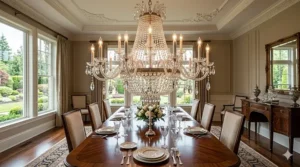
When discussing luxury crystal chandeliers, Schonbek represents the gold standard—literally, as many models feature genuine 24K gold-plated frames. Since 1870, this company has crafted chandeliers for palaces, luxury hotels, and discerning homeowners willing to invest in lighting that appreciates rather than depreciates. The Swarovski crystal elements used throughout their collection undergo machine cutting to achieve optical clarity and razor-sharp faceting that lesser crystals simply cannot match.
What justifies the $2,000-$5,000+ price points? Start with the invisible optical coating applied to each Swarovski crystal that resists dust accumulation and simplifies cleaning—this alone saves hours of maintenance over the chandelier’s lifetime. The laser-etched Swarovski logo inside each crystal element provides authentication against imitations and adds subtle prestige visible on close inspection. More importantly, the light refraction quality surpasses K9 crystal by a noticeable margin—where budget crystals might throw rainbow patterns 2-3 feet across a wall, Swarovski elements project sharp prismatic displays 6-8 feet with greater color intensity.
The Renaissance Rock Crystal collection exemplifies why serious collectors and design professionals specify Schonbek. Using genuine rock crystal elements (actual minerals mined from the earth and hand-polished by gem cutters) in Etruscan gold or silver finishes, these chandeliers function as illuminated sculpture rather than mere lighting fixtures. The weight—often 40-80 pounds for mid-size models—requires professional installation with reinforced ceiling mounting, which adds $200-$400 to initial costs but ensures safety for fixtures worth more than many cars.
From an investment perspective, vintage Schonbek chandeliers in good condition often sell for 70-90% of their original retail price after decades of use. Compare that to budget chandeliers that become worthless the moment you hang them, and the premium pricing begins making financial sense beyond pure aesthetics. The warranty coverage typically extends 5-10 years and includes replacement crystals for breakage—a critical consideration when individual Swarovski elements can cost $15-$50 each.
Pros:
✅ Swarovski crystals deliver unmatched optical clarity and refraction
✅ Heirloom quality construction appreciates rather than depreciates
✅ Invisible coating simplifies maintenance compared to uncoated crystals
Cons:
❌ $2,000+ entry pricing excludes budget-conscious buyers
❌ Professional installation required adds $200-$400 to total cost
Best For: Luxury home installations, heirloom lighting investments, or spaces where the chandelier serves as the room’s defining design element
Price Range & Value Verdict: Premium pricing ($2,000-$5,000+) positions these as investment pieces rather than consumable decor—expect appreciation over depreciation.
7. Saint Mossi 3-Light Rectangular Modern Chandelier (Crystal Raindrop)
The rectangular chandelier category remains underserved despite perfectly matching the geometry of kitchen islands and modern dining tables. This 33″ height × 25″ length × 10″ width fixture fills that niche with clean linear design and cascading K9 crystals that create vertical drama without overwhelming narrow spaces. The compact 10-inch width means it works over 30-36 inch wide islands where round chandeliers create awkward overhang.
The three-light GU10 configuration (maximum 40W per bulb) provides functional task lighting for food prep or dining while the crystal elements add decorative flair during evening entertaining. What kitchen island owners often discover too late is that traditional pendant lights create harsh shadows and glare on polished countertops—the diffused light from crystal elements solves this by scattering illumination in multiple directions for more even coverage. The 33-inch height gives you room to adjust suspension for ideal clearance: 30-36 inches above counter surfaces for islands, 28-32 inches above dining tables.
The chrome finish maintains the modern aesthetic while simplifying cleaning—kitchen environments inevitably deposit cooking oils and airborne particles on surfaces, and ornate finishes trap grime in decorative crevices. Smooth chrome wipes clean in seconds with damp microfiber cloths. Customer feedback reveals this chandelier punches above its weight class for visual impact, with the cascading crystals creating impressive light shows when caught by afternoon sun through kitchen windows. The flush mount ceiling attachment keeps the upper portion clean and minimal, letting the crystal elements provide all the decorative interest.
Pros:
✅ Rectangular profile perfectly matches kitchen island geometry
✅ Compact 10″ width fits over narrow surfaces without overhang
✅ Chrome finish simplifies maintenance in kitchen environments
Cons:
❌ Only 3 lights limit maximum brightness for large islands
❌ Modern linear design doesn’t suit traditional Victorian-style interiors
Best For: Kitchen islands, modern dining tables, or contemporary spaces needing linear lighting with crystal elegance
Price Range & Value Verdict: In the $200-$320 range, this solves the kitchen island crystal chandelier problem better than alternatives costing $400+.
How to Choose the Perfect Crystal Chandelier for Your Space
Selecting crystal chandeliers isn’t about finding the most expensive option or the one with the most lights—it’s about matching fixture characteristics to your specific room dimensions, ceiling height, and lighting needs. Start with the fundamental sizing rule: chandelier diameter in inches should roughly equal room length plus room width in feet. A 12′ × 14′ dining room suggests a 26-inch diameter fixture, though you can go 15-20% larger for dramatic effect or smaller for understated elegance.
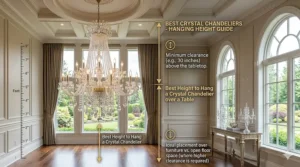
Ceiling height determines whether you need adjustable chains (8-10 foot ceilings) or long-drop designs (12+ foot ceilings). The critical clearance measurement runs from chandelier bottom to table or floor surface: maintain 30-36 inches above dining tables, 7 feet minimum above floor in foyers or living rooms. Violate these measurements and you’ll either bash heads on low-hanging fixtures or create awkward visual disconnection with chandeliers floating too high.
Crystal type dramatically affects both budget and aesthetic. K9 crystal represents the sweet spot—machine-cut for precise facets, chemically stable (won’t yellow or cloud), and priced accessibly. Swarovski crystals justify premium pricing with superior optical clarity and the invisible coating that repels dust accumulation. Avoid acrylic “crystals” regardless of price savings—they lack the refractive index to create genuine prismatic effects and yellow noticeably within 2-3 years.
Light bulb compatibility matters more than most buyers realize. E12 candelabra bases offer the widest bulb selection but limit you to smaller form factors. G9 and GU10 bases provide compact LED options ideal for modern fixtures. Always choose dimmable bulbs even if you don’t currently have dimmer switches—adding a dimmer later costs $20-$40 while replacing non-dimmable bulbs costs $50-$100 depending on quantity. Color temperature selection transforms the chandelier’s personality: 2700K warm white creates cozy dinner ambiance, 3000K neutral white balances task and mood lighting, 5000K+ daylight feels clinical except in modern minimalist spaces.
Finally, consider installation complexity and ceiling support requirements. Chandeliers under 30 pounds typically install to standard electrical boxes with included hardware. Fixtures exceeding 40 pounds require reinforced mounting brackets secured to ceiling joists—factor $150-$300 for professional electrician installation unless you’re confident working with electrical wiring and structural support.
Real-World Installation Guide: From Box to Brilliant
The gap between “some assembly required” and actually hanging a functioning crystal chandelier trips up even experienced DIYers. Here’s what the instruction manual won’t tell you: plan 3-4 hours for your first installation, recruit a second person (non-negotiable for fixtures over 20 pounds), and lay out all crystals by size before starting to avoid mid-installation treasure hunts.
Pre-Installation Checklist: Turn off power at the circuit breaker, not just the wall switch—testers can fail. Verify your electrical box can support the chandelier’s weight; standard boxes hold 50 pounds maximum, but boxes rated only for ceiling fans might fail with heavy crystal fixtures. Test this by checking for a “rated for fan support” stamp on the box or consulting installation documents from your home’s electrical work.
Critical Assembly Sequence: Mount the ceiling plate first, ensuring perfect level—even slight tilts become obvious once crystals hang. Thread electrical connections through the chain or rod before raising the fixture to final height; trying to fish wires afterward wastes an hour of frustration. Install all light bulbs before attaching crystals—you’ll never reach the sockets once crystals block access. Only then begin crystal attachment, working from top tier to bottom to avoid damaging already-installed elements.
Professional vs. DIY Decision Matrix: Handle your own installation if the chandelier weighs under 30 pounds, you’re comfortable with electrical wiring, and ceiling height stays below 10 feet. Call a licensed electrician for fixtures over 40 pounds, two-story foyer installations, or situations requiring new ceiling support brackets. The $150-$300 professional installation cost prevents $500-$2,000 chandelier damage from dropped fixtures or incorrect electrical connections.
Post-Installation Optimization: Adjust chain length for proper clearance before finalizing all connections—it’s exponentially harder to modify after crystals are attached. Clean all crystals immediately after installation using glass cleaner and microfiber cloths—factory shipping oils dull initial sparkle by 30-40%. Test dimmer compatibility with all bulbs installed; incompatible dimmer-bulb combinations create buzzing, flickering, or premature bulb failure.
Crystal Chandelier Maintenance: Keeping the Sparkle Alive
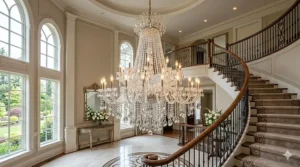
Crystal chandeliers accumulate dust faster than you’d expect—each crystal surface acts as a tiny magnet for airborne particles. Neglect quarterly cleaning and your $500 chandelier starts looking like a $50 garage sale find within six months. The good news: proper maintenance takes 15-20 minutes quarterly and requires only basic supplies.
The Two-Phase Cleaning Method: Phase one happens monthly: turn off power at the breaker, lay old sheets below the chandelier, and use a soft microfiber duster to gently wipe each crystal and frame element. This removes loose dust before it bonds to surfaces. Phase two runs quarterly: mix one part white vinegar with three parts distilled water (tap water leaves mineral deposits), spray onto microfiber cloths (never directly on crystals—overspray damages electrical components), and wipe each crystal individually. The vinegar solution cuts through airborne oils from cooking and skin contact that plain water can’t touch.
Common Mistakes That Damage Crystals: Never use commercial glass cleaners containing ammonia—they cloud crystal surfaces permanently over repeated applications. Avoid abrasive cloths or paper towels that scratch soft crystal surfaces; microfiber or cotton only. Don’t clean crystals while bulbs are warm—thermal shock can crack both crystals and bulbs. Never spray water or cleaning solutions near electrical sockets or wiring—moisture causes shorts and corrosion.
Deep Cleaning Every 12-18 Months: For fixtures with removable crystals, photograph the crystal arrangement before removal to ensure correct reinstallation. Remove crystals in batches of 20-30, place in plastic containers lined with soft towels, and wash in warm soapy water (dish soap works perfectly). Rinse in distilled water to prevent spotting, dry thoroughly with lint-free cloths, and reinstall following your reference photos. This process takes 2-3 hours but restores like-new sparkle that surface cleaning can’t achieve.
Crystal Chandeliers in Modern Design: Beyond Traditional Elegance
The “crystal chandeliers only work in traditional Victorian homes” myth dies hard, yet 2026 design trends prove otherwise. Minimalist interiors benefit enormously from crystal lighting’s ability to add visual interest without clutter—a single geometric crystal chandelier in an otherwise sparse room creates focal point drama that sculptures and art can’t match. The key lies in choosing contemporary silhouettes (linear designs, ring forms, abstract geometric arrangements) rather than ornate Victorian cascades.
Industrial lofts and modern farmhouses discovered crystal chandeliers solve the “too cold” problem plaguing many contemporary spaces. Exposed brick, concrete floors, and steel beams create visual harshness that textiles and wood alone can’t fully soften. Enter a well-chosen crystal chandelier: the light refraction warms the space literally (through distributed illumination) and perceptually (through the sparkle and movement of prismatic effects). Black metal frame chandeliers with clear crystal elements bridge industrial and elegant aesthetics perfectly.
Mixed metal designs represent another evolution—gold frames with chrome crystals, or vice versa, create layered visual interest that monochromatic fixtures lack. This matters in transitional spaces trying to bridge traditional architecture with contemporary furnishings. The chandelier becomes the translator, pulling warmth from traditional elements while maintaining the clean lines contemporary design demands.
Smart home integration transforms crystal chandeliers from static fixtures into dynamic lighting systems. Retrofit LED bulbs with built-in WiFi or Bluetooth connectivity, and suddenly your vintage-looking chandelier responds to voice commands, adjusts color temperature based on time of day, or syncs with music during parties. The juxtaposition of centuries-old crystal chandelier tradition with cutting-edge smart technology exemplifies how these fixtures remain relevant across design eras.
Understanding Crystal Quality: K9 vs. Swarovski vs. Alternatives
The crystal quality conversation often devolves into confusing technical specifications, so let’s translate to what actually matters to buyers. K9 crystal represents optical glass with specific chemical composition (potassium oxide and lead oxide) that achieves high refractive index—the measure of how effectively material bends light. When manufacturers claim “K9 crystal,” they’re promising clarity comparable to natural quartz with facets precise enough to create distinct prismatic effects.
Swarovski crystals take this further through proprietary cutting processes that achieve sharper facets and more consistent angles across thousands of pieces. The practical result: Swarovski crystals create crisper rainbow projections with more defined color separation. Think of it like camera lens quality—both budget and premium lenses capture images, but premium glass delivers sharper details and better color accuracy. For living room chandeliers where the fixture hangs 8-10 feet from viewers, K9 crystal performs excellently. For dining room installations where guests sit 3-4 feet from the chandelier, Swarovski’s superior clarity becomes noticeably apparent.
Lead crystal content confuses many buyers who worry about toxicity. Modern lead crystal chandeliers pose zero health risks—the lead oxide is chemically bonded within the glass matrix and doesn’t leach into air or food. However, European regulations have pushed manufacturers toward lead-free alternatives achieving similar optical properties through different chemical compositions. The spec sheet term “lead-free crystal” doesn’t mean lower quality—it indicates modern formulations meeting EU standards while maintaining the refractive index that makes crystal special.
Acrylic and glass “crystals” represent the budget tier, and while manufacturers try marketing them as equivalent, physics disagrees. Acrylic’s refractive index (1.49) falls significantly below K9 crystal (1.55) and Swarovski (1.58), resulting in duller, less distinct prismatic effects. More problematically, acrylic yellows under UV exposure—your clear crystals turn noticeably amber-tinted within 2-3 years in sunny rooms. Glass alternatives perform better than acrylic but still lack the optical precision of true crystal. Save the budget elsewhere; compromising on crystal quality undermines the entire reason for choosing crystal chandeliers.
Common Mistakes When Buying Crystal Chandeliers (And How to Avoid Them)
The biggest mistake I see repeatedly: buyers choosing chandeliers based on product photos rather than room dimensions. That gorgeous 48-inch chandelier looks perfect on Amazon, but in your 10′ × 12′ dining room it becomes a ceiling-dominating monstrosity. Always calculate the size-to-room ratio before falling in love with aesthetics: chandelier diameter = (room length + room width) ÷ 12. This formula prevents both undersized fixtures that disappear and oversized ones that overwhelm.
Second critical error: ignoring bulb type and quantity when calculating total cost of ownership. A $200 chandelier requiring 12 E12 bulbs at $8 each adds $96 to your initial investment. If you’re using incandescent bulbs (terrible idea, but people do it), those 12 bulbs at 60W each draw 720 watts total—running 4 hours daily costs $315 annually at average US electricity rates. Switch to LED equivalents and your 12 bulbs cost $48 total while drawing only 72 watts (annual electricity cost: $31). That “budget” chandelier suddenly costs more to operate than the initially-pricier LED-integrated model.
The “more crystals equals better chandelier” fallacy trips up buyers chasing quantity over quality. A chandelier with 1,000 small, poorly-cut acrylic crystals delivers less sparkle than one with 200 precision-cut K9 crystals because light refraction depends on facet precision, not crystal count. Marketing teams know buyers can’t evaluate facet quality from photos, so they emphasize crystal quantity. Resist this. Better to have fewer high-quality crystals positioned to capture and disperse light effectively than masses of mediocre crystals cluttering the design.
Installation ceiling clearance represents another frequent oversight. That adjustable 78-inch chain sounds fantastic until you realize your 8-foot ceilings minus the chandelier’s 24-inch height leaves 72 inches. Subtract the recommended 30-36 inch clearance above your dining table and you’re attempting to hang the chandelier at 36-42 inches—which sits directly at head-bumping height. Always work backwards from your ceiling height, subtract fixture height and required clearance, then determine if the remaining chain length accommodates your space. If not, either find a shorter fixture or accept flush-mount positioning.
Luxury Crystal Chandelier Living Room Design Ideas
Living rooms present unique crystal chandelier challenges compared to dining rooms because lighting needs fluctuate dramatically—bright task lighting for reading, ambient glow for TV watching, statement illumination for entertaining. The solution lies in dimmable crystal chandeliers paired with layered lighting (recessed cans, wall sconces, floor lamps) that can adapt to different activities.
High ceilings transform living room chandelier selection completely. Standard 8-10 foot ceilings demand compact designs to avoid overwhelming the space, but 12-16 foot vaulted ceilings require substantial vertical presence to avoid the “tiny decoration floating in vast space” effect. The IDEQUY ring design excels here because cascading rings fill vertical volume that traditional chandeliers can’t address. Alternative approach: cluster multiple smaller crystal fixtures at varying heights to create dynamic vertical composition rather than relying on single massive piece.
The “chandelier over coffee table” trend gains momentum in 2026, particularly for living rooms lacking traditional furniture arrangement centered around dining tables. Position an appropriately-sized crystal chandelier (24-32 inch diameter) centered over your coffee table or seating arrangement to create intimate lighting zone within larger open-concept space. This works especially well in loft-style homes where kitchen, dining, and living areas flow together—the chandelier delineates the living zone without physical barriers like walls or room dividers.
Color temperature strategy makes or breaks living room crystal chandelier success. Most living rooms benefit from 2700-3000K warm white that creates cozy, inviting atmosphere. Avoid 4000K+ cool white unless your design skews ultra-modern minimalist—cooler temperatures read institutional in residential living spaces. Smart LED bulbs offering adjustable color temperature provide ultimate flexibility: dial to 2700K for movie nights, bump to 3500K when reading or working, shift toward cooler temps during daytime when natural light supplements the chandelier.
High-End Crystal Lighting: Premium Features Worth the Investment
When chandelier prices jump from $300 to $3,000, what exactly are you paying for beyond brand prestige? Understanding premium feature value helps determine which upgrades deliver genuine benefits versus marketing hype.
Integrated LED vs. Socket-Based Designs: Integrated LED chandeliers eliminate bulb replacement for 10-15 years while consuming 80% less electricity than incandescent equivalents. The upfront premium ($300-$800 more than comparable socket-based fixtures) breaks even within 3-5 years through electricity savings and eliminated bulb costs. However, LED failure requires professional repair or full fixture replacement versus simple $8 bulb swap—calculate this risk based on your timeline. Planning to keep the chandelier 5+ years? Integrated LED wins. Might move or redesign within 3 years? Socket-based offers flexibility.
Hand-Cut vs. Machine-Cut Crystals: Heritage-style hand-cut crystals command premiums of 200-400% over machine-cut equivalents, justified by craftsmanship tradition rather than optical performance. Modern precision machinery cuts facets more consistently than human artisans, resulting in better light refraction uniformity across all crystals. Pay for hand-cutting if you value artisanal craftsmanship as part of the chandelier’s story; choose machine-cut if pure optical performance drives your decision.
Precious Metal Frames: 24K gold-plated and sterling silver frames resist tarnishing and maintain finish quality for decades without periodic refinishing. Bronze and brass alternatives develop patina (desirable to some, problematic to others) and require occasional polishing to maintain original appearance. Chrome and nickel-plated finishes offer modern aesthetics and nearly zero maintenance but lack warmth many traditional interiors demand. Match frame material to your maintenance tolerance and aesthetic preferences rather than assuming expensive equals better.
Optical Coatings: Swarovski’s invisible coating technology prevents dust accumulation and simplifies cleaning dramatically. Uncoated crystals require monthly attention to maintain sparkle; coated crystals maintain clarity with quarterly cleaning. The $500-$1,000 premium for Swarovski-equipped chandeliers breaks even through time savings only if you value your time at $50+ per hour. Budget-conscious buyers can achieve 90% of the visual impact with high-quality uncoated K9 crystal plus diligent cleaning schedules.
FAQ: Expert Answers to Your Crystal Chandelier Questions
❓ How do I determine the right chandelier size for my dining room?
❓ Can I install a crystal chandelier myself or do I need an electrician?
❓ What's the difference between K9 crystal and Swarovski crystal in chandeliers?
❓ How often should I clean my crystal chandelier to maintain sparkle?
❓ Are crystal chandeliers still in style for modern homes in 2026?
Conclusion: Choosing Your Perfect Crystal Chandelier
Crystal chandeliers transform ordinary rooms into extraordinary spaces through the simple physics of light refraction—hundreds of precisely-cut facets capturing illumination and scattering it into dancing rainbow patterns that flat ceiling lights can never achieve. The decision between a $200 budget fixture and $2,000 luxury piece isn’t just about price tags; it’s about matching crystal quality, fixture dimensions, and design aesthetic to your specific space and lifestyle needs.
Budget-conscious buyers can achieve stunning results with quality K9 crystal chandeliers in the $200-$500 range, particularly models from Saint Mossi and Maxax that prioritize crystal quality over unnecessary embellishments. Mid-range investments ($500-$1,200) unlock integrated LED technology and larger designs suitable for grand spaces, with the IDEQUY ring and Witkey tree branch representing standout value. Premium Schonbek Swarovski pieces justify $2,000+ pricing for homeowners viewing chandeliers as multi-decade investments that appreciate rather than depreciate.
The most critical takeaway: don’t buy based solely on product photos. Measure your room dimensions, calculate appropriate chandelier size, verify ceiling height accommodates required clearances, and understand total cost of ownership including bulbs and electricity. A properly-selected crystal chandelier becomes the crown jewel of your interior design—literally and figuratively—transforming everyday spaces into the kind of rooms that make you slow down and appreciate beauty in unexpected places.
Start with clear-eyed assessment of your space, budget, and aesthetic vision. Then choose the chandelier that delivers authentic crystal sparkle, proper scale for your room, and quality construction that’ll keep those rainbows dancing across your walls for years to come.
Recommended for You
- 7 Best Modern Geometric Chandelier Living Room Picks 2026
- 7 Best Modern Brass Chandelier Picks for 2026
- 7 Best Mid-Century Modern Chandeliers That Transform Your Space (2026)
Disclaimer: This article contains affiliate links. As an Amazon Associate, I earn from qualifying purchases. If you purchase products through these links, we may earn a small commission at no additional cost to you.
✨ Found this helpful? Share it with your friends! 💬🤗
